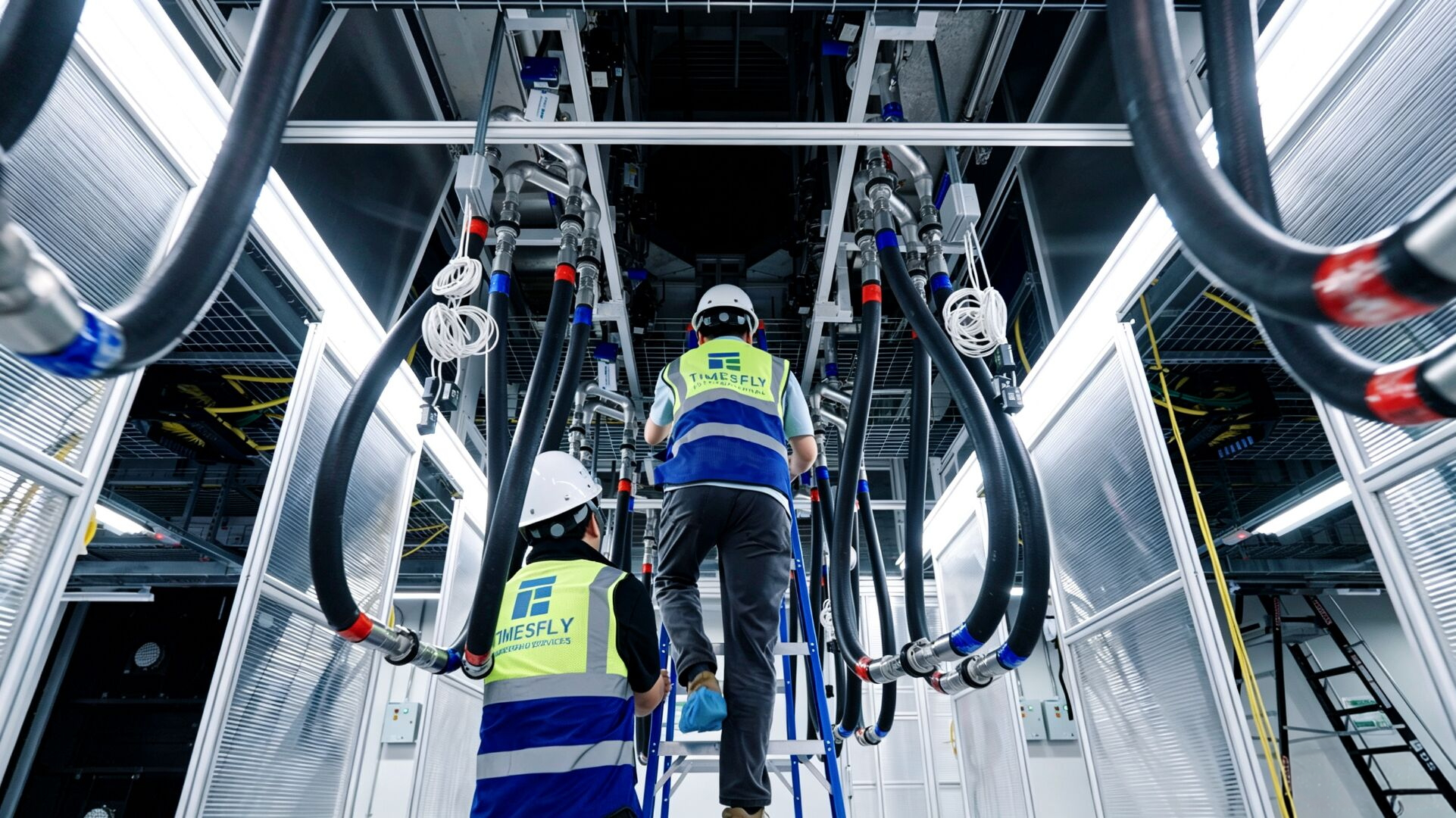
A data hall fit-out that once took years can now be done in six months. Timesfly argues the decisive work happens before construction starts.
Around the world, compute demand has risen sharply, pushed by digital transformation and skyrocketing AI demand. The result is a wave of data center construction of a magnitude never seen before. In spite of massive construction efforts in multiple markets, compute demand continues to outrun the industry’s ability to deliver commissioned digital infrastructure. Chips arrive in months; the buildings that house them have traditionally taken years.
Part of the reason revolves around the capital-intensive, laborious nature of building new data centers. Unlike a factory building, the bottleneck in data centers does not lie in civil construction work, but in long-lead electrical and cooling equipment, the coordination of dozens of contractors across disciplines, and designs outpaced by new GPU chips.
This gap carries a direct cost: every month a data hall sits unfinished is a month of expensive GPUs waiting in crates, and a month of compute revenue deferred. Speed of delivery, in other words, is no longer a construction metric but a business one.
The six-month fit-out
A new breed of firms now say they can deliver AI capacity fast enough to keep pace with demand. Among them is Timesfly, which delivers the mechanical and electrical fit-out of a data hall as quickly as six months. To be clear, this assumes the civil shell is completed and connected to the grid; the customer also cannot make major design changes once the work begins. Yet this is remarkable given that a construction timeline of between three and four years was considered a reasonable timeframe just a few years ago.
And this is not a one-off process when one looks at Timesfly’s track record with data centers. In recent years, the firm has already delivered 4GW of data center mechanical and electrical works, including 1.5GW of liquid-cooled halls. Indeed, Timesfly is currently working on large projects in Malaysia and Thailand, two disparate geographies, at the same time. Given the different regulatory environments, sustaining this pace comes down to a consistent way of working, with highly standardized processes for design, procurement and project management.
Malaysia and Thailand, for instance, have different electrical codes, fire standards, equipment import rules and handover requirements, which can trip up an engineer not already intimately familiar with them. Timesfly’s response to this challenge is to adapt designs to comply with local regulations while maximizing standardization across other business processes: deploy a generic baseline equipment list for all projects with localized adjustments for country-specific certifications, execute centralized procurement and customs clearance, and adopt reusable templates for construction, acceptance and handover modified to satisfy national requirements. This ensures the six-month fast-track delivery capability can be replicated on demand in different countries.
Compressing the build, not the quality
The work that makes a six-month build possible starts long before workers go onsite. Timesfly maintains a library of standardized drawings for both traditional and liquid-cooled AI halls, proven power distribution designs, as well as tried-and-tested modules. Everything including pipework, ductwork, busbars, cable trays and cabling, fire-protection facilities, electromechanical equipment and supports & hangers is fully modelled in BIM across all disciplines, so clash checks are completed well before construction and installation to resolve all spatial interferences and design conflicts in advance. Timesfly says its approach shortens detailed design by more than 30 percent and removes most of the rework that would otherwise surface mid-build.
Once the data center design is confirmed, work that typically takes place sequentially is initiated in parallel for speedy completion. Equipment production is scheduled, external power connections are coordinated, and regulatory filings are all lodged before the shell is completed. To help customers hedge against long waits for key data center systems, Timesfly also reserves annual production capacity with the manufacturers of transformers, UPS and liquid-cooling systems. It goes a step further and even maintains alternate suppliers in more than one region.
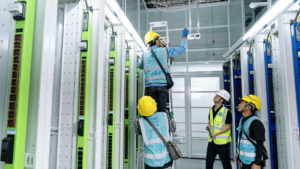
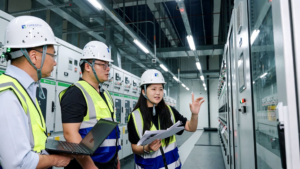
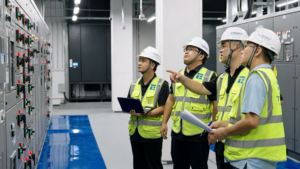
At the data hall, Timesfly’s team members coordinate various aspects of fit-out works spanning civil, electrical, HVAC, ELV, fire protection and commissioning. For consistency, standard construction templates and power-on procedures are used across projects. This matters most at first energization, as it is when construction defects surface all at once. While most issues are mundane, a data hall that fails its first power-on could result in weeks of delays. Timesfly reports a 100 percent first-time energization rate across its projects to date.
The twenty-year responsibility
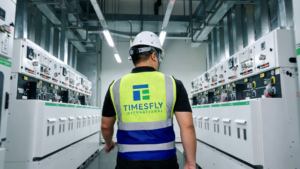
Behind the delivery system at Timesfly is Chairman Peng, who has spent 24 years in data center mechanical and electrical engineering. That experience has shaped a clear view of where data center projects go wrong. The industry, he argues, underestimates what happens after handover. A liquid-cooled hall has far more joints and connections than an air-cooled one, and a small leak that shows no symptoms at commissioning can surface months later as GPU throttling or corroded pipework.
The hard part, in his telling, is not the hardware but the engineering discipline that runs from design through to daily operation. Over the years, that view has settled into something close to a philosophy: “A data center must serve its owner for fifteen or twenty years. The work we do in six months determines those twenty years. This is a responsibility we take very seriously.”
This is also why Timesfly does not stop at construction. The company positions itself across the full lifecycle, from consulting and design through project management and construction to operations and maintenance. The O&M end is more than an add-on. Liquid-cooled facilities depend on routines many operations teams have never run, such as regular coolant quality testing, pipe purging and scheduled seal replacement, along with skills in fluid chemistry and leak monitoring that traditional data center staff rarely have.
For operators, the calculus is straightforward. AI chips will keep arriving on schedule. The advantage goes to those whose halls are ready when they do.
***
To find out how Timesfly can accelerate your next data center build, contact:
– Email: [email protected]
– Website: timesfly.com.cn/en