
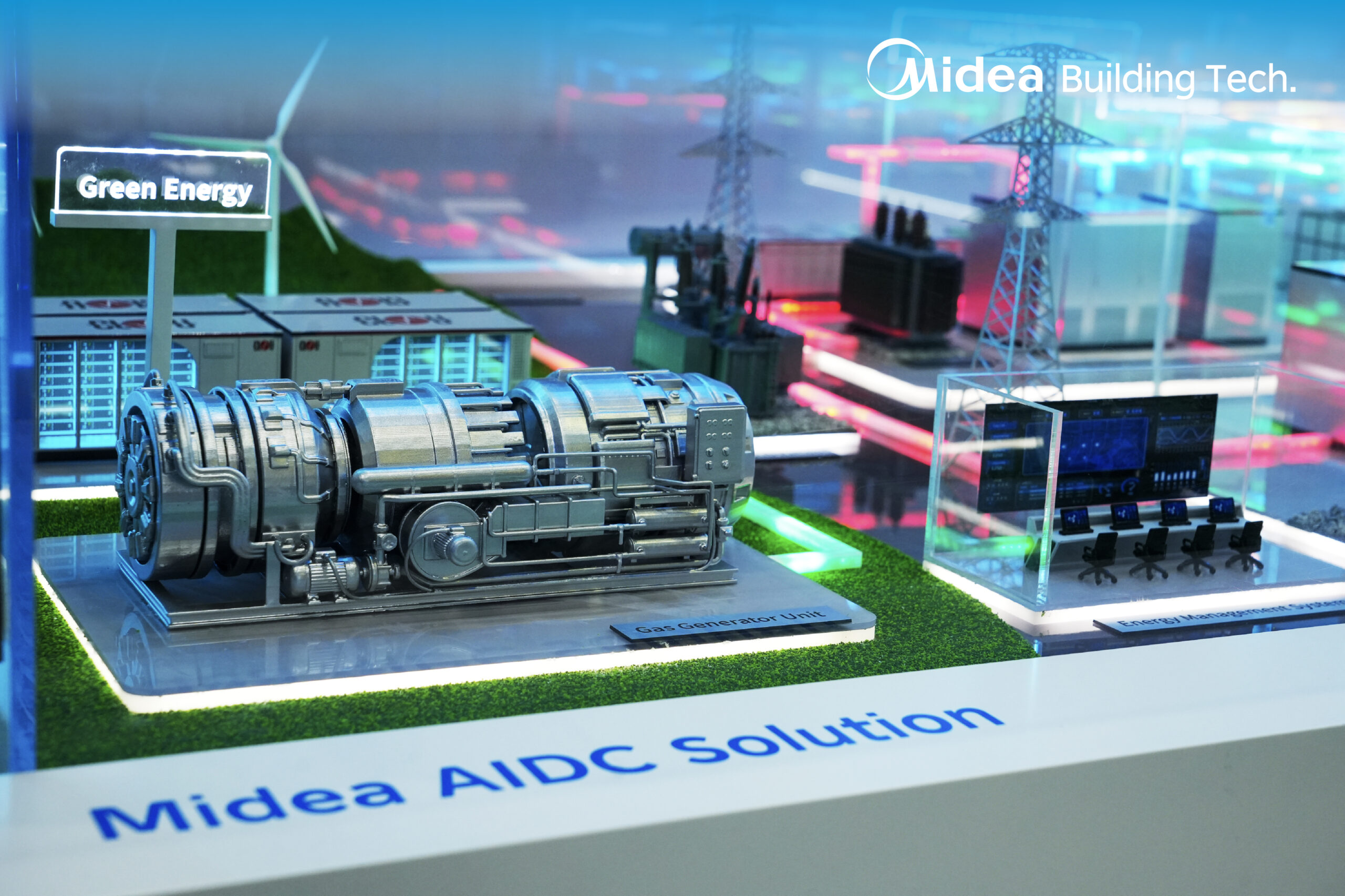
As AI infrastructure enters the 600 kW, ultra-high-density era, power and cooling can no longer operate as separate systems. Power-cooling, hyper-converged architecture, and full-stack capabilities from Midea Building Technologies serve as evidence supporting the argument.
By 2027, the data center of today will no longer serve the hardware it was designed to house. NVIDIA’s Vera Rubin generation arrives in a few months, at which point 600 kW racks won’t be a forecast; they will be a reality that operators will need to cater to. Traditional 400 V AC distribution will struggle to keep up with demand, as will uninterruptible power supplies that lack the necessary headroom and response to feed these new racks. Cooling too will feel the weight of these behemoths of compute as ceilings are reached and hardware throttles. In hot, humid, and water-scarce regions of the world such as Southeast Asia, the headroom shrinks even further.
The demand for high-performance computing in AI data centers is heralding a titanic shift in the decisions behind data center design, especially as regards cooling.
The parts become whole
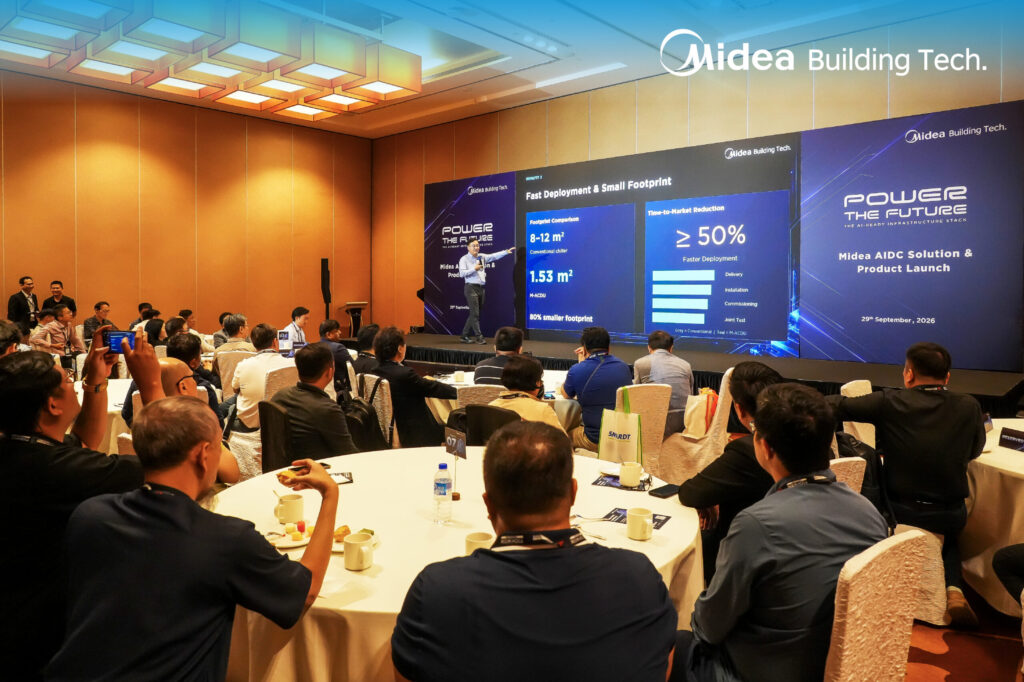
Midea Building Technologies, one of the seven businesses within the Midea Group, is prepared for the shift that is happening in the market.
Midea Building Technologies, Omdia and CLOU Electronics jointly released the AIDC Converged Infrastructure White Paper, which makes a clear point: convergence is not about bundling equipment, it is about system-level integration. The white paper proposes bringing the main power chain, energy storage buffer and cooling loop into one unified framework for capacity planning, redundancy design, monitoring, control and acceptance validation — with defined interfaces across energy storage, HVDC, SST, BBU and magnetic-bearing centrifugal cooling sources.
Midea Building Technologies, through its power-cooling hyper-converged architecture, developed with CLOU Electronics, power, storage, and cooling are treated as a single system rather than three different systems.
The architecture supports two parallel power pathways: a native 800 VDC route for new high-density AI facilities and an MGX-compatible 800V-to-54V route for phased upgrades to existing infrastructure. Energy storage, HVDC, SST and BBU modules work together to buffer rapid load fluctuations and support efficient, reliable power delivery as AI rack densities advance from 100 kW toward 1 MW and beyond.
For utility power, medium-voltage AC is converted to 800 V DC through solid-state transformers, supported by energy storage and a backup battery unit. Magnetic bearing chillers apply the cooling with rack-level coolant distribution carrying the heat from GPUs to form a cohesive system that can be coordinated through a unified control platform.
The design aligns with the direction hyperscalers are heading, including the 800 V DC standard, jointly advanced through the OCP by companies such as NVIDIA, Google, and Microsoft, Google’s move to high-voltage DC, and AWS building around highly effective cooling. Midea’s architecture aligns this thinking and packages it into a standard reference that is suitable for new builds and retrofits, including small-to-medium clusters and 400-600 kW rack-scale AI factory projects.
The products that deliver the promise
Midea’s full-stack AIDC liquid-cooling solution spans the thermal-management chain from dry coolers and magnetic-bearing cooling sources to CDUs, secondary piping, fan walls, and digital operations and maintenance. The portfolio is designed to coordinate cooling generation, distribution, and terminal heat removal across different rack densities and project conditions.
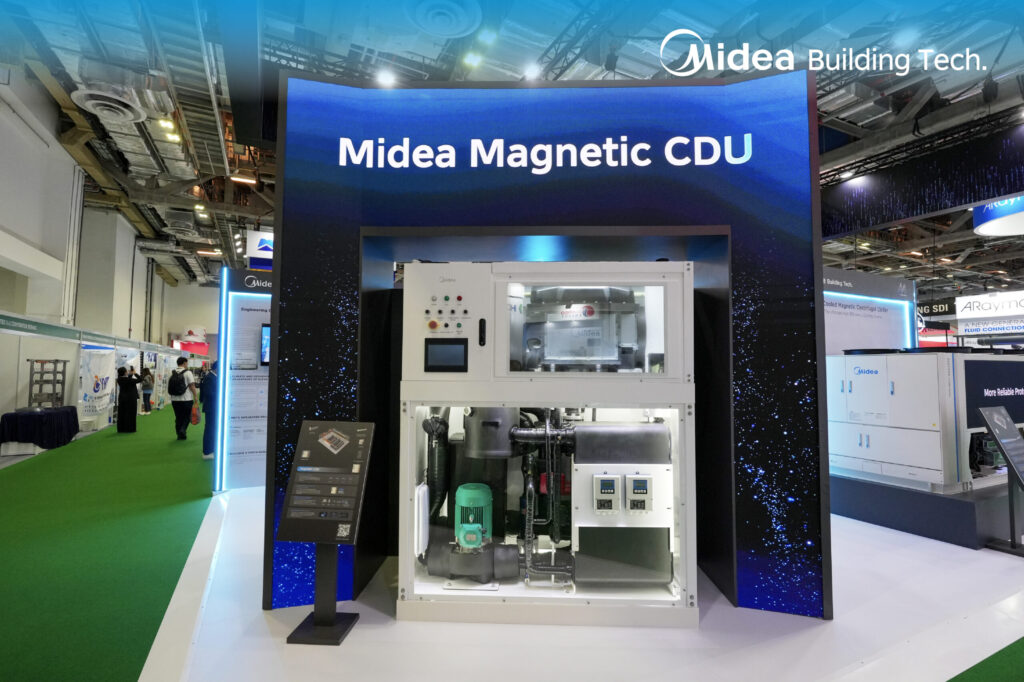
At the center of its solution is the Magnetic CDU. Midea’s Magnetic CDU is a paradigm-shifting innovation that replaces the traditional chiller and passive CDU architecture with a single, hyper-efficient integrated chassis. Built with a self-developed oil-free magnetic levitation compressor in Midea’s Al-powered Lighthouse Factory, the Magnetic CDU reduces the footprint by 70 percent. With a PUE of 1.2 or below, the majority of the power drawn by the Magnetic CDU goes to compute while still delivering exceptional cooling performance for next-generation Al data centers. The Magnetic CDU is designed around water-saving dry cooler operation and is validated globally to support sustainability targets without compromising efficiency or reliability.
For tougher deployments, the air-cooled magnetic-bearing centrifugal chiller is built for water-constrained regions. By reducing reliance on cooling water, it suits sites with limited water supply or complex construction conditions. With a COP of up to 5.4, it delivers stable cooling in high-temperature environments. The large-capacity industrial CDU is perfect for ultra-high-density clusters delivering 2.6 MW of cooling capacity at a 3K temperature difference, it supports 600 kW+ per rack with temperature fluctuation controlled within ±0.5°C. Its magnetic bearing consumes less than 0.2 kW, while multiple noise-reduction measures enable the unit to achieve a sound pressure level as low as 75 dB(A).
Combined with the power-cooling architecture, the portfolio cuts power supply losses, supports 400-600 kW rack cooling, matches cooling to output dynamically, and lowers operating costs across the life cycle. Midea Building Technologies has designed its products to respond to the industry trends playing out across the sector, creating complete systems that work as a unit rather than single products combined piecemeal to address one specific challenge.
The technology is backed by a company that has been working in the data center sector since 2007, holds over 7,000 patents, and runs seven research and development centers and 16 manufacturing bases. Midea Building Technologies operates in over 200 markets and leads the magnetic-bearing chiller market in China.
The demands of AI factories
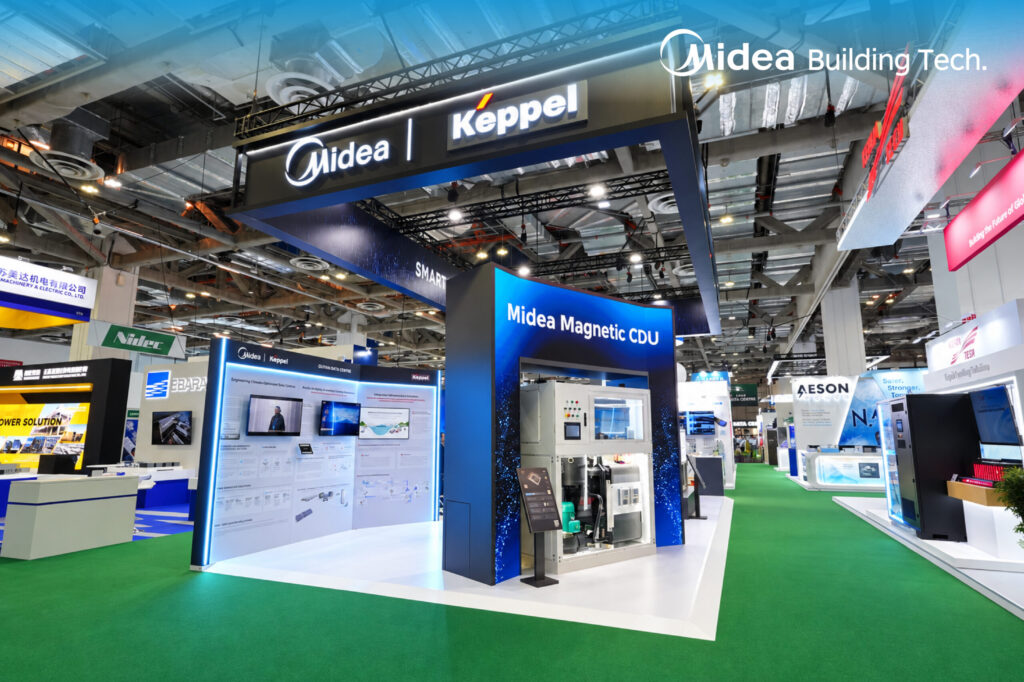
For Southeast Asia, solutions from Midea Building Technologies are primed to withstand the high heat, extreme humidity, and constrained water supply. These solutions offer a pathway to address these challenges through converged, water-conscious architecture that will power the next generation of the region’s infrastructure.
The full case is set out in Midea’s new white paper, AIDC Converged Infrastructure: Power, Energy Storage & Cooling Architecture for Next-Generation AI Infrastructure. The white paper proposes an end-to-end architecture, integrating electrical power, energy storage, magnetic-bearing chillers, and liquid-cooled CDUs into a unified hyperconvergence system built for next-generation AI data centers. For operators building for the 600 kW era, the message is direct. The next data center is a converged one, and the blueprint is ready now.
Read the white paper and follow Midea Building Technologies across the AI factory era, at mbt.midea.com/global and on LinkedIn, Facebook, and YouTube.