
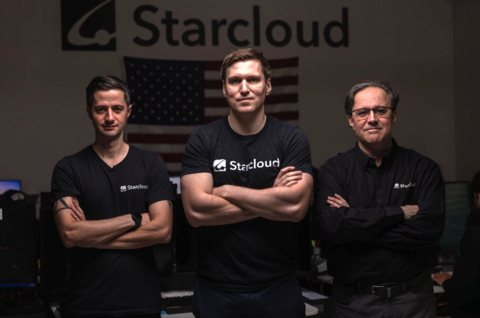
Starcloud, an aerospace and deep-tech startup, has raised US$ 250 million in a Series A extension led by Manhattan West, valuing the space-computing company at US$ 2.3 billion after the investment. Existing investors including Benchmark, EQT, Soma Capital, NFX and 776 participated alongside new investors NVIDIA, Cisco Investments, Cedar Capital, Goanna Capital and Standard Capital. The funding brings Starcloud’s total capital raised since its 2024 founding to US$ 450 million.
According to a press release, Cisco joined the latest funding round as a new investor, bringing expertise in networking, optical systems and AI infrastructure. Ken Abdalla and Lauren Selig led the investment for Manhattan West. Selig will join Starcloud’s board as an observer. Starcloud will use the new funding to expand manufacturing capacity, continue engineering work with NVIDIA and secure future launch capacity.

Philip Johnston, Co-Founder and CEO, Starcloud, “Last November we put the first NVIDIA H100 in orbit. Today this fresh capital empowers us to build the infrastructure to launch many more of NVIDIA’s most advanced GPUs into space.”
Aleem Rizvon, Vice President, Cisco Investments, said, “Cisco has long been a leader in secure data center infrastructure and looks forward to bringing that expertise to the emerging world of orbital data centers, Cisco Investments is excited to invest in Starcloud as they expand data centers into space.”
Starcloud and NVIDIA began working together after Starcloud launched an NVIDIA H100 GPU aboard its Starcloud-1 satellite in November 2025. The companies are now collaborating on NVIDIA’s Space-1 Vera Rubin Module, which is designed to operate in the conditions of space.
Starcloud-1 has been used for several computing demonstrations in orbit, including training an AI model, running a version of Google’s Gemini and performing inference and fine-tuning on high-performance computing hardware.
Starcloud is developing plans for a constellation of 88,000 satellites with a targeted 20 GW of computing capacity. It is also building a 100,000-square-foot manufacturing facility in Woodinville, Washington, where production of its next-generation Starcloud-3 spacecraft is underway.

Unlike conventional data centers, orbital computing systems must rely on radiators to dissipate heat and protect components from radiation. Starcloud’s satellites are expected to provide an early flight platform for space-rated hardware, using data collected from the company’s H100 deployment.