
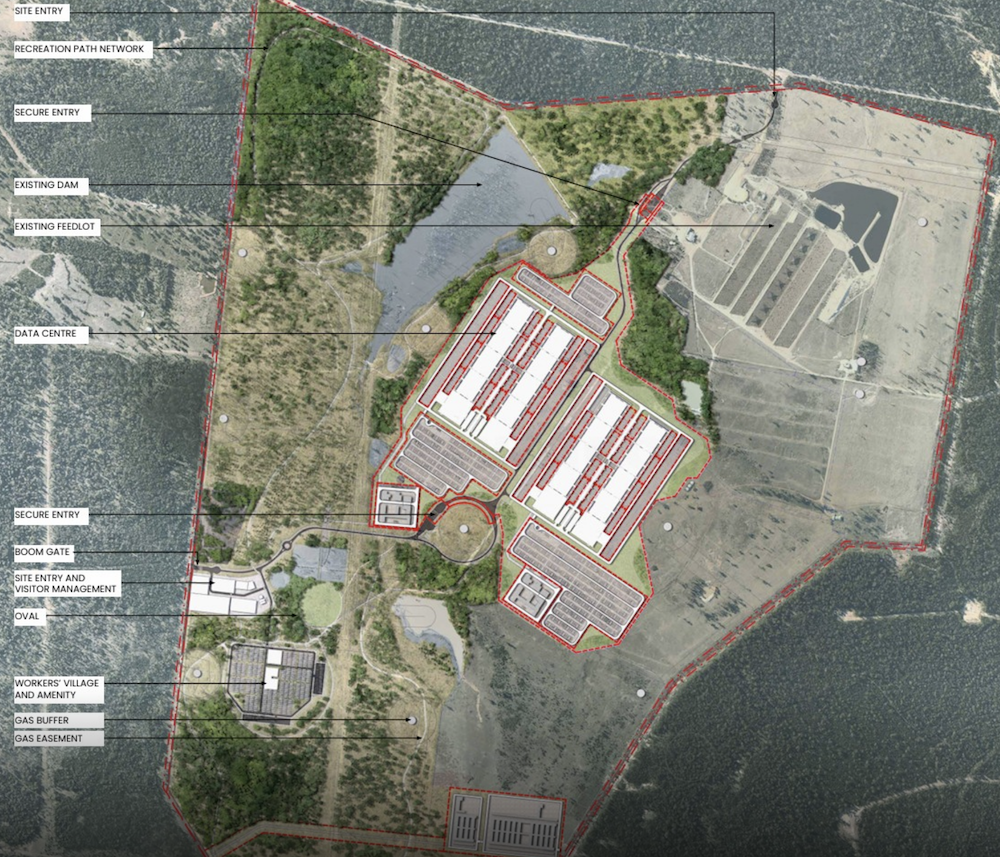
Singapore-based data centre developer Zerra DC is behind plans for a 1.44GW data centre campus in Queensland’s Western Downs region, with the development application lodged by project company WDDP Pty Ltd. The Western Downs Digital Park is planned for a 725.5-hectare site at 1933 Dalby-Kogan Road, approximately 37km north-west of Dalby, with the development application proposing four 360MW data centre buildings delivered across four stages.
The campus would represent one of the largest single digital infrastructure investments in Australia and aims to shift AI computing workloads away from traditional hubs like Sydney and Melbourne directly to where the power is generated. Neocloud data centre operators like Iren and Firmus have already made similar moves.
The application proposes approximately 195,000 sqm of data centre floorspace, alongside power infrastructure, internal roads, parking, a temporary workforce accommodation village and other supporting facilities. The Courier-Mail has identified Zerra DC as the developer behind the project. The planning documents describe the campus as a nationally significant digital infrastructure development in an established energy and industrial area.
The site is close to the Braemar transmission substation, Braemar 1 and 2 gas-fired power stations, Darling Downs Power Station and multiple 275kV and 330kV transmission lines. A 275kV transmission line also crosses the western portion of the site.
AUD 14.5bn development
The economic assessment accompanying the application puts the construction cost at AUD 14.5bn excluding GST, or approximately AUD 16bn including GST. Construction is expected to take four to six years, according to assumptions provided to Urbis by the project team. The economic assessment estimates around 1,500 direct construction jobs, with a further 2,120 indirect jobs generated through flow-on effects during construction.
Once operational, the assessment estimates around 1,400 direct on-site jobs and 2,100 indirect jobs, with the completed campus potentially generating approximately AUD 760m in annual direct and indirect gross value added to Queensland, according to the planning documents.
The scale of the construction operation has prompted plans for a temporary workforce village capable of accommodating up to 1,500 construction workers, with recreational and other amenities.
Power at the centre of the design
The project’s location has been selected in part for its proximity to Queensland’s high-voltage electricity infrastructure. The proposed campus would have customer-owned switching stations operating at 275kV and 330kV. The Braemar transmission substation is approximately 600m south of the site and operates at both voltages, while 275kV transmission lines run close to and across the property. A 330kV line is approximately 600m south of the site.
Several gas-fired power stations are also located close to the site, including Braemar, Braemar 2 and Darling Downs, while Daandine Power Station is approximately 1.6km away. Power would then be distributed through 33kV substations and underground reticulation to the data centre buildings, with battery-backed power conditioning systems forming part of the supporting infrastructure.
The application says the power-sourcing strategy will be phased to provide access to electricity from nearby generation alongside transmission network capacity.
Application contains 2.16GW reference
There is an apparent discrepancy within the application concerning the ultimate electrical capacity of the campus. While the principal planning, economic and transport documents describe the project as four 360MW data centre buildings providing 1.44GW of IT capacity, an HDR Infrastructure Services Report included in the application refers to an electrical design accommodating six 360MW data buildings, equivalent to 2.16GW of IT load and 3.24GVA of total facility demand.
The transport assessment explicitly describes the current proposed development as a campus with an ultimate capacity of 1,440MW, delivered in four 360MW stages.
W.Media has asked Urbis to clarify whether the 2.16GW figure represents a future expansion beyond the current proposal or reflects an inconsistency between the project’s electrical and planning designs.
Low-water design
The remote location means the project cannot rely on an existing town water supply. The nearest reticulated water infrastructure is approximately 15km away, according to the planning documents. The proposed approach uses primarily air-cooled technology and closed-loop cooling systems, with rainwater harvesting, recycled water and other on-site supply options forming part of the proposed water strategy.
The infrastructure assessment estimates peak construction water demand at approximately 322kL per day, with a further 200kL/day potentially required for dust suppression and construction activities.
Once operational, water demand falls substantially. The assessment puts the operational requirement for a single completed data centre building at approximately 16.5kL/day, or 4.8ML annually, comprising 10.6kL/day of potable water and 5.9kL/day of non-potable water. Each building would additionally require approximately 26.9ML of water for the one-off filling and flushing of its closed-loop cooling system during commissioning.
The planning documents say the project is intended to avoid reliance on town water infrastructure and to reduce demand through air cooling, rainwater harvesting and treated wastewater reuse.
Large-scale construction operation
Peak construction activity is expected to generate around 200 light-vehicle and 230 heavy-vehicle movements per day, including oversized deliveries associated with transformers, cranes and prefabricated components.
The completed campus is forecast to generate approximately 120 vehicle movements per day, comprising 86 light-vehicle movements, four bus movements and 30 heavy-vehicle movements. The primary access would be from Dalby-Kogan Road, with an internal road network connecting the various parts of the campus and separate arrangements for the workforce accommodation.
The site’s location also provides access to existing freight infrastructure. The transport assessment says a privately owned rail siding and unloading facility in Dalby is approximately 35km from the site and could potentially be used for selected bulk-material or plant movements, subject to operational and commercial arrangements.
Early-stage project
The application is currently before Western Downs Regional Council, which is the assessment manager, and remains subject to approval. The application seeks a Material Change of Use for Research and Technology Industry, workforce accommodation and a high-impact industry concrete batching plant, together with associated works. The proposal is subject to impact assessment under the Planning Act 2016 and the Western Downs Planning Scheme.
According to the documents. the site is within the Kogan East Special Industry Area, which the planning documents identify as an area intended to accommodate major industrial and special-industry activities requiring separation from sensitive land uses.
The site is owned by Wambo Cattle Company, which has consented to WDDP lodging the development applications. The application describes the proposed Western Downs Digital Park as a nationally significant digital infrastructure project that would establish Australia’s largest data centre campus.