
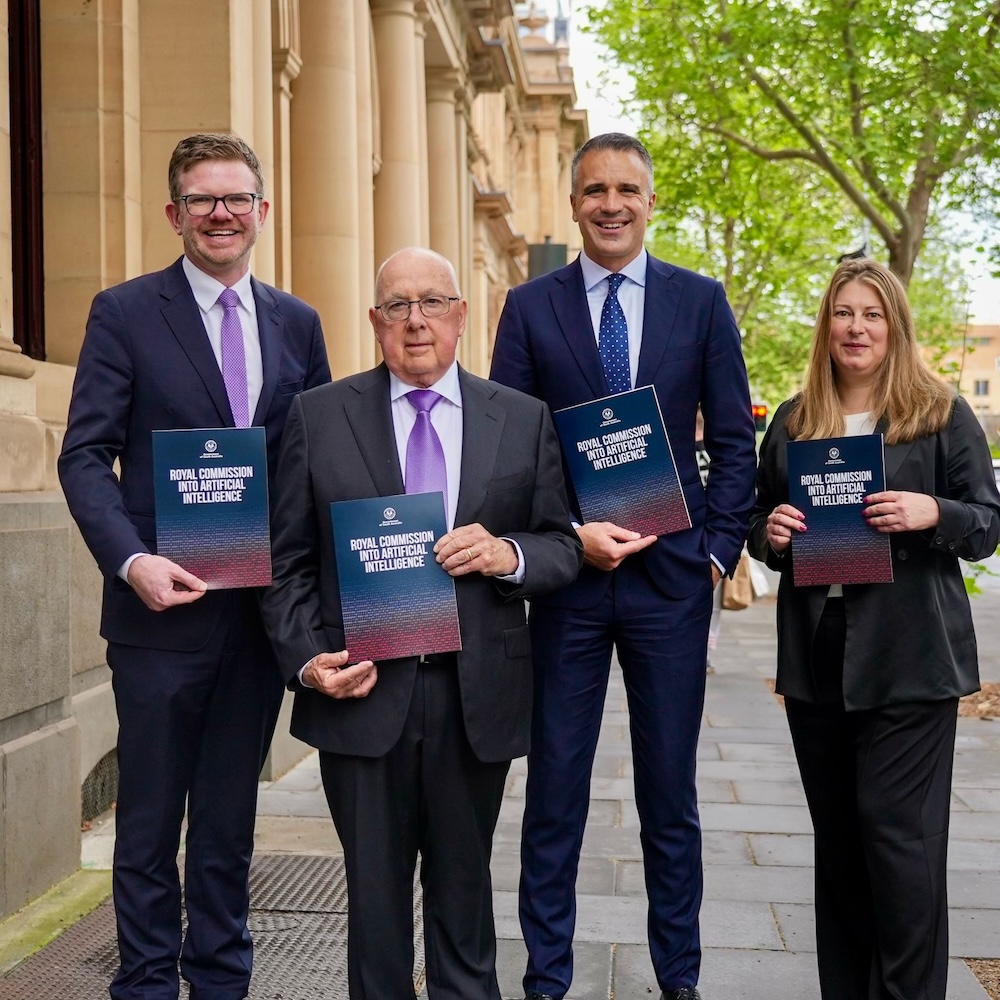
South Australia has formally established its Royal Commission into Artificial Intelligence, with the inquiry to examine how the technology will affect the state’s economy, workforce, public services and society. The Royal Commission will be chaired by Dr Iain Ross, with Kate Pounder and Professor Christopher Manning appointed as fellow commissioners.
The inquiry is required to begin on 1 October 2026 and report to the Governor by 1 July 2027. Its formal Terms of Reference cover the opportunities and barriers for AI to improve productivity, innovation and economic growth in South Australia, as well as the policy, legislative and regulatory frameworks needed to support its safe and responsible development and adoption.
The commission will also examine AI’s impact on employment and workplace practices, how the education system, including schools, higher and vocational education, should adapt to AI, how AI can be used to simplify and streamline the regulatory environment for South Australian businesses, and the delivery of public services including healthcare.
The commissioners have also been directed to have regard to data sovereignty and South Australia’s strategic autonomy over “AI systems data, and critical capabilities”, as well as developments and policy approaches in other Australian and international jurisdictions.
The inquiry is directed to have regard to the views of community representatives, business and industry bodies, unions, technology developers, academia, creative industries and governments at local, national and international levels.
The final Terms of Reference do not specifically mention data centres, electricity or water use. That differs from the South Australian government’s announcement of the Royal Commission in August, which said its proposed scope would include AI-related infrastructure and its relationship with energy transformation, water usage and electricity-grid implications.
The formal ToR nevertheless give the commission scope to consider the broader infrastructure implications of AI through its examination of economic growth, strategic autonomy and “critical capabilities”, although they do not define those capabilities specifically.
The commission has been instructed to consider practical actions for government, industry and the community in the short and medium term, alongside a longer-term approach to AI adoption. Meanwhile, the commissioners are also authorised to sit independently on particular parts of the inquiry at the direction of the chair.