
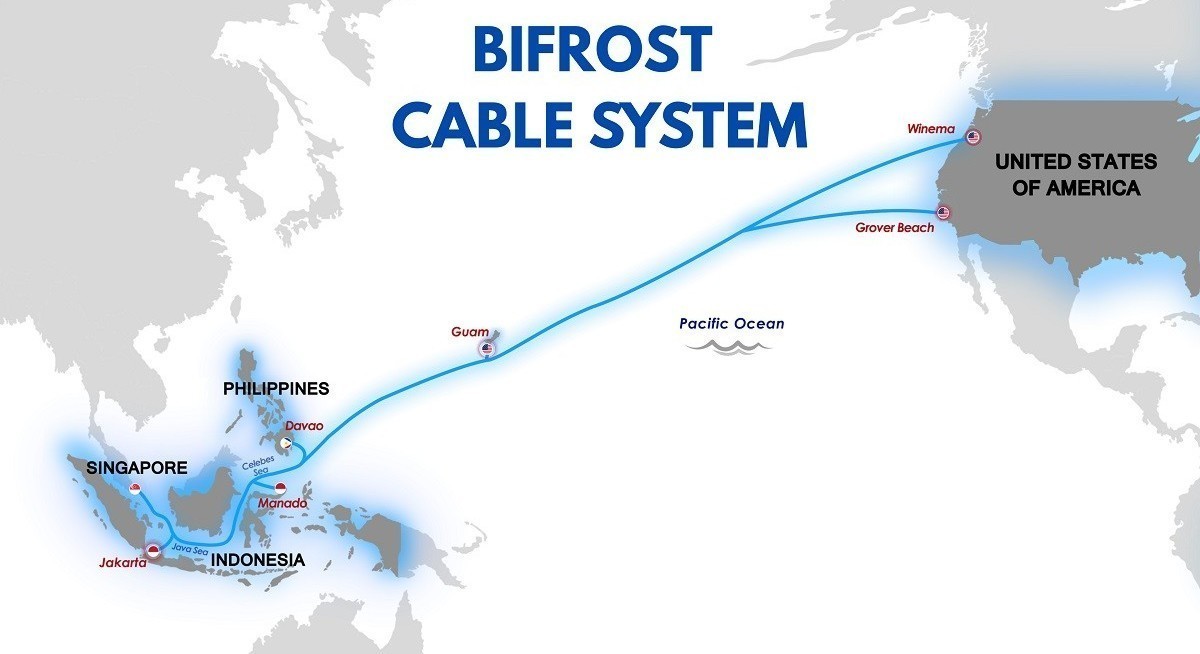
Singapore-based asset manager Keppel Ltd has signed an Indefeasible Right of Use agreement with an undisclosed global hyperscaler for the fifth and final remaining fibre pair on the 20,000 km Bifrost Cable System connecting Singapore to the west coast of USA via Indonesia. This marks the completion of commitment of all five fibre pairs that has a contract value of about US$1.3 billion (S$1.7 billion), including recurring income from cable operations and maintenance, according to the firm’s press release yesterday.
w.media had last reported on the fourth fibre pair commitment agreement signing last month when it was mentioned that the discussion for this last pair was about to be finalised. The report also mentioned Keppel is progressing well to finalise the development of its next two new cable systems, which has now been confirmed by Manjot Singh Mann, CEO, Connectivity of Keppel.

“Building on this track record, together with our private funds and listed trusts, we are pursuing and evaluating two new cable systems, one from Singapore to the Middle East with branches across South Asia, and the other from Singapore to Japan through the South China Sea with branches across ASEAN. By harnessing our capabilities across digital infrastructure, including data centres and power, we are well positioned to support the next wave of AI-driven digital growth,” said Manjot Singh.
Bifrost is the world’s first subsea cable system directly linking Singapore to the west coast of the USA via Indonesia through the Java Sea and Celebes Sea. Keppel’s investment is held through a 40-60 joint venture with its private fund co-investors.
The asset manager will continue to operate and maintain the fibre pairs, generating long-term recurring income over 25 years, and giving an internal rate of return of about 30 per cent for the entire project.
Bifrost supports AI and cloud-native workloads with round-trip latency of under 165 milliseconds, which is up to 10 milliseconds faster than existing systems, between Singapore and the USA. It carries over 240 Tbps of capacity.