
Transgrid, the transmission network operator for New South Wales, is warning that Sydney’s data centre boom is putting increasing pressure on the transmission network, with more than 20GW of data centre connection enquiries now in the pipeline across NSW.
The company says existing capacity in Sydney is largely committed, meaning new data centre developments will need to fund network upgrades to unlock additional capacity.
The figures come as Transgrid released its 2026 Transmission Annual Planning Report (TAPR), which identifies data centres as one of the biggest drivers of future electricity demand in NSW. NSW is already home to roughly 100 data centres, but these have typically connected to the distribution network. It’s the emergence of much larger facilities, some adding more than 1GW of demand at a single site, that is now pushing developers towards direct transmission connections and therefore into Transgrid’s remit.
Transgrid said the 20GW figure relates specifically to data centre connection enquiries, although only a proportion of the projects are expected to proceed. The pipeline is roughly twice current NSW peak electricity demand.
Around 1.5GW of data centre capacity is already covered by signed connection agreements in Greater Sydney, with all of those projects still to connect. Project maturity across the pipeline varies considerably, ranging from advanced developments with secured land, financing and end customers through to early-stage speculative proposals.
Transgrid said additional capacity in Sydney could be unlocked through network investment, including the proposed South Creek substation and associated transmission upgrades in Western Sydney. Technical studies are still being finalised, but the solution could unlock up to 2GW of additional transmission capacity.
Market-led allocation
Allocation of that capacity will be market-led, with projects effectively competing to be first to commit to funding the required augmentation, subject to meeting Transgrid’s readiness criteria.
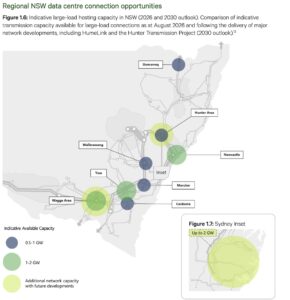
The constraints are prompting Transgrid to point prospective data centre developers towards regional NSW, where parts of the network may have greater capacity.
The TAPR identifies potential opportunities around areas including the Hunter and Riverina, although available capacity is indicative and would depend on the requirements of individual projects and any necessary network upgrades.
The report also highlights the potential impact of making large new electricity users pay for the full capacity they reserve, rather than only the capacity they ultimately use. Transgrid estimates such a reform could reduce like-for-like transmission costs for other consumers by up to 15%.
Data centre demand is also rising much faster than previously forecast. Transgrid’s latest analysis, prepared by Baringa, projects data centre peak demand in NSW to rise from around 660MW in 2027 to 3.67GW in 2036.
Four times higher
The report says data centre loads are now forecast to be approximately four times higher in 10 years than projected in Transgrid’s 2025 report. Under Baringa’s central scenario, data centres could reach around 3.5GW of peak demand by 2035, roughly twice the equivalent peak demand implied by AEMO’s 2026 ESOO Step Change scenario.
Transgrid estimates data centres will account for 66% of the growth in NSW end-use electricity consumption between FY2026 and FY2035, reflecting the extent to which the sector is reshaping the state’s demand outlook.
Data centres currently account for around 3% of NSW peak electricity demand, but Transgrid forecasts this could rise to around 20% by 2035.
The scale and characteristics of data centre demand are also becoming an important consideration for network planning. Traditional data centre loads tend to consume electricity relatively consistently throughout the day, while AI workloads can introduce greater variability.
Transgrid says connection agreements can incorporate provisions allowing loads to be curtailed during periods of system stress. Battery energy storage, intelligent workload scheduling and other forms of demand-side flexibility could also create additional room on the network.