
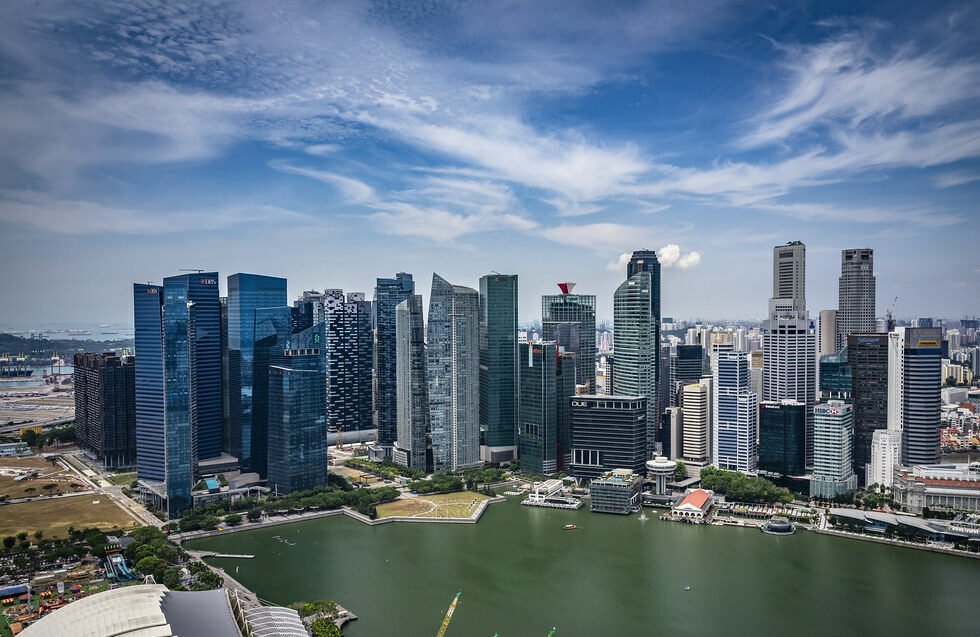
Singapore listed data center Real Estate Investment Trusts (REITs) plunged on November 17, just a day after the United States announced new export restrictions on advanced artificial intelligence (AI) chips and computing infrastructure, raising concerns about the impact on operators serving customers across Southeast Asia. However, analysts say that the panic may be unwarranted.
According to a report by The Straits Times, on November 17, NTT DC REIT fell 0.5 percent, DigiCore REIT declined 2.2 percent and Keppel DC REIT lost nearly 1 percent. ST Engineering shares closed 1.9 percent lower at US$ 8.86, while Singtel rose 2.5 percent to US$ 4.10.

Meanwhile Reuters reported that Singapore’s Frencken, a supplier to Dutch chip equipment maker ASML, slid 3.91 percent, while semiconductor testing company AEM, which works with Intel, fell 2.9 percent.
But Mikhail Jaura, Head of Data Center Research for Asia Pacific, JLL told w.media, “The new US rule is primarily a compliance and licensing event rather than a demand shock. Operational capacity in Singapore is largely contracted on long-term leases, and the US-headquartered hyperscalers that anchor much of that demand are exempt from the new licence requirement, subject to reporting.”
He further explained, “The headwinds sit mainly in the forward pipeline, where projects reliant on non-US AI tenants now face licensing uncertainty, longer timelines and closer lender scrutiny. Rather than an erosion of confidence in AI infrastructure, we see a repricing of regulatory risk: demand for compute across Asia Pacific remains robust, and capital is likely to favour assets with transparent tenancy and strong compliance.”
Charu Chanana, Chief Investment Strategist, Saxo Singapore too offered clarity on just who would feel the actual impact. “The biggest risks are for operators dependent on Chinese AI customers, where licensing uncertainty could affect utilisation, expansion plans and financing,” Chanana told The Straits Times. “Singapore remains an attractive regional data centre hub, but regulatory compliance and customer quality could increasingly determine which operators capture the next wave of AI investment.”
Therefore, the extent of the restrictions’ longer term impact will depend on operators’ exposure to affected customers, their ability to obtain export licenses, and whether their tenants qualify for exemptions.
Readers would recall that on Monday November 16, 2026, the U.S. Department of Commerce’s Bureau of Industry and Security (BIS) announced the Interim Final Rule (IFR) restricting chip exports to Singapore, Malaysia, Thailand, Indonesia and Brazil. Companies will now need licenses from the U.S. Commerce Department to ship advanced computing chips to these markets. The measure seeks to prevent sensitive U.S. chip technology from landing up in China’s hands, and also aims to prevent the restrictions from being circumvented through remote computing arrangements involving data centers in third countries.

Singapore’s government said it is reviewing the measure and engaging affected companies to assess its potential business impact. Although the announcement has raised concerns about licensing requirements and future expansion plans, analysts said the underlying demand for AI and cloud computing infrastructure remains intact.