
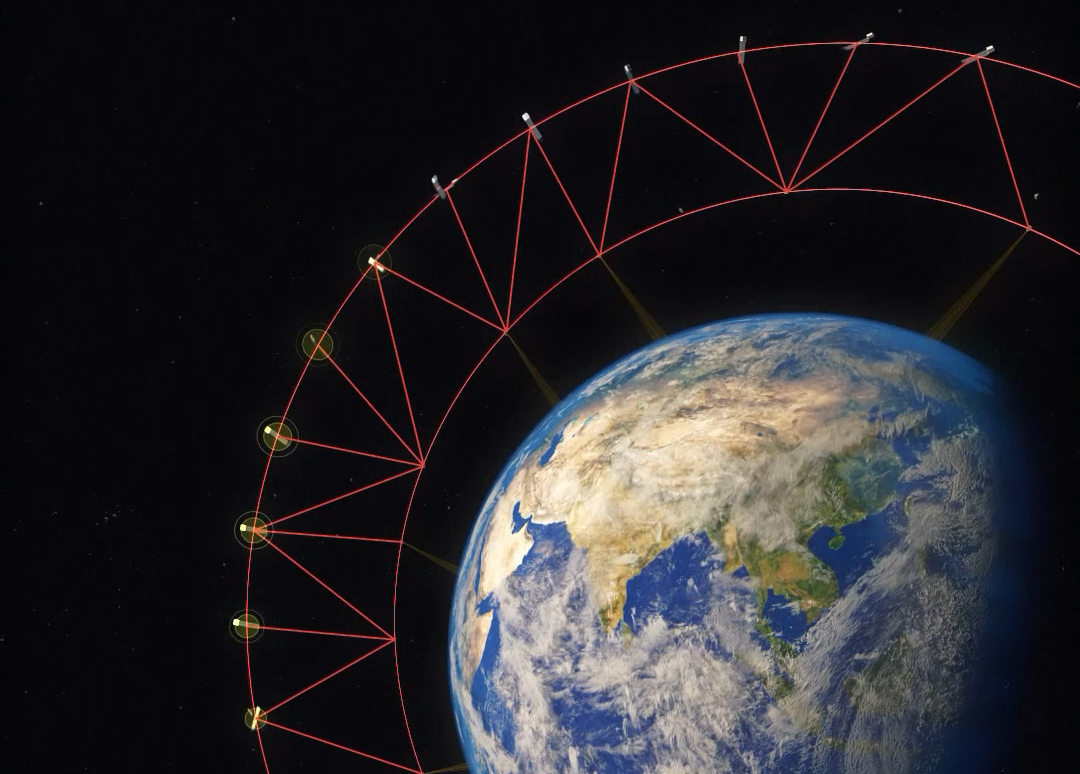
Open Cosmos, a European space technology company, is planning a 192 satellite low Earth orbit (LEO) constellation as the core of its ConnectedCosmos communications network. The company is targeting more than 96 satellites in orbit by the end of 2028, and global coverage by 2030.
According to a company press release, the constellation will use optical inter-satellite links to transfer data directly between satellites, reducing reliance on terrestrial ground stations and subsea cables. The architecture is intended to support the movement of large datasets, including raw Earth observation imagery, video, database transfers, and communications in environments where satellite navigation signals are disrupted or unavailable.

The next ConnectedCosmos launch is expected before the end of 2026, as Open Cosmos moves to expand a network aimed at government, institutional and commercial users that require secure communications and control over critical data.
“After much anticipation, we can finally reveal that 192 satellites will form the core connectivity backbone of our ConnectedCosmos constellation, giving our customers and partner nations a picture of the global, resilient network we’re constructing” said, Rafel Jordà Siquier, Founder and CEO, Open Cosmos. “The 192 satellites are the foundation, not the ceiling.”
Open Cosmos is developing ConnectedCosmos alongside its Earth observation operations rather than as a separate communications programme. The connectivity network will provide the transport layer for Earth observation satellites deployed through dedicated missions and the company’s OpenConstellation system, allowing data collected in orbit to be transmitted through the same network.
The programme follows a €300 million (US$ 337 million) funding round for Open Cosmos, which is being used to expand satellite manufacturing and accelerate development of its connectivity and Earth observation platforms.

The company is building the satellites through its European manufacturing operations, with production capacity of up to one spacecraft per day. It is also exploring a model that would allow independently owned and governed European satellite systems to connect to the wider network. Additional launches are under discussion with several launch providers, with missions planned between late 2026 and mid-2027.