
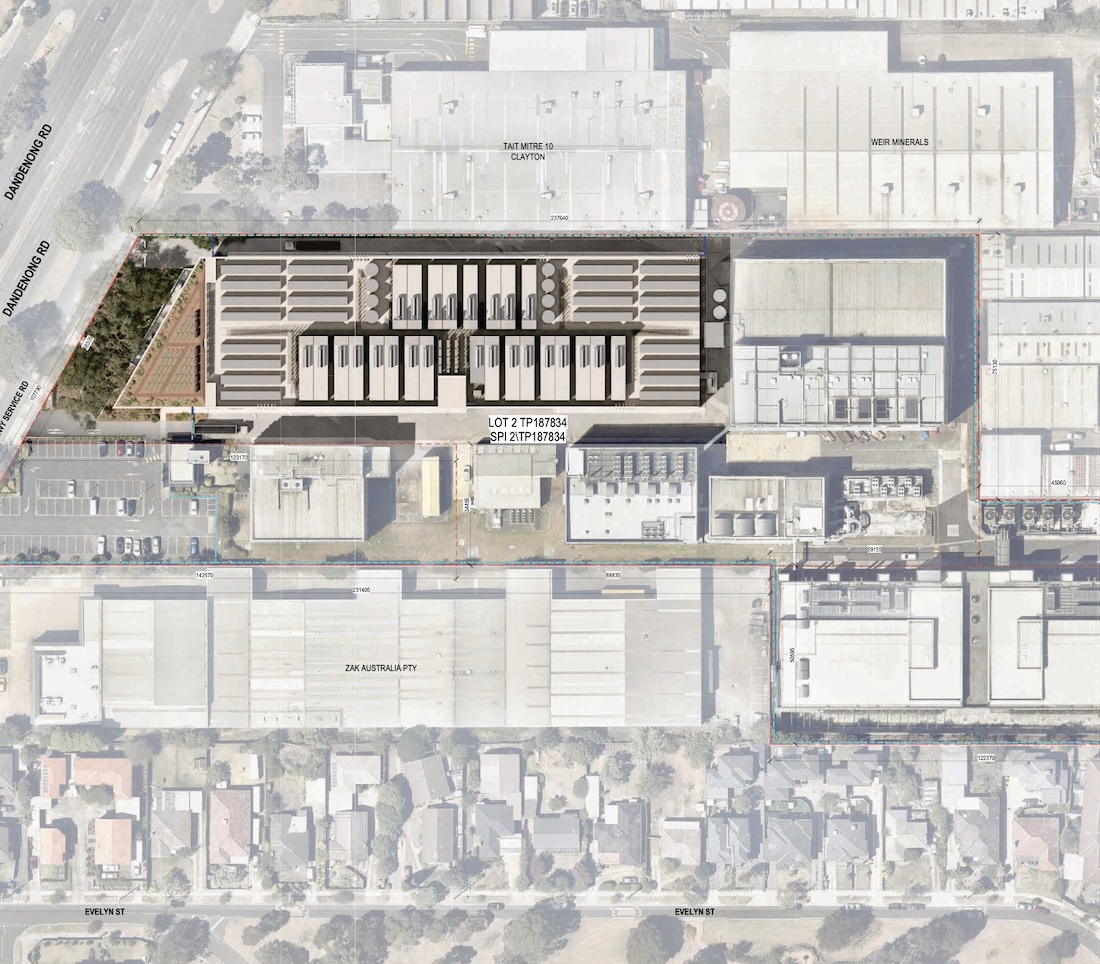
Monash Council has rejected Centuria’s plans for a 38MW data centre in Melbourne, overturning a recommendation by council planning officers to approve the AU$137 million project as the state of Victoria moves to tighten rules governing where and how data centres can be built.
The decision creates a new planning hurdle for Centuria, which is also seeking approval for a second data centre on the same site, while highlighting the tension between projects already moving through the planning system and the state government’s new approach to data centre development.
The proposed facility at 1816-1832 Dandenong Road would replace two existing buildings within the Telstra-occupied Clayton data centre complex, which is owned by Centuria Industrial REIT. The site already has a lawful data centre use, and council officers concluded that the proposed expansion was appropriate under the planning rules in force when the application was assessed. Officers recommended that a permit be issued, subject to conditions, but councillors voted down that recommendation on 29 September.
The refusal was driven principally by concerns about the scale and intensity of the expansion, its electricity requirements and potential impacts on surrounding residents, alongside uncertainty about how the project fits into Victoria’s rapidly changing data centre policy.
Power demand
Councillor Rebecca Paterson, who moved the alternative recommendation to refuse the permit, pointed to the increase in power demand from the existing operation to the proposed 38MW facility and argued that the project raised questions about electricity infrastructure, noise and community amenity. Councillor Brian Little said the cooling needed to reject that much heat could be large and noisy.
However, the council officers’ report said the submitted noise impact assessment found the proposed data centre would comply with all relevant criteria, including the EPA’s Noise Protocol limits and noise peak sleep disturbance criteria.
Little and Councillor Elisha Lee also referred to the Victorian Government’s new Sustainable Data Centre Action Plan, released a week before the decision. The plan says new data centres will be expected to bring their own renewable energy supply and storage, stay away from residential areas and contribute to local infrastructure and community benefits. The government has proposed a 150-metre separation between new data centre buildings and homes.
The officers’ report put the proposed building about 80 metres from the nearest residential properties to the west, across the Dandenong Road/Princes Highway road corridor, and considered the separation adequate. The residential properties are already separated from the industrial precinct by the major arterial road. Little and Lee nevertheless argued that the proposal fell short of the 150-metre separation from homes proposed under Victoria’s new data centre framework.
Lee said she could not support an expansion that “would otherwise be deemed non-compliant with the new guidelines”. Little said the new rules would not start operating until the beginning of 2027, and that the project would “probably fail” on the 150-metre and renewable energy requirements.
Not in force
The new requirements are not yet in force, however, and Paterson’s motion rested on the scale, intensity and operational nature of the development as opposed to the 150-metre rule. The Clayton application was already under assessment when the government announced the changes.
The new policy formed part of a wider argument about whether a project of this scale should proceed while the regulatory framework governing data centres is being rewritten.
The issue is particularly significant because the council’s own planning officers had reached a different conclusion. Their report found the proposal appropriate under the relevant Monash Planning Scheme provisions and recommended approval. There was one formal objection, raising concerns including residential compatibility, noise, heat, traffic, visual impact and safety.
Centuria had also modified the project during the planning process. The planning documents include February 2026 drawings issued in response to a council request for information, following the original December 2025 design application.
Victoria pipeline grows
The refusal comes as the Victorian data centre pipeline continues to expand. HyperDC has applied for a 400MW IT capacity data centre at Moorabool, north-west of Geelong, on a 39.65-hectare site close to AusNet’s Moorabool Terminal Station and the Victorian Big Battery. The project has a reported end value of around AU$6 billion.
Meanwhile, US investment manager PGIM has received approval for an 80MW data centre at Truganina, the first building of a planned larger campus. The initial development, with construction costs estimated at AU$422 million, was approved through Victoria’s Development Facilitation Program, the state-level planning pathway rather than the conventional council process.
Those and other projects also underline the challenge facing councils like Monash: projects can be well advanced under existing planning rules while the state government is simultaneously introducing new requirements around energy, water, location and community impacts.
Regulation lagging?
At the council meeting Monash Mayor Stuart James said he was comfortable with both the officer report and a refusal. He acknowledged that the council could only assess the application under the planning regulations in place, and said he did not know how successful a refusal would be, given there is no change to the existing data centre use of the land.
He also criticised the pace of government regulation, arguing that data centres had been developing for 10 to 15 years while governments were now trying to catch up with the rapid growth driven by AI. James said it was disappointing “just how behind the government is on regulations”, and that councils were being left to deal with something the federal government should have addressed years ago.
“There’ll be a lot of work in this space over the next six to eight months,” he added.
While the refusal relates to the 38MW application, Centuria also has a separate development application for a second data centre of up to 40MW on the Clayton site. Centuria Industrial REIT has agreed with Telstra to take back part of the site for the project, with the development expected to follow Telstra’s decommissioning of that section, currently anticipated around mid-2027.
For Centuria, the immediate question is whether the Clayton refusal ends the proposal or simply moves the dispute to the next stage of Victoria’s planning system. The company may be able to challenge the council decision, while the broader question of how projects already in the pipeline will be treated under Victoria’s new data centre framework is only beginning to emerge. W.Media has asked Centuria about its options following the refusal.