
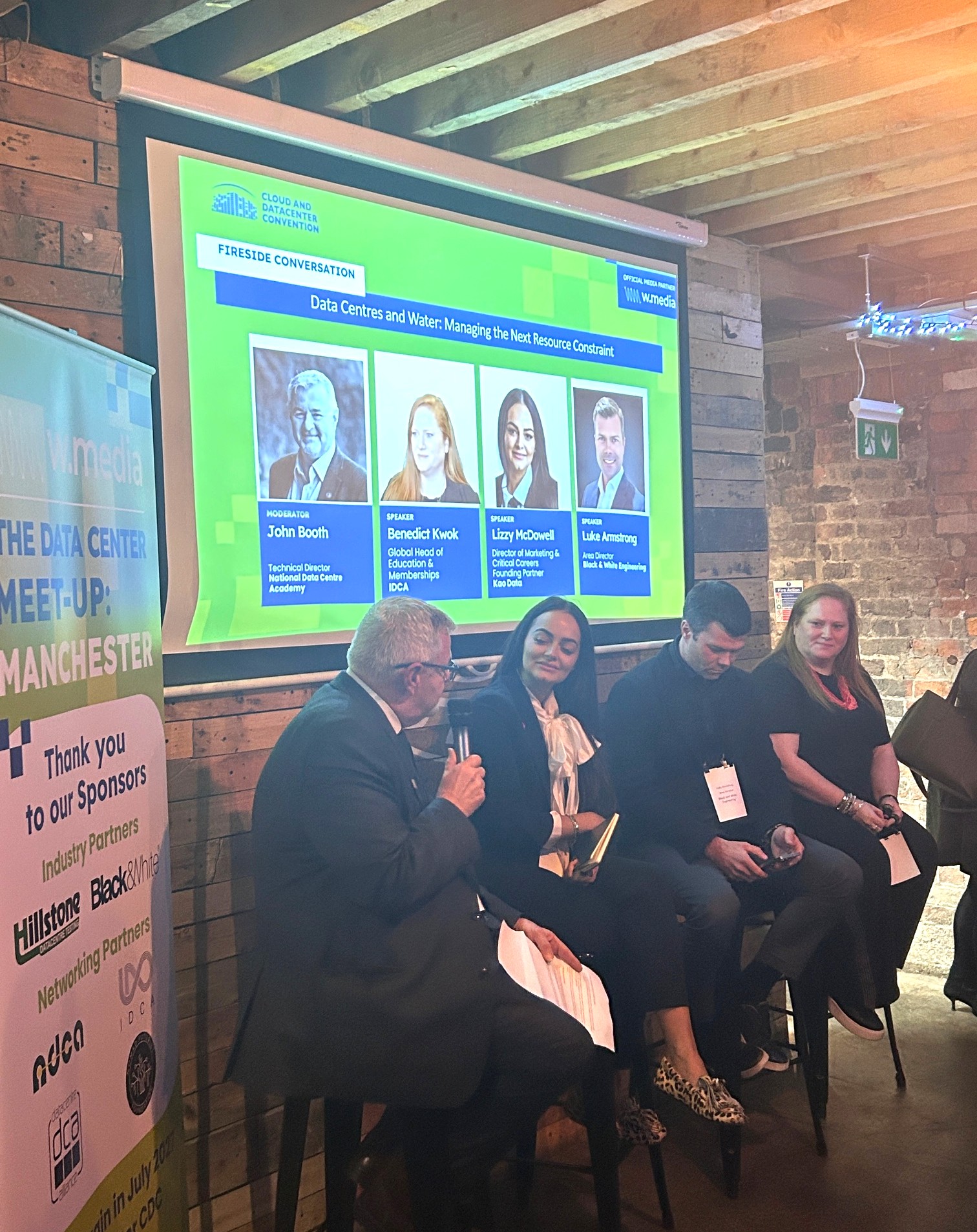
Data centers may account for just 0.01 percent of global water use and 0.03 percent in the UK, but the real challenge lies beyond the headline figures. It is how water is managed, accessed and shared at a local level. That was a key message from w.media’s inaugural Data Center Meet-up in Manchester last week.
The event brought together members of the Manchester and Greater North data center community for an evening of discussion, knowledge sharing and networking, exploring one of the industry’s increasingly important sustainability challenges.
The evening opened with a keynote from Lizabeth Hood of the IDCA, who highlighted the uneven distribution of water resources around the world. While the UK has adequate freshwater availability overall, this varies significantly between regions, with population growth, industrial activity and changing weather patterns all influencing local supply.
Hood also highlighted that a data center’s water footprint extends beyond its direct consumption. The electricity used to power a facility carries its own water footprint, depending on how it is generated. Nuclear power, for example, can require significant volumes of water for cooling, meaning that on-site nuclear generation and small modular reactors (SMRs) also have water-management implications. This reinforces the need to consider energy choices, from grid power to on-site generation, as part of the wider water-management conversation.
This highlighted the need for a locally informed approach. Operators must understand local resources and consider competing demands when planning new developments.
Technology can reduce water consumption
Building on the keynote, the evening continued with a panel discussion on how technology can help address these challenges. Moderated by John Booth, Technical Director at NDCA, the panel brought together Lizabeth Hood of the IDCA, Lizzy McDowell of Kao Data, and Luke Armstrong of Black and White Engineering.
With AI driving greater infrastructure density and heat output, cooling was a key focus. Luke highlighted how closed-loop liquid cooling, dry coolers and hybrid systems can reduce or even eliminate operational water use.
However, there are trade-offs. Dry cooling can increase electricity demand, while equipment footprint and cost must also be considered. The right solution depends on local climate, water availability and power supply.
Advances in cooling technology and higher operating temperatures are making dry cooling increasingly effective. Reclaimed water also offers an opportunity to reduce reliance on freshwater where available.
Putting data center water use into perspective
The panel recognised a gap between public perceptions of data centers and how they actually operate. Historically, the industry has focused on building and operating facilities rather than explaining their purpose and local impact.
Lizzy McDowell highlighted Kao Data’s Data centers Explained website, developed in association with techUK and the Data Center Alliance, as an example of efforts to make information more accessible.
The panel also discussed a planned 40 MW data center in Stockport, expected to use closed-loop liquid cooling. Its anticipated water consumption was compared with the annual usage of five families of four, offering a more relatable way to understand the figures.
The discussion also highlighted the importance of meaningful measurement. Metrics such as Water Usage Effectiveness (WUE) help quantify consumption, but it is important to consider both direct water use and the water associated with electricity generation.
Communities must be part of the conversation
Building trust with local communities was another key theme. Concerns around water, electricity, noise and new developments need to be addressed through early engagement, transparency and evidence.
McDowell highlighted Kao Data’s Kao Seed Fund, which supports local not-for-profit projects based on needs identified by the communities themselves. The company has also appointed a community liaison manager to maintain an ongoing relationship with residents.
The message was clear: engagement cannot stop at planning permission. Listening to communities and demonstrating a commitment to local needs are essential to building long-term trust.
Data centers as part of the solution
The discussion also explored how data centers can deliver local benefits, rather than being viewed solely as consumers of resources.
Waste heat recovery was one example, with Nordic projects demonstrating how excess heat can supply homes and local heating networks. McDowell explained that Kao Data aims to recover at least 25 percent of waste heat from its facilities, although this depends on collaboration with local authorities and other partners.
Data centers can also support renewable energy developments and wider infrastructure planning, creating opportunities to contribute positively to the communities in which they operate.
Collaboration and transparency will be key
Audience questions highlighted wider challenges around public communication, planning and development consent. The discussion reinforced that responsible development requires collaboration between operators, developers, designers, utilities, regulators, local authorities and communities.
Ultimately, managing data center water consumption is about more than choosing the right cooling technology. It requires an understanding of local resources, honest communication about trade-offs and meaningful engagement with the communities affected by development.
As demand for digital infrastructure and AI continues to grow, the industry’s challenge is to demonstrate that this growth can be managed responsibly. Looking beyond global statistics and focusing on local impact will be essential to building a more sustainable and trusted data center sector.
The conversation will continue at the Manchester Cloud and Data Center Convention taking place on July 8, 2027. Sign up to attend or to support.