
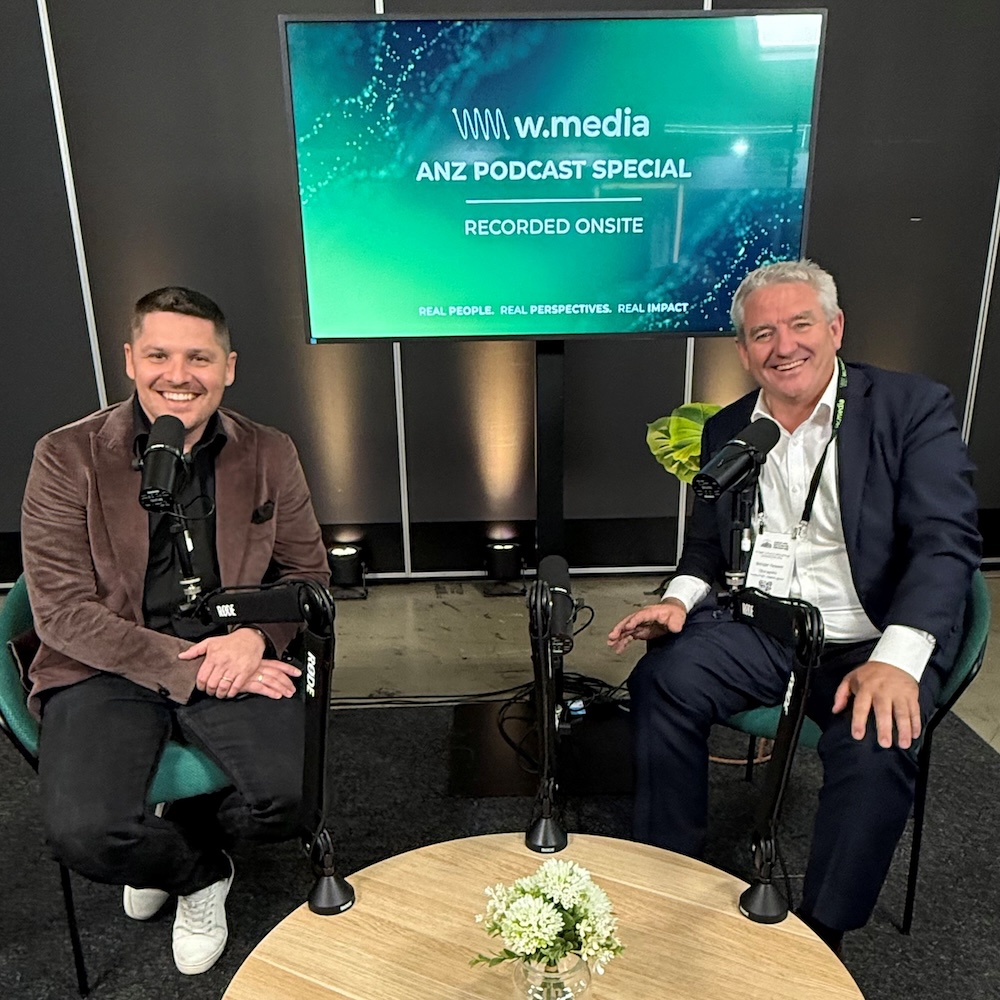
The rapid rise of AI is not only driving unprecedented demand for data centres. It is fundamentally changing how those facilities are designed. Legrand’s Head of Data Centre Solutions Brendan Dessent told W.Media that one of the biggest shifts underway is the gradual disappearance of the traditional divide between “grey space” and “white space” inside data centres.
What was once a clear separation between supporting infrastructure and IT equipment is becoming increasingly blurred as AI workloads push compute density to new levels. Historically, white space housed servers and racks, while grey space accommodated the electrical and mechanical infrastructure needed to support them. However, AI-driven deployments are bringing critical infrastructure closer to the rack itself.
Dessent explained that technologies such as rack-level UPS systems, rear-door cooling and closed-loop cooling solutions are moving equipment traditionally located outside the data hall directly into the white space. “The grey space is now not going to be a separate part of the data centre,” he said, describing a future where infrastructure becomes increasingly localised around high-density compute environments.
AI driving density
The trend is being accelerated by the extraordinary power demands of AI. While data centres have traditionally been designed around relatively modest rack densities, today’s AI environments are pushing rapidly toward 150kW racks, with designs for megawatt-scale racks already being discussed across the industry.
“As rack power climbs, operators can no longer rely on centralised support systems alone,” he said. “Cooling, power protection, and monitoring must become more targeted, more responsive, and physically closer to the equipment being supported.”
“This shift is forcing designers to rethink the data hall itself,” he emphasised.
In one recent example in Australia, electrical infrastructure inside the white space occupied almost the same physical footprint as the rack environment it was supporting, highlighting how support systems are increasingly becoming part of the compute environment rather than separate from it.
Monitoring becomes mission-critical
With more infrastructure being incorporated into the data hall, operational visibility is becoming increasingly important. As power densities rise and cooling systems become more localised, operators will require far more granular monitoring and management capabilities than in traditional data centre environments.
AI itself is also play a growing role in supporting data centre infrastructure management, as well as generating the reasons for its evolution. Rather than replacing jobs, AI is expected to help project teams handle growing workloads, enabling engineers, estimators, and project managers to manage larger and more complex projects more efficiently.
“There is plenty of work going around,” Dessent said, arguing that AI should be viewed as a capacity multiplier rather than a workforce replacement tool.
Security challenges emerge
The convergence of infrastructure and computing environments also introduces new security considerations. As mechanical and electrical systems move closer to sensitive computing environments, a larger proportion of maintenance and operations staff may require access to secure areas of facilities. For government and high-security sites, this can involve baseline security clearances and, in some cases, NV1-level security clearances.
The challenge is compounded by Australia’s ongoing shortage of skilled technical workers.
“As we know, we rely in this country a lot on people who aren’t Australian citizens to keep the wheels turning,” Dessent observed.
The data hall of the future
While debate continues about exactly how far densities can rise, there is broad agreement that AI is driving the industry towards a more integrated model. The future data hall is likely to feature localised power, localised cooling, and highly intelligent monitoring systems, all centred around the rack itself.
In that future, the rack becomes what Dessent described as “the centre of the universe”. Infrastructure will no longer sit around the compute environment. Instead, it will become an inseparable part of it.
If it can, data centres may prove to be more than digital infrastructure. They could become a catalyst for the revitalisation of regional Australia itself.
This article, the second of two, is based on a W.Media interview with Brendan Dessent at the Sydney Cloud & Datacenter Convention 2026 in September. Listen to the full podcast.