

The greatest boom in history involving trillions of dollars is set to continue despite the occasional speedbumps. Big Tech is making sure it does. w.media SEA Editor Jan Yong examines the evidence.
In recent days and months, things have ratcheted up very quickly in the AI investment world and investors are still grappling with both the frenetic speed and the increasingly jaw-dropping amounts pumped into the ecosystem.
The four mega hyperscalers alone (MAMA) – Microsoft, Alphabet, Meta and Amazon, have collectively signed leases exceeding US$1.5 trillion since the artificial intelligence boom started. This includes headline commitments that have yet to take effect.
The sheer size of the investment needed to keep the AI trajectory going is unprecedented and so extraordinary that questions since 2023 have been asked about when this supposed AI bubble would eventually pop.
But instead of winding down because the promised revenue has not kept up with capital expenditure so far, the parties in the ecosystem have continued to pump relentless (some say ‘obscene’) amounts of cash into the AI ‘black hole’ (where cash disappears and continuously requires larger amounts to keep the hole from imploding).
The amounts have reached such dizzying heights that even hyperscalers that were previously awash with cash now have to borrow to sustain the AI momentum. The Financial Times (FT) reported that since 2025, “hyperscalers have tapped the US$11.7 trillion US corporate debt market repeatedly, so much so that they have to begin raising debt in foreign currencies to broaden the investor pool.”
By 2030, tech companies are expected to pump between US$3 trillion – US$7 trillion globally into data centers. Sounds bubbly or is it just the natural capital draw of a technology that’s touted to have unlimited potential?

Circular game?
The bears have cited the so-called circular financing mechanism as evidence that demand is being ‘manufactured’ by Nvidia, the apex in the AI ecosystem. Without the chipmaker providing financing to an AI platform, say, OpenAI, which then commits to buy Oracle’s cloud capacity, which then buys AI chips from Nvidia, thus returning part of the initial investment back to Nvidia, the boom would arguably not have happened. Nvidia, as the GPU supplier to Oracle, is also the financier and investor of OpenAI, with its investment circling back to it. In other words, Nvidia’s investment helps create demand that eventually returns to Nvidia as revenue.
Proponents contend that even if it is truly circular financing, it would still be a legal mechanism to finance AI platforms which otherwise would not have been able to expand due to their inability to obtain financing from conventional sources like banks.
“One player has capital and has an interest, because they’re selling the chips, and the other player is pretty confident they’ll have the revenue at the right time, but they don’t have US$50 billion at hand. So I don’t think there’s anything inappropriate about that in principle,” Anthropic CEO Dario Amodei reportedly said.
Apart from Nvidia, Oracle and other infrastructure investors and lenders also contribute substantial capital. Hence ‘circular’ describes more the economic relationships rather than the literal movement of identical amounts of money.
But the fact remains, circular financing is the main fuel that’s driving the current AI boom. It’s not just Nvidia doing it; it’s happening across the entire AI ecosystem. It’s happening because there is a strong (some might say irrational) expectation that there will be extraordinary profit from AI investment.
At some point however, when the gap between revenue and investment is too enormous to ignore, when revenue cannot catch up with the vast infrastructure commitments, the domino might fall.
‘Extraordinary’ risks
The utilisation rate of new GPU capacity keeps rising as more and more new AI data center buildouts are announced across the globe.
At the same time, several risks have already been flagged by various parties. Among them are technical obsolescence, the global backlash against data centers, and much cheaper China AI models. Each of them poses serious threats to the current setup.
Technical obsolescence is an ongoing risk – Whereas billion-dollar AI data centers are built to last at least 10 years, the chips they support last only 2-3 years (some say 1-2 years) before the next generation of chip emerges, thanks to Nvidia and other chipmakers. This means data centers and chips will not retain their value during the lifetime of the financing. The shortage of AI and memory chips, and existence of a robust second-hand chip market, do not diminish this risk.
The global backlash is spreading like wildfire. More and more communities are pushing back against data centers citing huge power and water consumption. And more and more governments are listening, the latest being Thailand which recently paused the construction of 49 data centers pending the tightening of data center rules.
In America, some large projects have been cancelled due to local opposition and lawsuits while several states such as New York have implemented moratoriums on the development of new hyperscale data centers.
China is also narrowing the gap in the AI race with the US. Recent news that DeepSeek plans to deploy at least 160,000 Huawei Ascend 950DT accelerators at a large new data center in Inner Mongolia, should worry investors. Ascend 950DT is Huawei’s next generation AI accelerator and is expected to launch in Q4 2026. If China can come up with AI models that equal or even in some metrics surpass the top frontier American models at a fraction of the cost, then all those billions poured into developing American frontier models could be money down the drain.
There is also the risk of overconcentration of exposure to certain sites or huge projects such as Stargate. Permitting delays, changing local regulations and political uncertainties add to the risks.
AI chips are now considered an “investable asset class” of its own where loans are secured using AI chips (or rather the GPU-backed AI compute infrastructure and the cash flow it generates), as collateral. This was unthinkable last year! Examples include CoreWeave’s US$ 2.3 billion debt facility which is backed by Nvidia AI chips and contracted neocloud compute deployments, and Lambda’s US$ 500 million loan secured by GPU infrastructure and cash flows.
More notably, in August 2026, Nvidia partnered with six Wall Street finance powerhouses – BlackRock, Blackstone, Apollo Global, KKR, Brookfield and Goldman Sachs – to establish independent compute financing platforms to mobilize over US$ 500 billion of third party capital for AI infrastructure buildout. The collateral is Nvidia’s compute which was described as a ‘critical infrastructure asset’.
Exposure angst
As a result, lenders are starting to reduce their exposure and those that have already committed are looking for ways to offload the risks. But this is not easy given the many risks that are coming to the fore.
Typically, insurers step in to underwrite the risks. But this being such a ‘novel asset class’, insurers are hesitating to underwrite billions of dollars of coverage citing the usual risks namely technical obsolescence, revenue not catching up with heavy investment, and the China factor.
Hence, lenders and developers are resorting to other avenues to shift their exposures. Several financing structures have been explored such as special-purpose vehicles (SPVs) which keep the projects off the balance sheets of tech firms and shift the risk to external investors; credit guarantees by triple-A companies such as major hyperscalers, corporate bonds and initial public offerings where the risks are shared with pension funds, insurers and retail investors. Essentially, the idea is to share the exposure with a wider pool of investors.
As long as the conviction is still strong that AI can massively increase productivity and hence profit, the money will continue to pour in. The trick is to keep this belief alive for as long as it takes – OpenAI’s Sam Altman is the poster boy for promoting AI’s potential, at least until artificial general intelligence (AGI) or Superintelligence is achieved, or unlikely as it is, until revenue actually justifies the massive investment.
To be sure, there are speedbumps along the way. FT reports there’s less interest in corporate bond sales to finance data centers in recent times. Some investors are getting sceptical of the long-term demand for AI compute. “We don’t know what this data center is going to be worth in 10 years’ time” is an oft-quoted sentiment expressed by some investors.
Also, many lenders are asking for their loans to be fully repaid before the underlying lease ends. Loans typically run longer than the initial lease. Once the lease ends, the borrower would have to get new tenants to fund the repayment.
The best possible insurance perhaps lies within the four corners of the financing contract. A ‘get-out’ clause if certain conditions are not met or things fall through, together with ensuring all the requirements like permits, equipment and labour are obtained before the contracts are signed, could well alleviate lenders’ angst.

Data-based crystal ball
For now though, Big Tech is reportedly moving ahead with US$ 3 trillion potential spend on data centers without full insurance coverage, exposing themselves to billions of dollars of potential damages in the event of a catastrophe, grid outage or lawsuit.
Why have they thrown caution to the wind? Because the narrative now is too compelling. Too much is at stake if the boom is to pop. It’s a once-in-a-generation opportunity.
Recent reports suggest the AI boom is marching along just fine despite an analyst’s dire prediction that AI computing capacity will outstrip demand after 2029. At the other end, statistics showed semiconductor-equipment spending, an indicator of the AI investment cycle, has just hit another record. Worldwide semiconductor-manufacturing equipment billings reached US$ 40.53 billion in Q2 2026, up 23 per cent year-on-year, according to industry association SEMI.
Furthermore, Nvidia is still making strategic investments across the AI and semiconductor ecosystems. The worst case scenario for the chipmaker is a reduced share of the accelerator market when competitors catch up.
Meanwhile, neoclouds are increasingly combining long-term compute contracts, vendor relationships, leases and external financing to maximize growth.
Based on committed financing and pipeline projects, the momentum is still considerable for data center buildout over the next six to 12 months. There is real demand amid massive digitalisation and strong AI push globally.
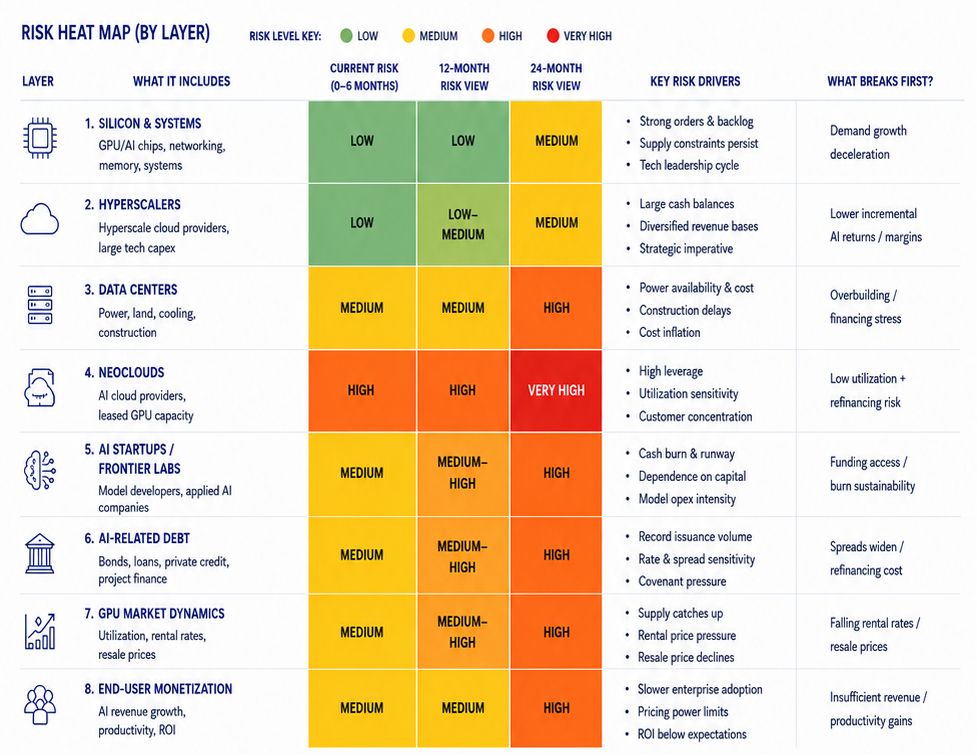
If AI demand or financing softens, what’s likely to happen is that strong hyperscalers and top facilities will continue expanding while highly leveraged neoclouds and speculative projects will struggle. Private credit, special-purpose vehicles or data center bonds will take the first hit but there likely won’t be a massive equity crash.
But if there is, just like the telecom/fiber boom of the 1990s and the internet boom of the noughties, AI technology will survive but the highly leveraged entities will not.
*This article first appeared in Issue 14: cloud & datacenters magazine.