
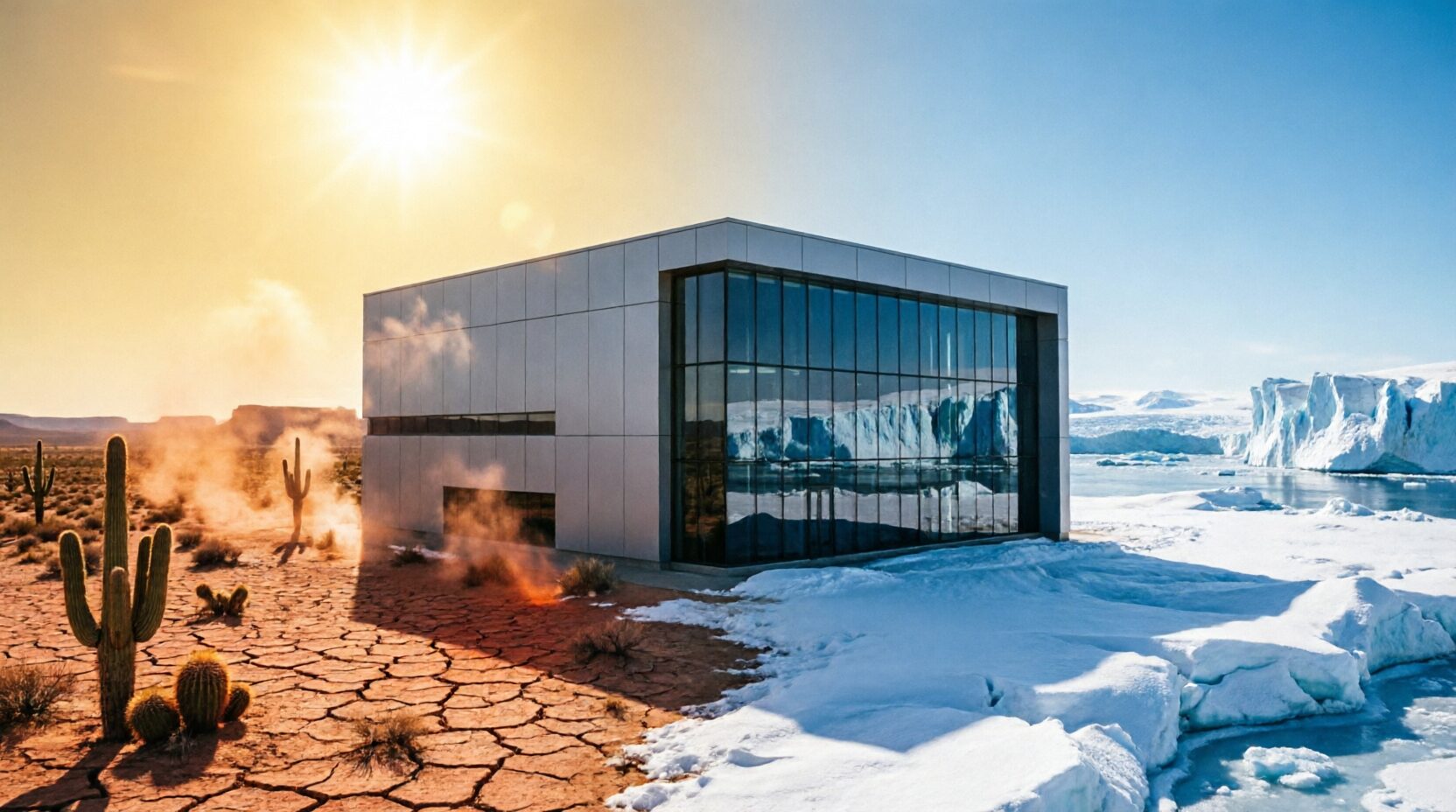
Liquid cooling is fast becoming the default for AI-dense data centers. But what happens when your facility sits in one of the hottest regions on earth, where ambient temperatures offer no relief and water is scarce?
In this piece, technology leaders and data center operators across the Middle East, South Asia, and Southeast Asia share how they choose their cooling mix and navigate the tradeoffs.
Designing for heat: How local climate shapes the cooling mix
“In the Middle East, ambient temperatures, humidity patterns, and water availability are critical design parameters. We adopt a climate-responsive approach, optimizing for high dry-bulb temperatures while minimizing water dependency wherever possible,” says Himmath Mohammad, Chief Information Officer, Gulf Data Hub (GDH), illustrating how climate and geography shape the cooling mix for data centers.

He highlights three core inputs: IT load density profile, climatic conditions, and long-term scalability. Therefore, he says his organization’s thought process includes:
- Forecasting rack density evolution (particularly AI-driven high-density workloads)
- Evaluating air-cooled versus hybrid or liquid-cooled architectures
- Designing for modular scalability without stranded capacity
- Balancing PUE improvement against lifecycle cost and operational resilience
“Ultimately, cooling is not selected as a standalone system, it is integrated into the overall energy, sustainability, and uptime strategy of the facility,” he elaborates. The UAE-based GDH is also expanding its footprint across North Africa, with plans to build a data center complex in Egypt.
Next door in Saudi Arabia, DataVolt’s upcoming facility in NEOM is also making the most of available natural resources, especially seawater.
“DataVolt’s AI factory site in NEOM is designed to use innovative seawater cooling. Seawater provides 100 percent of the heat rejection,” says Somen Mathur, VP, Engineering & Design, DataVolt. “Under full (100 percent) AI data center load, the 70 percent liquid-cooled portion is rejected directly to seawater through a plate heat exchanger (PHE), while the remaining 30 percent air-cooled portion is served by water-cooled chillers, with condenser heat ultimately rejected to seawater,” he explains.

In South Asia, tropical conditions prevail across key markets including Mumbai, Chennai, Hyderabad, Pune, and Delhi NCR. Nxtra, the data center arm of Airtel, a homegrown telecommunications major, has built its data centers keeping ground realities in mind.
“In a country like India where the weather can be extreme, we must think and move beyond ‘keeping things cool’. In the AI environment, sustainability in India is a conscious choice that is necessary to efficiently handle heat and humidity. There are multiple geographical studies done even before site selection to determine feasibility of data centers from a network, power and cooling perspective as well,” explains Ashish Arora, Chief Executive Officer, Nxtra by Airtel.
“We believe that cooling should be a foundational design, and not an afterthought. For this reason, our hyperscale data centers are modularly designed from the ground up to seamlessly support air, liquid, direct-to-chip and immersion cooling techniques across any floor/ section, providing our customers with the flexibility to choose precisely what is right for them,” he says shedding light on Nxtra’s thought process.

In Southeast Asia, most data center markets sit in tropical regions close to the Equator, contending with persistent heat and humidity. “The primary challenge in markets like Singapore and Indonesia is the high ambient humidity, which limits the effectiveness of traditional free cooling methods, meaning we cannot simply pull in outside air to cool the facility. This forces us to be far more innovative with our internal mechanical chilling and heat rejection cycles to maintain optimal conditions at the rack,” says Ng See Kian, Senior Director, Mechanical Engineering, ST Telemedia Global Data Centres. “We must maintain a delicate balance between keeping the air cool enough while ensuring that moisture does not trend too high or too low to damage sensitive electronics.”
As far as the thought process goes, he says, “Our starting point is that we are no longer just cooling data halls and racks, but the silicon itself. As such, we evaluate our cooling strategy based on the specific power densities of the IT workloads we host,” adding, “While traditional air cooling remains highly effective for many cloud and enterprise workloads, the 30kW to 250kW densities required by AI and high-performance computing require that we also deploy advanced liquid-based solutions where necessary.”
He continues, “To that effect, we adopt a design philosophy that is both modular and flexible. Instead of forcing a choice between air or liquid, we build data halls that support both technologies simultaneously, ensuring we can host a client’s legacy stack while also able to scale the appropriate cooling solutions needed for next-generation GPU clusters. The fundamental ingredient is ensuring we have facility water at the perimeter of every data hall, which affords tremendous flexibility to accommodate air-based cooling (using CRAHs and/or fan walls) or liquid cooling (using CDUs).”
The tradeoffs: Water, cost, complexity, and speed
GDH’s Himmath Mohammad identifies four key tradeoffs:
- Water vs. Energy Efficiency
“Evaporative cooling offers strong energy performance but increases water consumption, which is an important consideration in arid regions like the UAE,” he explains. - CapEx vs. Future Density Readiness
“Over-designing for ultra-high density increases upfront capital cost, while under-designing risks expensive retrofits later. The balance lies in phased, modular deployment,” he says. - Complexity vs. Reliability
He points out, “Advanced cooling technologies can improve efficiency but introduce operational complexity. Simplicity often enhances uptime, which remains the ultimate priority.” - Sustainability vs. Speed to Market
“AI demand is accelerating timelines. However, sustainability targets cannot be compromised for speed. We ensure that rapid deployment does not undermine long-term ESG goals,” he explains.

Meanwhile, DataVolt’s Somen Mathur says, “Some of the key cooling tradeoffs we are carefully considering include the capital cost of seawater infrastructure, long-term biofouling control in seawater piping and equipment, and material durability in corrosive marine environments. These factors significantly influence our approach to future projects, pushing us to optimize system configurations, select corrosion-resistant materials, and incorporate maintainable biofouling mitigation strategies to ensure long-term reliability and cost-effectiveness.”
In India, sustainability is the key consideration. “When we plan our cooling strategy, the primary tradeoff is balancing maximum efficiency with environmental responsibility. Keeping the consequences of global warming in mind, we must construct facilities that remain resilient even as outside temperatures rise,” says Nxtra by Airtel’s Ashish Arora. “Even Original Equipment Manufacturers (OEMs) today recommend optimizing our internal environments in accordance with the ASHRAE standards that recommend having a maximum set-point temperature of 26–27 °C. Also, the decision to follow cold aisle containment vs hot aisle containment is another choice that weighs impact, costs and convenience.”
Arora also delves into other considerations. “Another critical trade-off involves resource scarcity. Utilizing liquid-cooling methods would require additional resources, higher costs, and increased maintenance, and may not be the most sustainable choice in water-stressed regions. We manage this by conducting water-stress analysis during site selection and aiming for zero liquid discharge,” he says. “We have built future-ready infrastructure equipped with a cooling mix that allows us to pivot between air and liquid cooling based on both the environment and the customer’s requirements. That way, we ensure that the best cooling mix (air + liquid) is considered for the respective servers to ensure optimum utilization and useful life as well as minimize resource consumption.”
STT GDC’s Ng See Kian raises similar concerns around sustainability, power, and water consumption. “One of the most critical balances we manage is the relationship between water and energy consumption. In water-stressed regions, we often face a choice between evaporative cooling, which offers lower PUE but higher water use, versus dry cooling, which preserves water but can increase energy demand. We are increasingly pivoting toward air-cooled chiller plants and closed-loop systems for new data centers to achieve high efficiency without taxing local freshwater resources,” he says.
Much like his contemporaries in other geographies, he also acknowledges the tradeoff between complexity and operational resilience. “Liquid-to-chip cooling offers superior heat rejection but introduces more installation cost and complexity in maintenance. This has fundamentally influenced our building blueprints. Our AI-ready facilities now support higher-density racks and advanced cooling technologies such as immersion and direct-to-chip solutions, powering training and inference workloads while maintaining peak efficiency,” he says.

What comes next
As AI continues to develop into a formidable gamechanger for the digital infrastructure industry, and billion-dollar investments continue to pour into these regions, it is clear that the data center cooling mix will have to evolve across all these markets. Despite the ambient disadvantage, South Asia, Southeast Asia, and the Middle East must accelerate adoption of liquid cooling and hybrid options if they are to evolve into global AI hubs.
Himmath Mohammad sums it up best when he says, “The future of cooling is not about a single technology winning; it is about designing flexible, adaptive infrastructure that can evolve with workload demands, while maintaining sustainability and resilience.”
*** This article originally appeared on Issue 12 of w.media’s Cloud & Datacenters magazine and may be read on pages 12-13-14 here.