
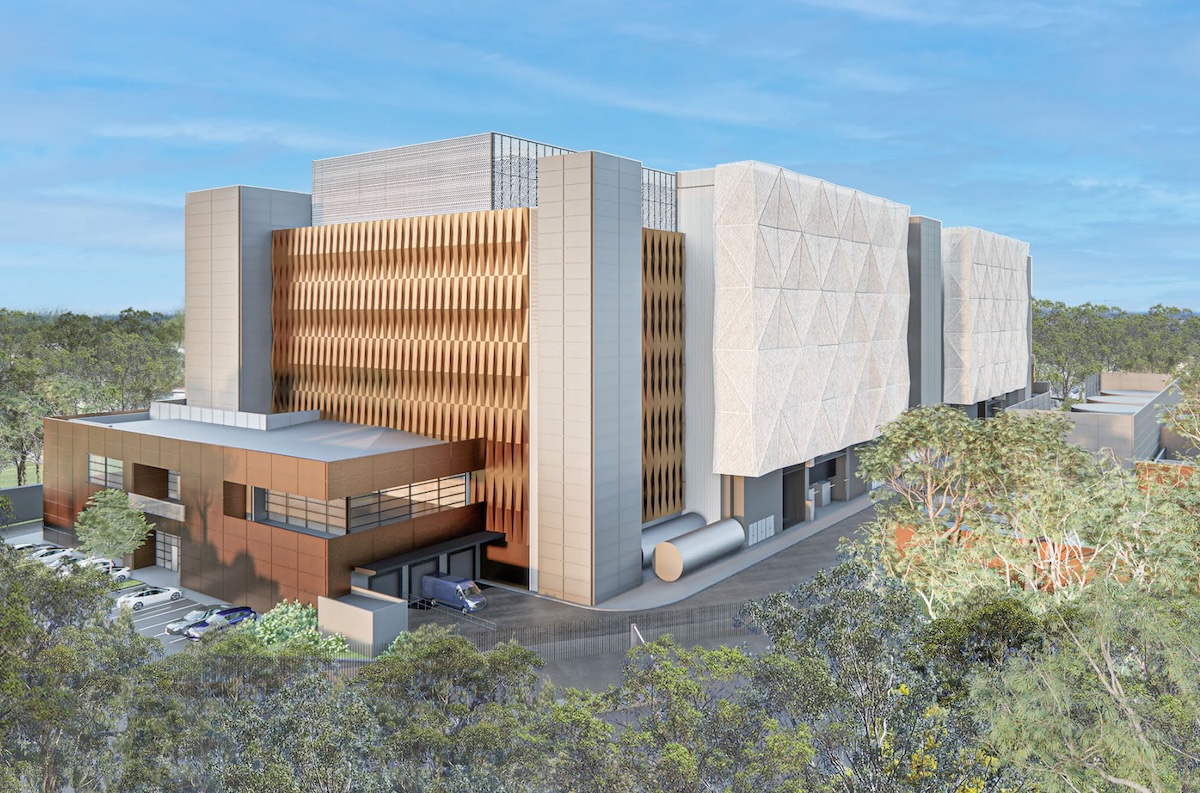
Microsoft has secured NSW planning approval for a 96MW data centre in Sydney’s west, following a prolonged assessment that included objections from Blacktown City Council over the project’s impact on a protected conservation area. The AU$1.263bn Honeman Close Data Centre in Huntingwood will comprise a five-storey, 43.25-metre-high facility with 40 data halls and 39,267sqm of gross floor area.
It will have an IT load of 96MW and a total power demand of 140MVA, operating around the clock. The facility is expected to consume approximately 3.9 megalitres of water per day and has a projected PUE of 1.28. The development will also include 46 diesel backup generators, lithium-ion battery systems and diesel storage. The approved design provides for up to 158,763kg of lithium-ion batteries and 1.532 million litres of diesel storage.
The NSW consent caps total site power consumption at 140MW and generator capacity at 133.4MW. Backup generators, other than during unplanned power outages, will be limited to 187 hours of operation per year, while no more than one generator can be tested at a time. Diesel storage at the site is capped at 2,000 tonnes at any one time.
The consent also explicitly prevents the generators from being used to generate electricity for the National Electricity Market, support load curtailment at the site or operate during planned power outages.
Biodiversity dispute
Biodiversity was one of the central issues during the assessment. The project will remove approximately 0.33 hectares of native vegetation, including 0.31ha of critically endangered Cumberland Plain Woodland, and reduce an existing conservation area from approximately 1.11ha to 0.78ha. The area also contains potential habitat for the threatened Swift Parrot.
Blacktown City Council initially objected to the proposal, principally over the reduction in the conservation area, as well as concerns about the project’s bulk, scale, visual presentation and landscaping.
However, the NSW Department of Planning, Housing and Infrastructure’s (DPHI) final assessment says the applicant subsequently refined the building design and landscaping, updated its biodiversity assessment and mitigation measures, and added measures to address noise and air quality.
Following further consultation, Council withdrew its objection, subject to biodiversity management measures and conditions consistent with those imposed under an earlier development consent for the site.
The final consent requires Microsoft to purchase and retire 11 ecosystem credits and 24 species credits (or pay the equivalent into the Biodiversity Conservation Fund) before vegetation clearing or construction can begin.
The remaining 0.78ha conservation area must also be protected in perpetuity through a public positive covenant to be registered on the site’s title. The consent requires the existing Vegetation Management Plan to be implemented across the conservation area and requires the 10-metre landscape buffer adjoining Honeman Close to be maintained as a deep-soil zone.
The Department concluded that the retained conservation area would remain functional and that the project would not result in a serious and irreversible impact on Cumberland Plain Woodland or the Swift Parrot.
Emissions
Greenhouse gas emissions were the only issue raised in the single public submission. The Department’s notice of decision says the development would generate 1,326 kilotonnes of CO2-equivalent in its first year of operation, mostly Scope 2 emissions from electricity consumption.
Before operation can begin, the consent requires Microsoft to demonstrate that all operational electricity demand is matched at all times by additional, firmed renewable supply. It must also have entered power purchase and firming agreements for NSW-based supply within the National Electricity Market. Microsoft has committed to sourcing 100% of the facility’s electricity from renewables by 2030.
Extensive operating conditions
The approval comes with a broad range of environmental monitoring and management requirements. These include noise verification monitoring, ambient air monitoring, annual emissions testing, an Air Quality Management Plan, ongoing biodiversity management, landscaping controls and monitoring and reporting of energy use, water consumption and greenhouse gas emissions.
Within three months of full operation, Microsoft must undertake noise verification covering both normal operation and backup generator testing, with the results submitted to the Planning Secretary.
The Department said the project would provide additional digital infrastructure capacity in Greater Sydney while making productive use of industrial-zoned land in the Western Sydney Employment Area. It estimates the project will generate up to 250 full-time-equivalent construction jobs and 74 operational jobs, alongside the AU$1.26bn capital investment.
The consent is valid for five years unless physical development has commenced before it lapses.
The NSW approval does not, however, represent the end of the project’s regulatory process. Microsoft’s Huntingwood data centre is also being assessed under the federal Environment Protection and Biodiversity Conservation Act.
The separate federal process covers the proposed SYD01 facility at 6 Honeman Close and its potential impacts on nationally protected threatened species and ecological communities. Public consultation on preliminary documentation closed in September.