
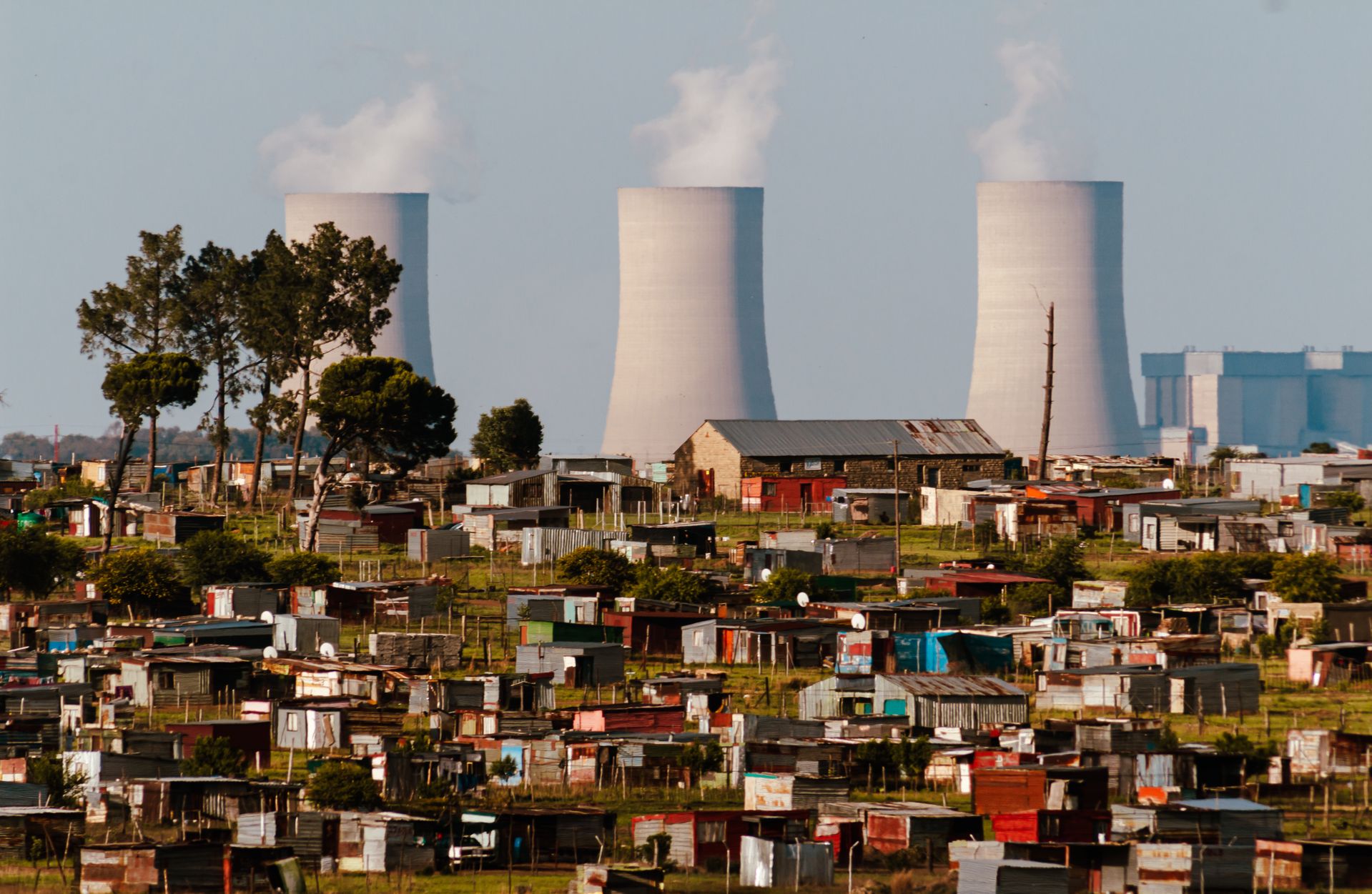
All across the African continent there is buzz about digital transformation. Government leaders will often toss the phrase into their speeches in an effort to look forward-thinking but over the last decade there has been a growing interest in turning those words into action. The trouble is that after decades of neglect African nations now face a power problem. Where some regions of the world are running out of power, more than 600 million people of Africa’s 1.5 billion population, have never had power to begin with.
That constraint has led to an evolution of energy policy from Cape Town to Cairo and everywhere in between. Across the continent governments are dismantling the monopolies that governed their power sectors for decades and open generation, and increasingly transmission, to private developers. The upshot is that these efforts have caught the attention of investors, big tech companies, and most importantly for the future of the continent, data center operators.

South Africa: The mature market that ran out of power
South Africa struggled with rolling blackouts, called loadshedding, for many decades. State-sanctioned power cuts were implemented in order to prevent the national grid from overloading. By 2020, national utility Eskom was in disarray, rocked by scandal after scandal that made it near impossible for the utility to function. As a result, the government was almost forced to take action and open up the electricity market.
In 2020 the licensing threshold for embedded generation was raised from 1 MW to 100 MW and wheeling was permitted giving businesses a lifeline. The next year the cap was removed entirely, leaving only a National Energy Regulator of South Africa (NERSA) registration requirement for operators to navigate. The Electricity Regulation Amendment Act 38 of 2024 went even further, ending the rule that IPPs sell only to Eskom, recognizing wheeling, and creating a central purchasing agency.
Where data center projects were left sipping power off of a fragile grid, these projects can now invest in their own power generation and wheel it via the national grid to their operations.
Teraco, a Digital Realty company, leaned on these capabilities in 2024, when it announced construction of a solar photovoltaic plant in the Free State, to power its operations in other parts of the country. The power plant is expected to come online sometime this year and deliver 120 MW of solar power.
“Teraco’s approach is to complement the grid by investing in its own utility-scale solar project and contracting additional renewable capacity through wind Power Purchase Agreements (PPAs). Investing in renewable generation and entering into long-term power purchase agreements brings additional renewable capacity onto the South African grid while providing greater long-term certainty around our energy supply,” says Bryce Allan, Teraco Head of Sustainability.
However, the problem the country faces now is grid capacity.
“The primary constraint is not linked to generation capacity itself, as South Africa currently has a generation surplus of between 3GW to 6GW. The main constraint facing the industry relates to connecting and unlocking new renewable energy capacity through grid access and frictionless wheeling to enable the data centre industry to meet near-term ambitions for 100 percent renewable energy,” added Allan.
The newly formed National Transmission Company South Africa, a spin-off from Eskom, is tasked with expanding the grid by 14,494 km by 2034 in order to allow fresh power generation, especially from renewable sources, to be added to the grid so it can be delivered where it is needed.
Due in part to reforms, investment in data centers in the country has been reinvigorated. The South African data center market was valued at US$ 2.55 billion and is expected to more than double to US$ 5.28 billion by 2031. As the energy market evolves and grid capacity comes online, this figure will surely rise.
Kenya: The grid that broke the deal
If South Africa’s strained grid threatens potential build-outs, Kenya’s grid is breaking those plans outright. The Microsoft G42 campus at Olkaria was billed as the country’s largest-ever digital investment, drawing 100 MW rising to 1 GW.
Then came the realisation that this may not actually be possible.
“To switch on that one data centre, we would need to shut off power for half the country,” President of Kenya, William Ruto said per iAfrica. Following these concerns the country has hit pause on the project.
The irony here is that Kenya’s energy mix is among the world’s cleanest, with between 85 and 90 percent of the country’s power coming from geothermal, hydro, wind, and solar sources. This is tantalizing to investors pursuing sustainable data center developments. By 2025 the data center market in Kenya was worth US$ 266 million and was expected to be worth US$ 805 million by 2031 with power capacity growing to 240 MW by 2031. The trouble is that there simply isn’t enough power to go around right now.
This is because in 2021, Kenya put a yoke around the neck of its power sector and froze all power purchase agreements (PPAs) with independent power producers (IPPs). Granted, the freeze was implemented for good reason as IPPs were bleeding the energy sector. In 2022, despite producing just 37 percent of purchased power, IPPs walked off with 59 percent of the funds made from power sales. The state meanwhile walked off with 41 percent of the funds for the 63 percent of power it produced.
Eventually the National Assembly lifted the freeze on PPAs and added new guardrails. The country introduced competitive auctions, capped new wholesale prices at US$ 0.07 per kWh,
and mandated disclosure of IPP ownership in a bid to address the ailing power grid and stoke investment. Ruto aims to increase national power capacity to 10,000 MW by 2030 and needs about US$ 38 billion to do so.
Despite the Microsoft stall, the country has a thriving data center market with players including Safaricom, Oracle, iColo and Liquid Intelligent Technologies. There is growing interest in the market thanks in large part to the regulatory reforms and signs of an improving electricity sector.
Oracle launched its first Oracle Cloud Infrastructure (OCI) region with iXAfrica at 22MW campus in Nairobi Kenya in January 2026 made possible, in part, by reforms in the energy sector.
“We are delighted to be in execution mode to bring OCI to Kenya,” said Snehar Shah, CEO, iXAfrica. “With this collaboration, iXAfrica is leveraging the renewable energy, talent, and abundant submarine and national connectivity available in our market.”
Nigeria: Building around the grid
Nigeria is unique in that most if not all data center projects need to be accompanied by a power supply project given the instability of Nigeria’s grid. The country is working to improve that though.
By December 2025, Nigeria’s Minister of Power, Adebayo Adelabu said that the country had added 1,000 MW to its generation capacity. The minister also announced that transmission resilience was being built to support more capacity through the multi-phase Presidential Power Initiative.
“Nigeria’s transmission capacity has grown from 5,000 megawatts to about 8,500 megawatts, and we are currently transmitting only around 6,000 megawatts,” Adelabu said.
The magnetic force attracting investment in Nigeria is geography and demand, not cheap power. The city of Lagos accounts for over 85 percent of planned capacity in the country, thanks to the presence of subsea cables including Google’s Equiano and Meta’s 2Africa.
This has led to several investments from the likes of Kasi Cloud, which is building a US$ 250 million hyperscale campus in Lekki, and Equinix, which has committed US$ 22 million to a data center expansion. Equinix says all of its Nigerian facilities are covered by 100 percent renewable energy.
By late 2024, 66 MW of third-party data center capacity was available with more than 320 MW planned or under construction, a near-fivefold expansion, with an investment figure estimated above US$ 1.7 billion by 2027.
“As Lagos emerges at the crossroads of talent, innovation, and global connectivity, this facility is accelerating access to technologies like cloud, AI, and the next wave of startups. We’re not just building data centers, we’re fostering growth, empowering innovation, and laying the groundwork for an interconnected African economy ready to lead on the global stage,” Wole Abu, Managing Director for West Africa at Equinix said in 2025.
The Nigeria data center market was valued at USD 288 million in 2025 and is forecast to reach USD 1.09 billion by 2031 with around 200 MW of new power capacity expected over the period.
Egypt: The dream destination
Egypt is the fastest-growing of the four markets. Its data center market was valued at US$ 305 million in 2025 and is projected to hit US$ 865 million by 2031, a CAGR of 18.97 percent, with roughly 254 MW of power capacity expected to be added between 2026 and 2031. It is also one of the more forward-thinking markets as regards electricity provision.
The Electricity Law 87 of 2015 liberated the sector, mandated third-party grid access, and created a separate independent system operator. This led to the nation going from a 6,000 MW daily deficit in 2014 to a 13,000 MW surplus by 2020.
Combined with its geographic proximity to Europe and the Middle East, as well as the 19 subsea cables, and government support, the market has become a premier destination for data center operators
“Data centers are an essential pillar to promote digital sovereignty. We aim to expand the export of digital services globally,” Minister of Communications and IT in Egypt, Raafat Hindy said in June.
And investors are taking note. Over just two years, the country’s National Telecommunications Regulatory Authority has issued 10 data center operator licenses. The most recent of which was granted to Hassam Allam Digital which plans to spend US$ 400 million building a data center in Egypt.
“We are building a platform designed to meet future digital needs, attract high-value investments, and contribute to positioning Egypt as a leading regional hub for technology, innovation, and digital services,” said Mohamed Magdy Allam, Hassan Allam Digital Infrastructure Managing Director.

There is still much work to be done across Africa’s 54 nations. Not even the markets above are perfect and they are further along the path to reform than most.
There are other problems across the continent including water for cooling AI data centers, a skills shortage, and the cost of importing materials and then getting them to sites. These problems can’t be ignored as they threaten the very buildouts that are waiting to break ground. These are problems that can be solved, so long as governments recognize that those solutions can, and should, include the private sector. The evolution of the power sectors in South Africa, Kenya, Nigeria, and Egypt stand as evidence of that, and other nations would do well to learn from their experience.