
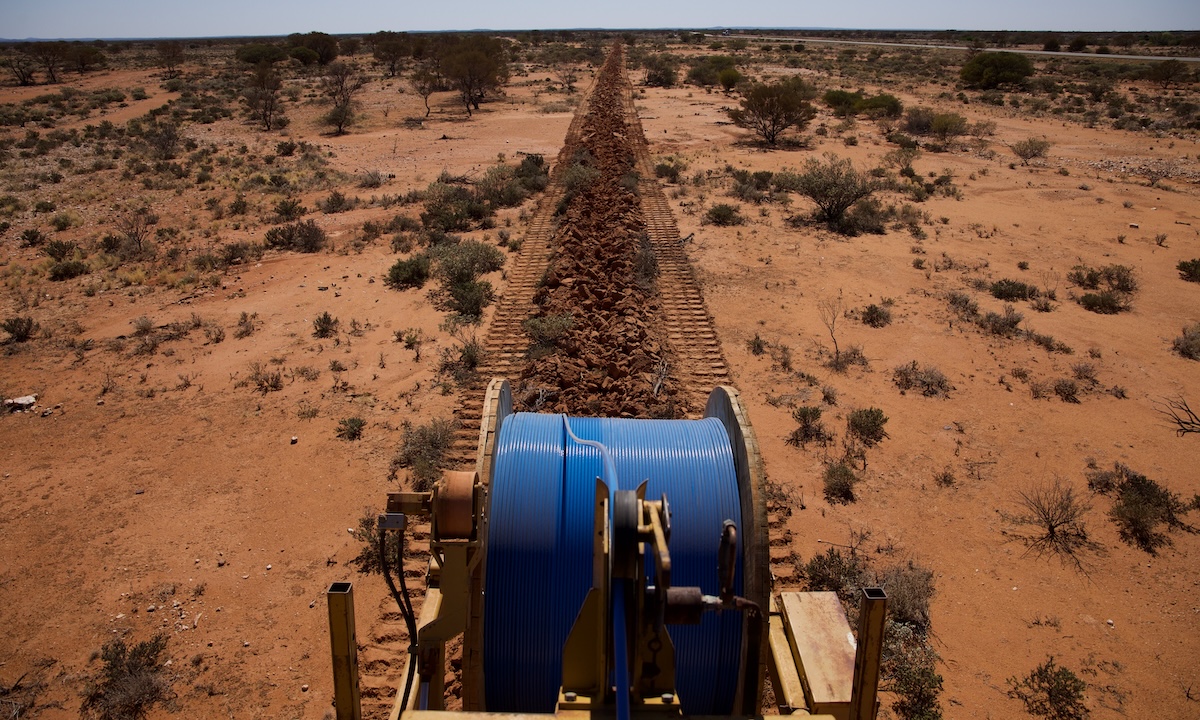
Vocus has announced plans to build what it says is Australia’s first ducted long-haul fibre route between Sydney and Melbourne, launching a new Australian Digital Infrastructure Platform (ADIP) initiative that it adds is designed to address surging AI-driven demand for terrestrial fibre capacity. The new route will require an investment of approximately AUD 500 million, create more than 1,000 jobs, and is scheduled to enter service in 2029. Vocus said the network will be capable of accommodating up to 6,912 fibre cores (3,456 fibre pairs), providing significantly greater long-term scalability than conventional long-haul fibre deployments.
Vocus estimates that by 2030, data centre capacity will triple, with AI workloads expected to account for between 85 and 95 percent of long-haul fibre demand and 70 to 80 percent of metro fibre demand. The company also warned that the Sydney-Melbourne corridor, which carries around 40 percent of Australia’s long-haul data traffic, risks becoming capacity constrained without further investment.
“The AI era runs on high-capacity, diverse fibre networks, the critical arteries that power digital infrastructure ecosystems,” said Vocus chief executive Andrés Irlando. “Australia, like many countries in the world, currently lacks sufficient terrestrial and subsea networks to enable existing and future AI workloads. Vocus – through ADIP – will address skyrocketing customer demand for high-capacity, sovereign fibre networks built to global standards.”
Ducted design targets long-term AI growth
Unlike traditional Australian inter-capital fibre routes, the Sydney-Melbourne project will be constructed using ducted infrastructure, an approach widely adopted by hyperscale cloud providers in North America and Europe but not previously deployed on an Australian long-haul route.
According to Vocus, the design allows additional fibre cables to be installed in future without undertaking new civil works or disrupting live customer services. Chief technology officer Nikos Katinakis said the higher upfront construction cost would deliver greater long-term flexibility and resilience.
“Ducted long-haul fibre networks are more demanding and costly to build but will allow us to add capacity in the future without breaking ground again or interfering with customers’ active networks,” he said. “The approach also offers greater resilience and protection against cable cuts to improve customers’ uptime and service levels.”
The Sydney-Melbourne build forms the first project under ADIP, a multi-year programme that Vocus said will include thousands of kilometres of new fibre routes, thousands of additional fibre pairs and hundreds of terabits of new capacity designed to support Australia’s growing AI infrastructure requirements.
Building a national AI connectivity platform
The announcement follows the completion earlier this month of Vocus’s 2,000km Horizon fibre network linking Perth and Port Hedland through Western Australia’s Mid West and Pilbara regions.
Horizon provides the Pilbara with a second long-haul fibre route and direct connectivity into Asia for the first time, while connecting directly into NEXTDC’s new edge data centres in Newman and Port Hedland to support AI, cloud and industrial automation workloads.
“Automation, remote operations and data-intensive processing are already running across this region and they are growing quickly,” said Vocus chief customer officer Matt Walsh when Horizon was commissioned. “We’ve put the capacity the region needs in five years in the ground today.”
The operator said ADIP is intended to complement future demand for data centres, cloud platforms and hyperscale AI deployments, while also supporting critical national infrastructure, including banking, healthcare, education and emergency communications.
Backed by infrastructure investors Macquarie Asset Management and Aware Super, Vocus said the initiative is intended to help close what it sees as Australia’s widening digital infrastructure gap as AI workloads drive unprecedented demand for high-capacity terrestrial and subsea connectivity.