
Indonesia is projected to experience a 1 GW shortfall of capacity by 2030 accompanied by a critical undersupply of Tier 3/4 data centers. This indicates ample room for growth in Southeast Asia’s largest economy, according to Mordor Intelligence. Live inventory in Indonesia currently stands at about 1.44 GW with over 70 per cent occupancy.
The supply crunch is particularly acute for Tier 4 facilities where only fewer than five facilities exist nationwide. Tier 3 facilities dominate 94 per cent of the Indonesian data center market share in 2025 and this is expected to continue well into the next few years. Tier 3 is 35 per cent cheaper than Tier 4, adheres to compliance requirements and offers reliable uptime for 90 per cent of enterprise workloads.
This also means that the upward pricing trajectory of Indonesia data center market will continue until at least 2028 when large brownfield conversions in Bekasi are due to come online, Mordor states in a recent report. A good example of a data center holding both Uptime Tier III and Tier IV certifications is NeutraDC’s Cikarang complex.
Exponential growth to close the gap is however hampered by land constraints in Jakarta and up to 30-month grid-interconnect queues. Some developers have worked around the constraints by building multi-storey, high-powered density designs that reach 3.2 kW per square meter. Examples include EdgeConneX’s 200 MW pipeline and STT GDC’s 24 MW Jakarta-2 build. Although Tier 3 is becoming the standard data center architecture, Tier 1-2 data centers still exist in edge deployments in Balikpapan and Yogyakarta, according to Mordor.
Growth trajectory
The Indonesian market is expected to grow from 1.44 GW in 2025 to 3.56 GW by 2030 at a CAGR of 19.89 per cent. In terms of value, the market is forecast to grow at a CAGR of 13.71 per cent from USD 1.83 billion in 2026 to reach USD 3.48 billion by 2031, figures from Mordor state.
Main drivers include rapid hyperscaler roll-outs, tax exemptions that allow 100 per cent foreign ownership in Special Economic Zones, and a sharp increase in digital consumption among 280 million residents.
Jakarta still dominates deployment due to its dense fiber network and submarine cable landing points. Batam island’s 25 ms round-trip latency to Singapore’s central business district makes it an attractive redundancy site.
Most deployments are colocation facilities although more hyperscalers are preferring to own their own facilities and localize their platforms to comply with strict data-residency laws. AWS, Google Cloud, and Microsoft have each activated or announced multi-AZ regions.
Hyperscalers’ strict renewable-energy procurement policies are accelerating long-term power contracts with PLN that bundle renewable certificates. Coal still accounts for 40 per cent of the national energy mix but things are changing. Recently, DayOne inked Indonesia’s largest power deal which is equivalent to 450 MW to power the firm’s second hyperscale data center in Batam. Meanwhile, large-scale hydropower from Papua is only expected to be delivered in the 2030s.

In January this year Stonepeak-backed Digital Edge announced a US$ 4.5-billion investment package to build CGK Campus, a hyperscale AI-ready campus scalable to 1GW, which is currently under development.
Over the next five years, expect to see more groundbreaking news on renewable energy, and more AI data center deployments as firms race to fill up the 1 GW capacity shortfall.
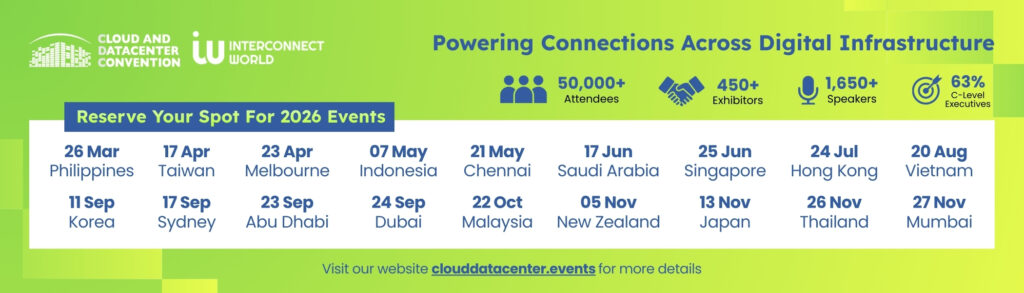
* w.media’s Indonesia Cloud and Datacenter Convention is taking place tomorrow at Shangri-La Hotel, Jakarta. This event will bring together leaders from the regional data center industry and offers an excellent networking and collaboration opportunity.