
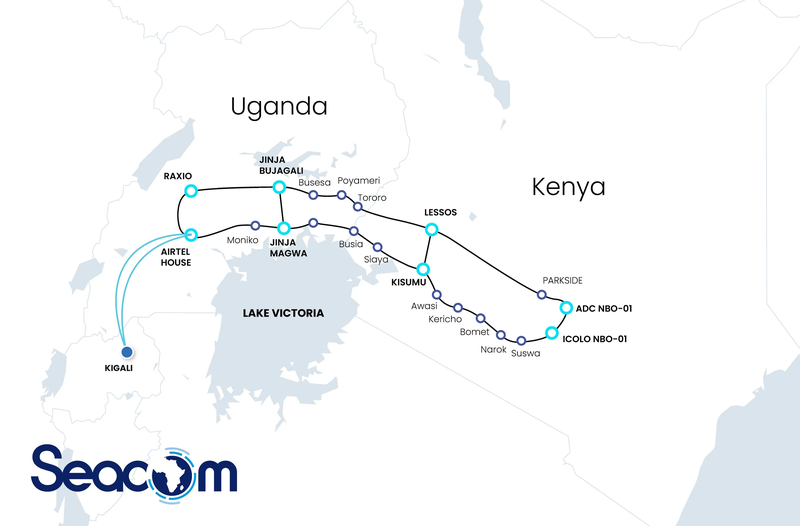
African connectivity infrastructure firm Seacom has launched a new high-capacity terrestrial network route running from Kenya through to Uganda. The new digital corridor will connect Nairobi, Kisumu, and Kampala, improving internet connectivity for businesses in the region.
The network will activate 1Tbps of capacity at launch with a view to growing this to 30Tbps as demand increases. The network is built on Dense Wavelength Division Multiplexing (DWDM) technology and supports high-capacity interfaces including 1GE, 10GE, 100GE, and 400GE, enabling flexibility for enterprises, service providers, and hyperscale customers.

Latency is said to be as low as 7ms when connecting to the capital city Nairobi and 13ms when connecting to Mombasa along Kenya’s coast.
“We’re strengthening a route that already plays a central role in regional connectivity,” David Kariuki, Chief Technology Officer at Seacom, said in a press release. “We are ensuring that this segment is served by a high-capacity, carrier-grade network that can support the scale and performance today’s digital economy requires.”
Not only will this network connect the two nations, but it will also improve regional integration with Rwanda, Burundi, and South Sudan by offering a more efficient pathway into those countries. The goal here is to support access to cross-border digital services and encourage trade between East African nations.
Regarding resilience, Seacom has implemented its Automated Switched Optical Network (ASON) solution here, allowing traffic to be rerouted in less than 50ms in the event of a disruption. The company says it will be improving the resilience of this network by using an alternative pathway via Narok, Kericho, and Kisumu. This eliminates the risk of a single point of failure.
The network will also leverage two border crossings in Malaba and Busia to reduce the risk of network downtime while also improving stability.
“This is a continuation of the work we’ve been doing to strengthen our network across the region,” Kariuki said. “We upgraded our IP network in Uganda last year, and this route builds on that foundation by improving both capacity and quality across a key corridor.”
The impact this network will have on the region will be felt by banks, cloud operators, and other organizations that require stable connectivity.

Seacom is on a push to improve the reliability of connectivity on the African continent. Part of that includes what it calls overland subsea cables. Here the firm plans to take its learnings from subsea cable operations and apply them to terrestrial cables. The advantage here is that landlocked countries such as Malawi and Rwanda, among others, can tap into subsea cables. This project is yet to come to fruition, but it’d be a boon for the continent.