
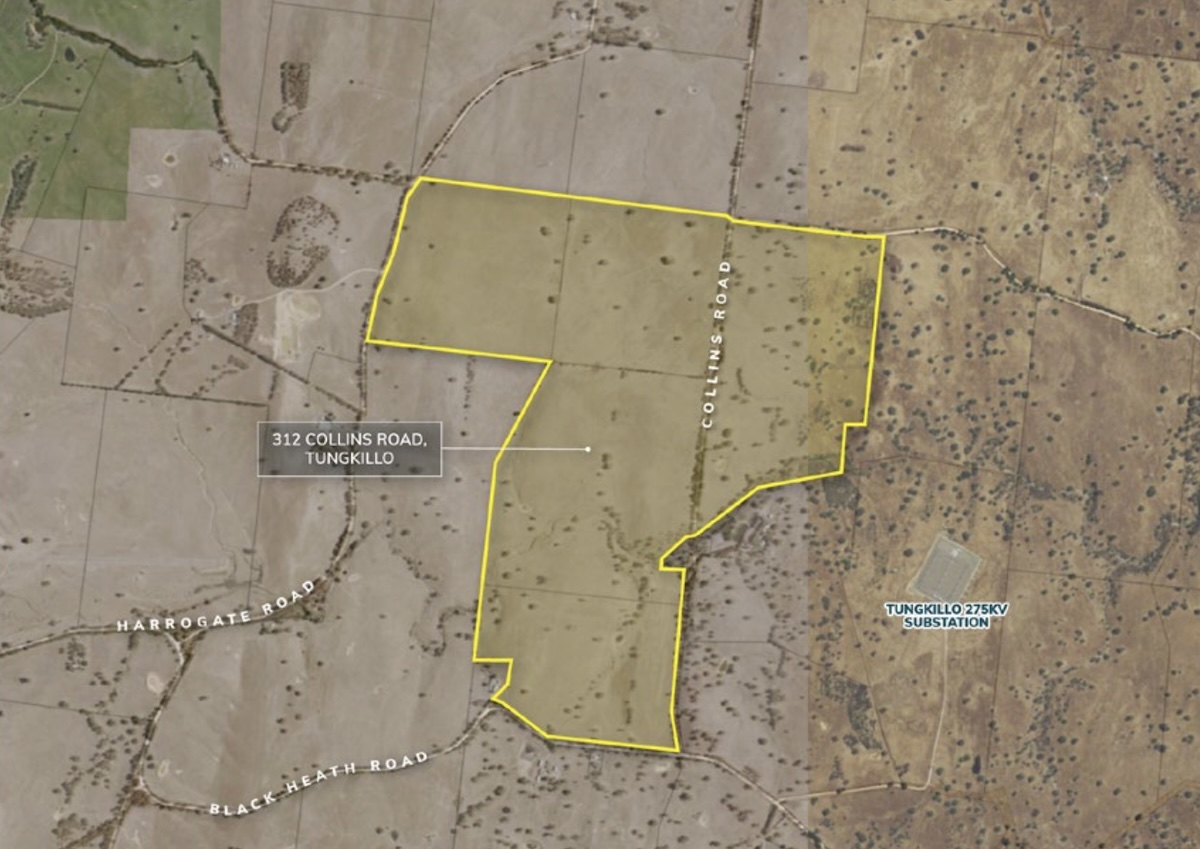
Quantum DC has proposed an approximately 1.2GW data centre and energy hub on a 220-hectare site near Tungkillo in South Australia’s Adelaide Hills, combining hyperscale computing infrastructure with renewable energy procurement and on-site gas-fired generation.
The Tungkillo Compute and Energy Hub is planned for 312 Collins Road, around 55km east of Adelaide. The 220-hectare site spans five land parcels. Quantum DC intends to develop around 120 hectares, leaving the remaining 100 hectares undeveloped and in use for grazing.
The project would be delivered in three stages, with the first stage anticipated to begin operations in 2028 and the full development completed by 2031, according to the developer.
The proposed facility would connect to existing ElectraNet 275kV transmission infrastructure crossing the site through two new substations. Quantum DC says it will contract new wind and solar generation from elsewhere in South Australia and build gas-fired turbines on site to firm supply when renewable output is low, rather than to run continuously.
The project is designed so that wind and solar supply around 80% of the data centre’s electricity and on-site gas around 20%, the developer says.
Local reporting has put the proposed gas-fired generation capacity at 400MW, although Quantum DC’s published project description hasn’t specified the capacity. The developer says the hub’s on-site generation will also supply electricity into the grid at times. It has commissioned modelling to examine the project’s potential effect on electricity prices, but the results have not been detailed in the published project information reviewed by W.Media.
Closed-loop
Quantum DC says the project will use closed-loop, direct-to-chip liquid cooling with air-cooled heat rejection. Its current estimates put operational water consumption at around 20 megalitres annually, with 150-250 megalitres required across the construction period, a preliminary figure that excludes water for concrete production and for commissioning the cooling systems.
Rainwater collected from building roofs is intended to be the main source of operational water, supplemented where necessary by commercial water deliveries. The developer says it does not propose a permanent connection to SA Water’s mains or to take water directly from the River Murray. Construction and commissioning water arrangements are still being confirmed.
The proposal has drawn opposition from some local residents and farmers concerned about the potential effects on the rural landscape, agriculture, wildlife, noise, light and water resources. Tungkillo sits just within the River Murray Dark Sky Reserve, according to the ABC, an internationally accredited area protected from light pollution.
Quantum DC says specialist studies will examine traffic, noise, air quality and emissions, water management, biodiversity, Aboriginal cultural heritage, bushfire risk and visual impacts.
The company intends to lodge a development application through South Australia’s Essential Infrastructure/Crown assessment pathway. To date, no application has yet been lodged and the proposal has not received approval. Under the process outlined by the developer, there will be a public notification period of at least 15 business days, during which the community can make written submissions.
The State Commission Assessment Panel will then review the proposal and submissions before advising the Minister for Planning, who will make the final decision.
Quantum DC is holding community drop-in sessions in Tungkillo on Thursday 29 October and in Mannum on Saturday 31 October, ahead of lodging its application.
BESS nearby
The site is also near the separately approved Tungkillo battery energy storage project. The 270MW/1,080MWh battery was approved in December 2024 and acquired by Iberdrola from RES Australia in 2025, with construction expected to commence in late 2026.
Quantum DC says the nearby battery projects are being developed separately and do not form part of its data centre application. W.Media has asked if there is supply agreement between the battery and the proposed data centre.