
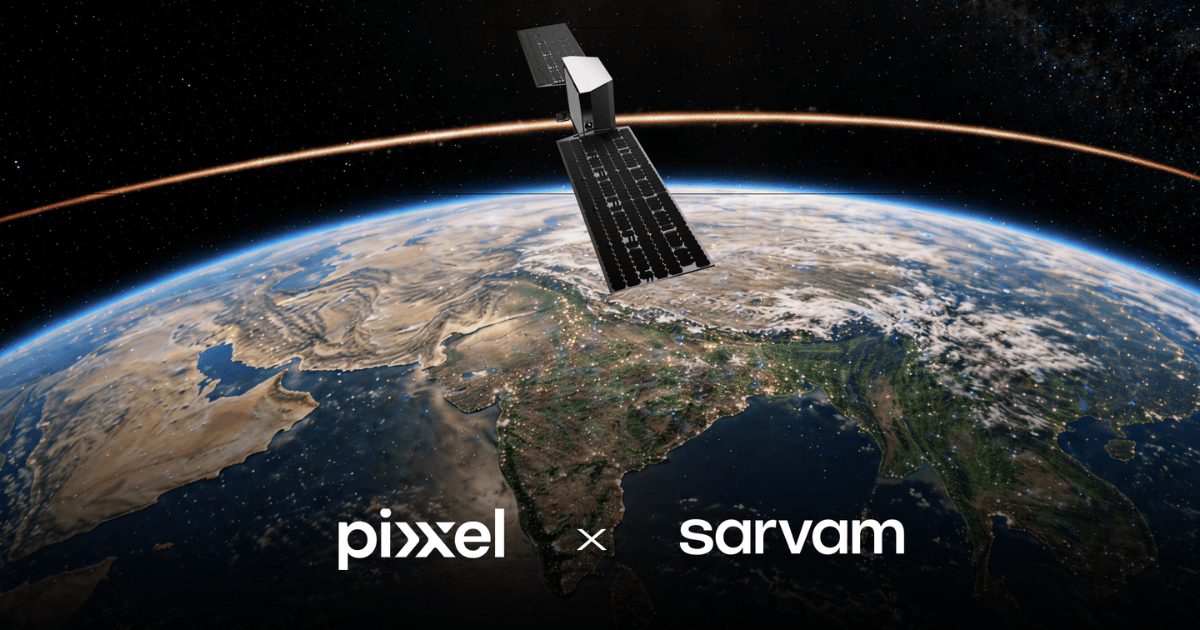
Pixxel, a planetary intelligence company that builds and operates imaging satellites, has announced a strategic partnership with Sarvam, an Indian AI company, to develop and build what it claims will be India’s first orbital data center satellite.
In a press release, the companies revealed that under the partnership, Pixxel will design, build, launch, and operate the Pathfinder satellite. Sarvam will provide the AI backbone, handling both training and inference directly in orbit, with full-stack language models running on board the satellite.The Pathfinder, a 200 kg-class satellite, is scheduled to reach orbit as early as Q4 2026.

“Ground-based data centers are facing increasing constraints around energy, land, regulation, and scale, and the current model is becoming harder to sustain environmentally. Orbital data centers open up a new frontier, where compute can be powered by abundant solar energy, operate closer to space-based data, and move beyond some of the limits faced on Earth,” explained Awais Ahmed, CEO, Pixxel. “For Pixxel to build the next generation of space infrastructure, we have to help shape this shift, not watch it happen from the sidelines. With Sarvam, this mission is our first step toward making orbital data centers real, operational, and scalable from India.”
For Sarvam, the partnership extends the reach of its Full-stack Sovereign AI Platform beyond terrestrial infrastructure and into orbit. Sarvam’s models and inference platform, developed and governed in India, will run directly on the satellite’s GPU compute layer, processing data in orbit with no dependence on foreign cloud or ground infrastructure.
“AI infrastructure is not just a software question – it is a sovereignty question. Sarvam has been building India’s full-stack AI platform from the ground up, and partnering with Pixxel allows us to extend that sovereign stack into space,” said Pratyush Kumar, CEO, Sarvam. “Having India-built models running in orbit aboard an India-built satellite is exactly the kind of foundational capability that the country needs to control its own intelligence infrastructure. The goal has always been to make intelligence accessible to everyone, everywhere. Now, everywhere includes space. We are proud to power the AI backbone of this mission.”
Unlike conventional satellite computing, which relies on low-power edge processors optimized for survival rather than performance, the Pathfinder satellite will host datacenter-class GPUs, the same generation of hardware as on-ground data centers that power frontier AI training and inference.

The demonstrator will also carry Pixxel’s hyperspectral imaging camera, enabling it to capture high-fidelity hyperspectral data and analyze it directly in orbit using foundation models. Instead of sending large volumes of raw imagery back to Earth for processing, the system can identify patterns, detect changes, and generate insights in real time. This aims to reduce the delay between data capture and decision-making, enabling faster responses across environmental monitoring, resource management, and critical infrastructure tracking.
As demand for AI, data, and compute continues to grow, this shift toward processing data closer to the source becomes increasingly important, positioning orbital compute as a new layer of high-performance infrastructure. The mission will validate real-time AI inference and data processing in the harsh space environment, testing performance, power management, thermal constraints, and real-time data workflows under operational conditions, to establish the technical and commercial groundwork for future orbital data center systems.
The satellite will be developed at Gigapixxel, Pixxel’s upcoming facility designed to scale satellite production to up to 100 units. The partnership aims to prove a model for building dedicated orbital data center satellites from India for organizations with strategic, commercial, and compute-intensive needs.
This is the second announcement pertaining to orbital data centers by Indian companies this year. Readers would recall that in February this year, NeevCloud, an Indian sovereign AI cloud infrastructure company under RackBank Datacenters Private Limited, an Indian data center service provider, announced the signing of a Memorandum of Understanding (MoU) with Agnikul Cosmos Private Limited, a Chennai-based space technology company, aiming to deliver India’s first indigenous, AI-powered data center in space.