
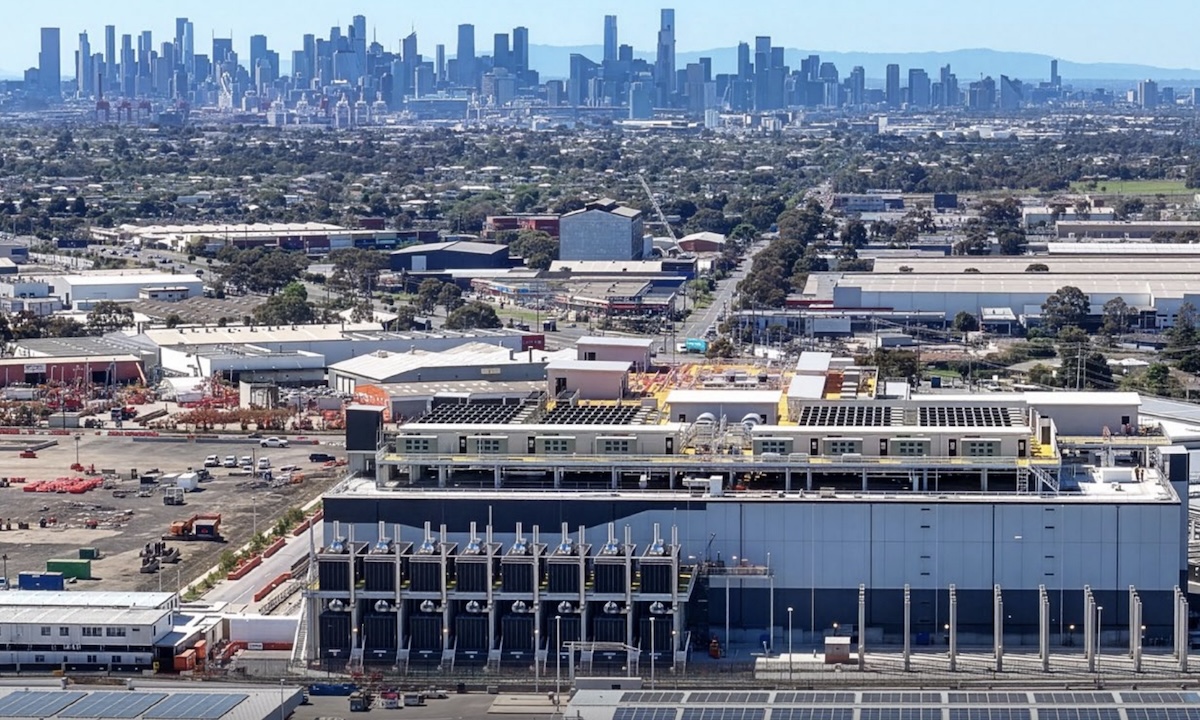
Melbourne recorded 1.55GW of data centre absorption so far in 2026, overtaking Johor to top Asia Pacific, but rising costs, power constraints and community concerns are expected to reshape Australia’s development pipeline.
Melbourne has overtaken Johor to lead Asia Pacific for data centre absorption, with 1,546MW so far in 2026, as hyperscalers commit to major campus expansions and increasingly compete for access to power.
According to datacenterHawk’s 3Q 2026 APAC Data Center Market Report, Melbourne ranked first in the region for absorption, ahead of Johor at 1,279MW, Jakarta at 973MW and Sydney at 710MW.
The results confirm a big shift in Australia’s data centre landscape, with Melbourne seen as offering easier access to land and power than Sydney, where grid capacity and land costs are becoming increasingly restrictive.
Donny Gunadi, senior insight analyst for APAC, said hyperscalers had continued to commit to expansions close to their existing campuses in Melbourne’s west.
“Long lead times for power infrastructure and energisation have made it clear to hyperscalers that everyone will have to wait. The ones who secure power will be those willing to commit early and lock in their place in the queue,” he said.
“Over at least the past 12 months, Melbourne has also been seen as offering easier, and cheaper, access to land and power. Sydney, by contrast, is facing tighter grid capacity and higher land costs in its established data centre precincts, which has shifted demand south.”
Near term lead
Melbourne is expected to retain its lead in the near term, supported by the volume of capacity already pre-committed, although the gap with Sydney could narrow as power constraints ease.
The scale of the market’s expansion is also reflected in pricing. DatacenterHawk found that Melbourne hyperscale rates increased by 32 percent between 2025 and 2026, compared with 16 percent in Sydney. Melbourne’s increase puts it among the fastest-rising hyperscale markets in APAC, alongside Seoul, Osaka, Tokyo and Singapore.
Gunadi said Melbourne’s ability to accommodate expandable campuses and future development phases had strengthened its position with hyperscalers.
“Melbourne still offers expandable campuses with space for future phases, whereas Sydney is running out of that kind of capacity. Hyperscalers have committed heavily to Melbourne to secure that growth path, and with power available only to those prepared to commit early, operators there have been able to price accordingly.”
AI demand and the risk of rising costs
The extent to which AI is driving Australia’s data centre expansion is difficult to quantify separately from conventional cloud demand, according to Gunadi, because hyperscalers are developing flexible capacity that can support both.
However, he said AI was clearly a major factor, with the large majority of new capacity being committed designed to support GPU workloads and liquid cooling.
The report highlights the broader acceleration in APAC demand. Regional commissioned colocation power, built or preleased, reached 18.6GW, while vacancy fell to 2.96 percent from 7.3 percent a year earlier. It also found that 94 percent of APAC leasing in 2026 was preleased.
Gunadi said Australian capacity was generally not being developed without firm customer commitments, with most preleasing backed by signed agreements rather than informal reservations.
“That commitment is usually phased, a customer might take an initial block of capacity on day one, with further phases scheduled over several years. This structure works well for both sides: the customer secures a growth path, and the provider has the certainty it needs to build.”
Contracts can also include rights of first refusal over additional capacity, or reservations that hold capacity for a customer for a specified period. “The industry is quite firm and positive that reserved capacity will be taken up when it falls due, and in many cases it is taken up earlier,” he said.
“We are not seeing signs of speculative over-ordering in Australia. The contract structures make it costly for customers to reserve capacity they do not intend to use.” Gunadi said rising prices could be a real risk to Australia’s AI ambitions.
Construction rises
Australian construction costs continue to rise, while customers typically expect facilities to meet the specifications of major Western cloud, hyperscale and AI operators. Gunadi said this contrasted with some other APAC markets where customers prioritise price and facilities are built to match.
The scarcity of land and power has also strengthened operators’ pricing positions, with customers willing to pay a premium for guaranteed delivery within committed timeframes.
But he cautioned that Australia’s location and geopolitical standing justified some premium but not an unlimited one. “Workloads that need to stay onshore, such as sovereign and latency-sensitive services, will absorb higher costs. More mobile AI workloads, particularly model training, can move to wherever capacity is cheapest, and if the price gap with other markets becomes too steep, some of that investment will go elsewhere.”
Regional Australia as the next growth frontier?
Grid connection timelines are now shaping where new data centres can realistically be delivered, rather than simply where customers would prefer to locate, with power and water remaining the biggest factors in site selection.
Gunadi expects regional Victoria and regional NSW to become dominant themes in Australian development during 2027, as operators look beyond increasingly congested metropolitan and industrial areas.
“Regional sites can ease the pressure on space and power in congested metro and industrial areas, and they can also help reduce community concerns,” he said.
However, the shift will not remove the need for developers to secure community support. “Capacity requirements remain strong, but social licence and community expectations are getting more attention. I expect 2027 to be a year of adjustment, as the market works to balance the needs of the AI economy against those of local communities.”
State government support is also becoming an important consideration, particularly through planning and permitting processes and the identification of suitable development sites.
Gunadi pointed to Queensland’s Western Downs Digital Park, where Anthropic’s lease was announced by the state premier, as an example of a government signalling its willingness to attract AI infrastructure.
South Australia is pursuing a similar approach through its dedicated data centre strategy and proposed legislation intended to provide greater certainty around planning, energy and water approvals.
Several regional projects are emerging as potential alternatives to established metropolitan markets. These include the proposed CDC campus near Wagga Wagga in NSW, IREN’s planned campus at Bundey in South Australia, and Keppel’s campus at Morwell in Victoria.
“These locations are emerging as viable alternatives for large data centre campuses because of their access to land, power and water,” he said.
But he warned that projects would need to demonstrate tangible benefits to local communities, particularly where energy and water consumption had already attracted scrutiny. “The projects that progress will be those that engage early with communities and show clear local benefits, such as jobs, investment and contributions to the grid.”
Western Australia, South Australia and Queensland target investment
Beyond the established Sydney and Melbourne markets, Gunadi identified Western Australia, South Australia, Queensland and the Northern Territory as emerging contenders for significant new data centre capacity.
Each offers different advantages, although the fundamentals remain the same: access to land, power, water, skilled labour and network connectivity.
South Australia is benefiting from strong renewable energy resources and a dedicated data centre strategy, with IREN and Firmus planning large AI infrastructure campuses.
Queensland’s Western Downs Digital Park is positioned in a major energy-producing region, while Perth offers direct submarine cable connections to Asia and the Middle East and an independent power grid. CDC is also planning a major campus at Maddington.
The Northern Territory is positioning itself as a gateway to Asia, with self-powered proposals including Beetaloo Digital and Project Ares.
Gunadi said government expectations were also changing the definition of an attractive data centre site, with developers increasingly expected to be more self-sufficient and less reliant on the existing electricity grid.
“The definition of an ideal data centre site is also changing. Government expectations are pushing data centres to be more self-sufficient and less reliant on the grid, which favours locations with access to new renewable generation and transmission capacity.”
Combined with investment in submarine cables and renewable power generation, he said these developments would help open up opportunities beyond Australia’s traditional east coast markets.
For Melbourne, the near-term outlook remains strong, with pre-committed capacity expected to sustain its lead over Sydney.