
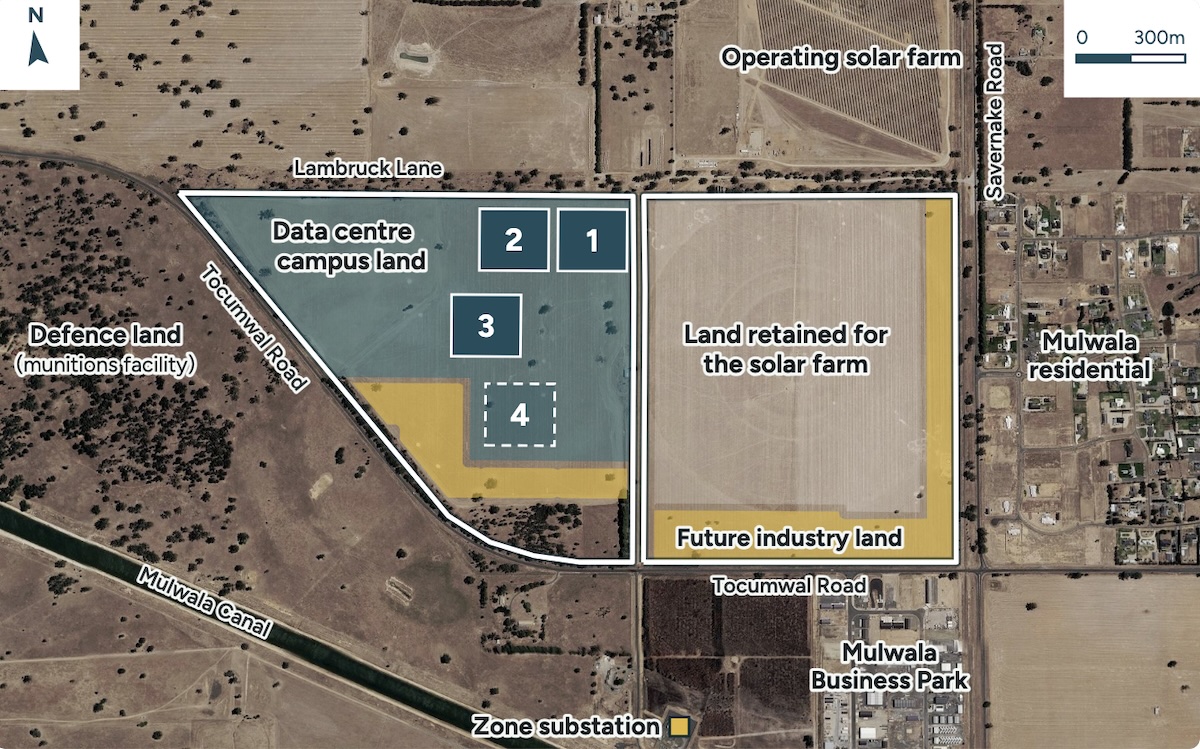
Australian developer Lambruk Mulwala Futures has proposed a data centre campus with maximum grid demand of 350MW in Mulwala, southern New South Wales, with construction planned in three stages and a separate 27-hectare industrial precinct. The project is at an early planning stage, with the developer yet to secure a major development partner and electricity supply currently indicated by Essential Energy for the first stage only.
The proposed campus would occupy approximately 62 hectares of a 168ha site on the northern edge of Mulwala, west of the railway line and between Tocumwal Road, Lambruck Lane and Savernake Road. The land is about 390 metres from Essential Energy’s Mulwala 132kV zone substation and adjoins the existing Mulwala Solar Farm.
Lambruk proposes to build up to three data halls sequentially, with each stage dependent on the electricity network being able to supply the additional demand. The combined facilities and supporting infrastructure would draw a maximum of 350MW from the grid. The developer estimates that the computing equipment would account for approximately 250–280MW, with the remainder required for cooling and other equipment.
The developer’s website says Essential Energy has advised that the local network has capacity for the first stage. Subsequent stages would depend on connection studies and any network upgrades required. No formal connection agreement or capacity allocation has been disclosed.
The proposed electrical infrastructure includes a switching yard and substation linked to Essential Energy’s zone substation through an easement, alongside battery storage and other supporting equipment. Lambruk says it intends to use batteries and flexible computing loads to meet NSW Data Centre Guidelines requiring facilities to reduce grid demand by 25 percent of forecast average demand for up to two hours during periods of grid stress, without relying on diesel generation.
Possible fourth hall
The site also includes land for a potential fourth data hall, although this is not part of the current three-stage proposal. A fourth hall would require additional electricity network capacity and a separate planning approval.
The wider development would retain approximately 61ha for the existing solar farm and set aside about 27ha beside Mulwala Business Park for future industrial use. The proposed industrial precinct could accommodate future industrial lots, although their size and configuration have yet to be determined.
The solar farm has approval for 80MW of generation, of which approximately 31MW has been built. The developer says the data centre would need its own planning approval, with changes to the existing solar farm approval where the projects overlap.
Australian-owned
Lambruk Mulwala Futures is the project proponent, with the proposal described as 100 percent Australian-owned and backed by local capital. Infrastructure advisory firm Lecroma is managing development and community engagement. The proponents say a major development partner will be sought at a later stage, acknowledging that a campus of this scale will need a major partner to build.
The developer has not published job or investment estimates as yet, saying they will be released once project studies are complete. Local employment opportunities are expected to include construction trades and suppliers, followed by a smaller specialist workforce to operate the facilities.
The proposed cooling system would use water circulated through sealed pipes in a closed loop. Lambruk intends to use water from the landowner’s bore for the initial system fill and says town water would not be used for cooling. The system would require periodic top-ups, but the amount of water required for initial filling and ongoing operation has yet to be quantified through a planned water and cooling study.
The project would also include water storage, stormwater controls and landscaped screening. The developer says most homes are more than one kilometre from the nearest proposed data hall. Its indicative October 2026 site information identifies three dwellings within 500 metres of the nearest hall, four businesses between 500 metres and one kilometre, and 52 dwellings and five businesses between one and 1.5 kilometres. Noise, including from cooling equipment and other plant operating around the clock, will be assessed as part of the environmental studies.
Rezoning needed
The site is currently zoned RU1 Primary Production and R2 Low Density Residential, neither of which permits a data centre. Lambruk is seeking advice from the NSW Department of Planning, Housing and Infrastructure on the planning pathway and intends to ask Federation Council to support a rezoning. Options include changing the campus land to an employment or industrial zone, or listing data centres as an additional permitted use.
The development is proposed to proceed through the State Significant Development planning pathway. Lambruk is targeting submission of a scoping report to the department in December 2026, followed by an Environmental Impact Statement in March or April 2027. Public exhibition is targeted for mid-2027, although the timing of the assessment process will be determined by the NSW planning department.
Further studies are expected to examine noise, generator emissions, hazards and safety distances in relation to a nearby Defence munitions facility, ecology, Aboriginal cultural heritage, traffic, water and cooling. The developer says part of the site has been kept free of buildings because of identified Aboriginal cultural heritage values, with a more detailed assessment to be undertaken in consultation with Aboriginal people with knowledge of the area.
According to the company, early engagement with Federation Council and neighbours began in late October, with a first public briefing planned for Mulwala in December. Lambruk says it intends to work with Federation Council on potential community benefit arrangements, with local priorities including infrastructure, agriculture and opportunities for young people.