
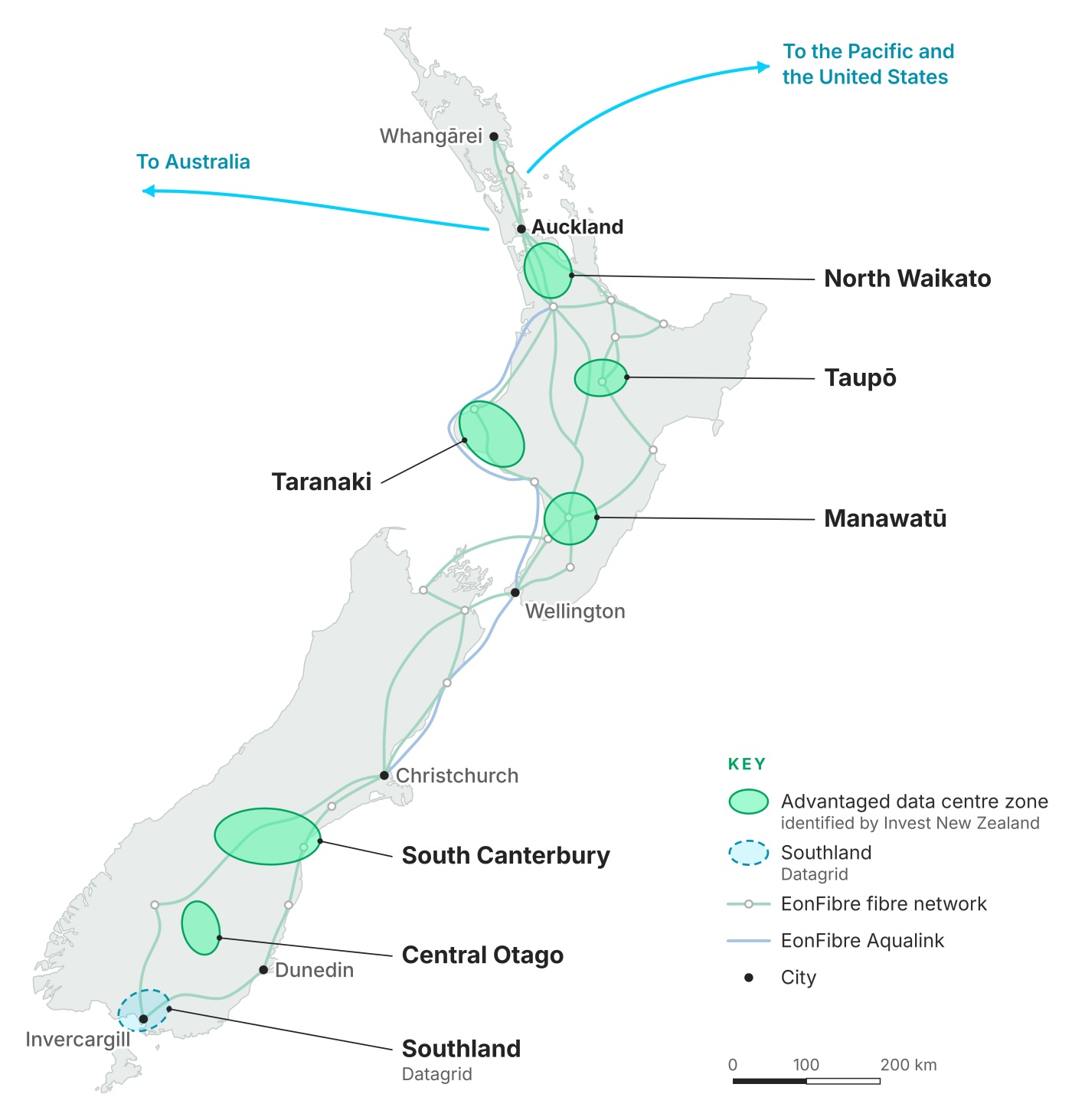
New Zealand fibre network operator EonFibre has launched Zone Direct, a connectivity service aimed at data centre developers, hyperscalers, neocloud providers and carriers considering entering or expanding in the country. The service is designed to help investors assess connectivity during site selection, covering connections to existing and proposed data centres, cable landing stations and international capacity.
Zone Direct is based around six data centre zones identified by Invest New Zealand in its Data and Digital Infrastructure sector overview: North Waikato, Taupō, Taranaki, Manawatū, South Canterbury and Central Otago.
The zones were selected for their access to high-voltage electricity infrastructure, backhaul fibre and potential speed to power. Invest New Zealand says some sites within the zones could have infrastructure connections for new data centres within one to three years. However, a footnote to the report’s zone map cautions that the listed capacities cannot all be achieved simultaneously because of constraints on total system capacity.
EonFibre chief executive Richard Mooney said connectivity needed to be considered alongside power availability and land when investors assessed potential locations. “The case for data centres in New Zealand starts with renewable power, land and stability,” Mooney said.
“Investors also need to know how capacity at a new campus will reach customers in Australia, Asia and the United States. National and international bandwidth is our core business. We want to be part of those conversations early, while sites are still being chosen, to enable efficiencies across the development and operational process.”
Zone Direct will provide a connectivity brief for each zone, outlining route options, physical diversity and indicative latency to international cable landing stations and destinations in Australia and the US. The service will also offer site-specific desktop assessments, a single point of contact for network planning and delivery, and the design, construction, operation and maintenance of campus connectivity networks.
EonFibre operates more than 11,000km of fibre between Whangārei in the north and Invercargill in the south. Its network includes metropolitan fibre rings in Auckland, Hamilton, Wellington and Christchurch, three diverse routes between the North and South Islands, and the Aqualink domestic submarine cable.
The operator says its network reaches major data centres and exchange sites across New Zealand, including the Auckland clusters at Albany, Westgate, the CBD and Silverdale.
Internationally, EonFibre co-owns the Tasman Global Access cable between New Zealand and Sydney and provides capacity on the Hawaiki and Southern Cross systems. It also has points of presence in Australia and the US, alongside partnerships with global operators for onward connectivity.
EonFibre has also worked with Google on fibre infrastructure for the Honomoana submarine cable, which landed north of Auckland. The cable adds international capacity and connectivity between New Zealand, Australia and other Pacific destinations.
Zone Direct combines these national and international network assets with EonFibre’s existing Direct Fibre, FlexWave managed wavelength services of up to 400Gbps, data centre interconnection and international capacity.
“Developers want to know how many physically separate routes reach a site, how far it is to the international cables, and how quickly capacity can be delivered,” Mooney said. “Because we hold both the national routes and the international capacity, we can answer those questions and deliver the service end to end, from the campus to Sydney or the United States.”
New Zealand targets data centre investment
Invest New Zealand’s sector overview positions the country as a potential location for data centre and AI infrastructure investment, citing renewable electricity, available land, a cool climate, political stability and international connectivity.
The report says hydropower accounted for 54% of New Zealand’s electricity generation in 2025, while geothermal contributed 20%. It also points to further renewable generation development as an opportunity to support additional data centre demand.
New Zealand’s electricity system is connected through a national high-voltage transmission network operated by Transpower. The report says data centres accounted for approximately 0.6% of grid electricity consumption in 2025, while planned transmission upgrades and new generation projects are intended to support future demand.
Connectivity is another part of the country’s investment proposition. The report identifies four operational international submarine cable systems serving New Zealand: the Southern Cross Cable Network, Southern Cross NEXT, Hawaiki and Tasman Global Access. It also highlights Honomoana, which landed in 2026, and several proposed systems intended to expand international capacity and route diversity.
The report, citing BCG analysis, forecasts that New Zealand’s data centre capacity could grow from approximately 125MW in 2025 to 425MW by 2035 based on domestic demand. Export-oriented development could raise total capacity to around 725MW in its base scenario or as much as 1,425MW in a high-growth scenario.
The six zones form part of the government’s effort to direct investors towards locations where electricity infrastructure and fibre routes could support new development. EonFibre’s new service is intended to give prospective developers a clearer view of connectivity options before they commit to a site.
For those interested in the opportunities and challenges shaping New Zealand’s data centre market can also attend the New Zealand Cloud & Datacenter Convention 2026. The event will provide an opportunity to hear from industry participants and discuss the country’s evolving cloud and data centre landscape.