
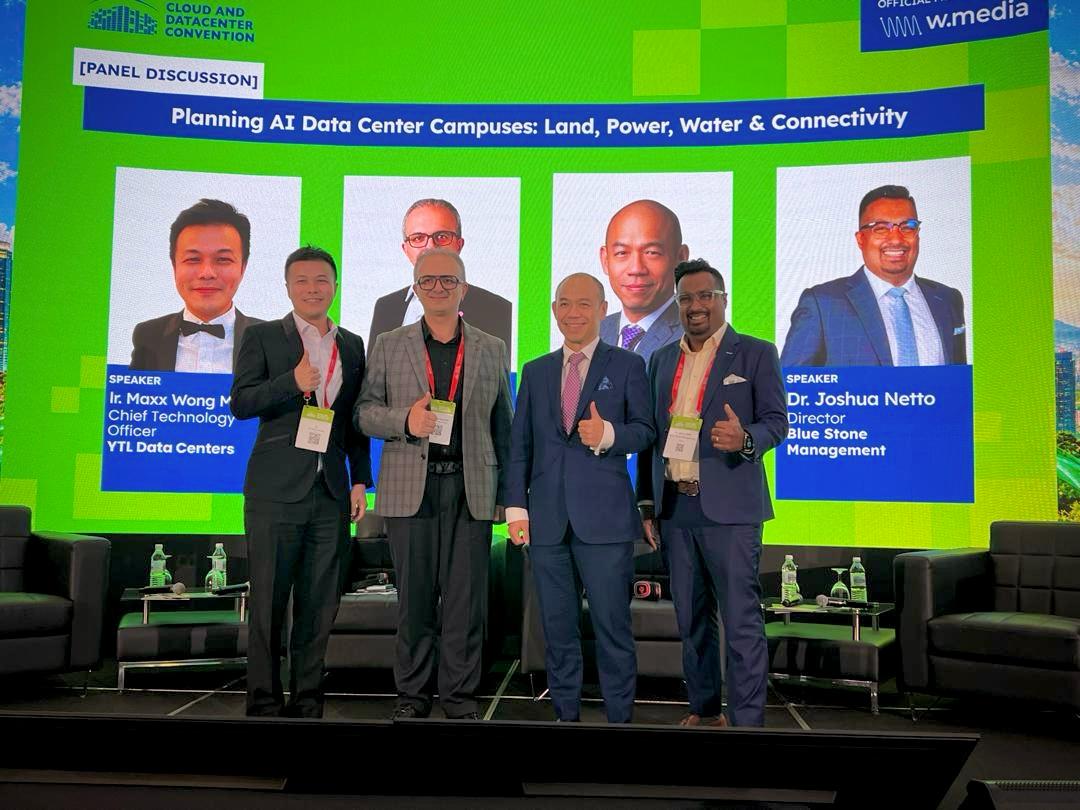
Data center operators are feeling the heat as Malaysia tightens its requirements for data centers, a seminar in Kuala Lumpur heard yesterday. Amid several recent announcements of stricter requirements for data centers particularly with regards to power consumption, many operators have flagged this as the biggest concern to their operations.
In the last few days, government ministers have proposed in Parliament that data center developers should bear transmission upgrade costs, be charged for committed electricity capacity they did not use, and were encouraged to generate their own electricity.
As panellist Ir. Ts. Maxx Wong said: “Power is the ultimate prerequisite because power availability dictates site viability above all other metrics.”
“Without a highly reliable, scalable baseload power supply, high-density AI data centers fundamentally cannot operate,” he said during a panel discussion on “Planning AI Data Center Campuses: Land, Power, Water and Connectivity” held at the Malaysia Cloud & Datacenter Convention 2026 yesterday.
Amid the unprecedented demand from rapid digital infrastructure developments, national grids are facing severe bottlenecks that if not addressed soon could delay or impede the momentum of data center growth. To sustain this momentum, Wong said the industry must actively invest in off-grid power infrastructure, captive power generation, and localized microgrid solutions.
The Chief Technology Officer at YTL Data Centers also said raw compute power is irrelevant without seamless data distribution. “Comprehensive fiber routing and base station networks are critical to bridging the gap between hyperscale campuses and the end-user devices relying on them,” he said.
Malaysia is sitting at a critical juncture en route to becoming the biggest data center hub in Asia (ex-China) by 2030. It is in the middle of a data center boom driven by cloud and AI adoption.
Malaysia has already surpassed other ASEAN countries in the AI Readiness Index, scoring 73 against a global average of 57. France and Nordic countries in comparison, scored 85 and between 93-95 respectively, said Mehdi Paryavi, Chairman & CEO of the International Data Center Authority (IDCA). Mehdi when delivering the Opening Keynote at the convention.
The keynote explored Malaysia’s strategic position in the digital economy and the opportunities emerging from the rapid expansion of AI and digital infrastructure. It discussed Malaysia’s regional digital ambitions, sovereignty, investment and economic resilience.
Beyond technology
A participant, Kevin Stevens, Head of Industry Practices at Chubb Asia Pacific, found many of the discussions very useful, saying, “The more I learn about data centres, the more questions I have.” Stevens was looking beyond the technology to contractual and liability aspects especially those relating to physical security and cybersecurity risks.
With cybersecurity concerns now top of mind especially with increasing reports of unauthorised AI agents being discovered in bank customers’ accounts, banks are now warning that this could trigger unwanted transfers and call-center contacts. Increasing cyberattacks were also reported while critical vulnerabilities in the PHP programming language used in most websites were being patched yesterday.
The insurance expert wondered how much liability insurance would be enough for data centers that house billions of dollars worth of third party GPUs and other expensive equipment in the event it caught fire.
“Physical security, cyber resilience, business interruption, contractual obligations, professional indemnity and third party liability are increasingly interconnected. From an insurance perspective, understanding these exposures requires more than assessing the physical assets, it means understanding how the entire ecosystem operates when things go wrong.”
The Malaysia Cloud & Datacenter Convention 2026 is an annual event organized by w.media. Yesterday’s event drew more than 1,200 attendees, many of whom are C-suite decision-makers.