
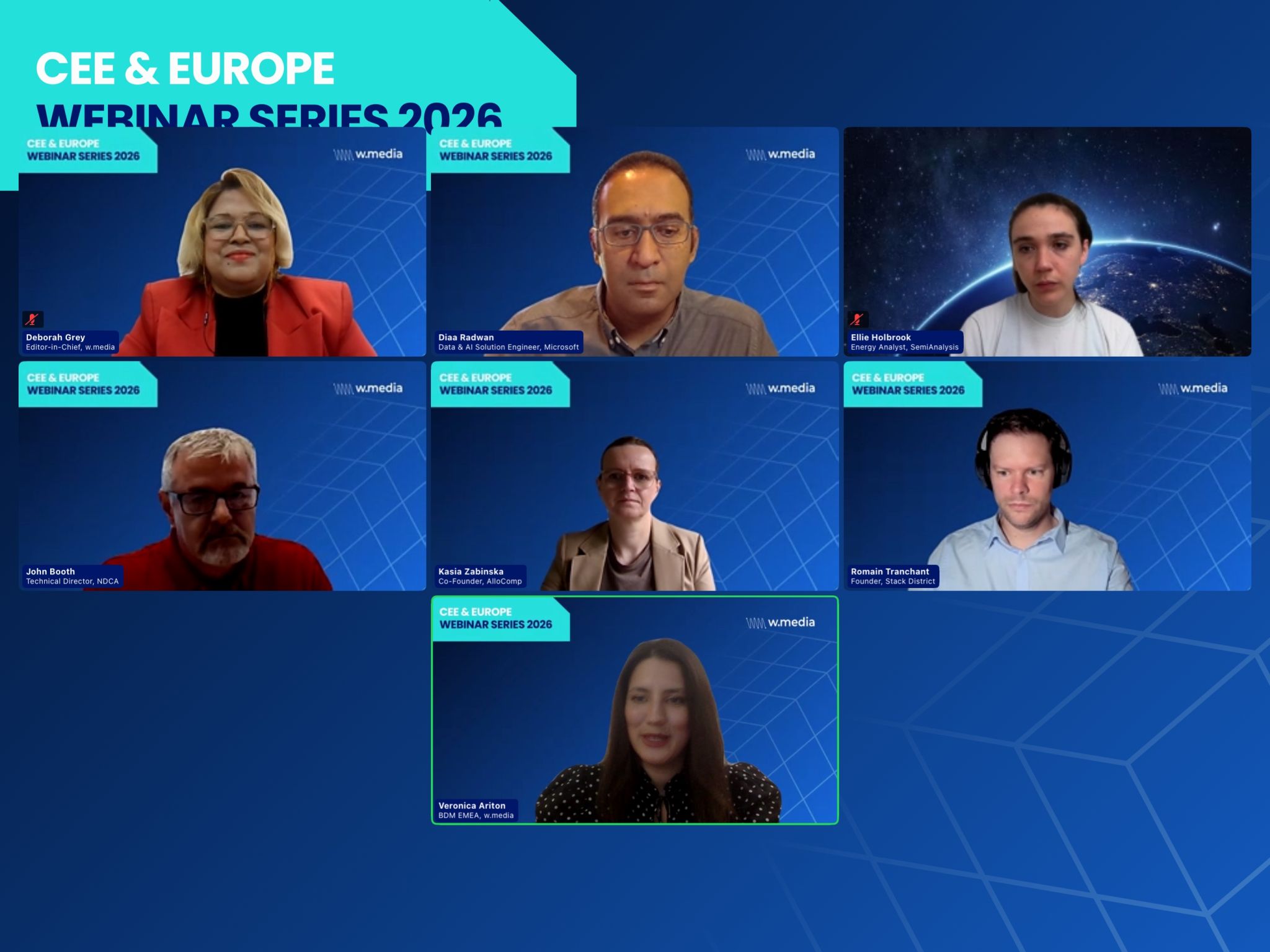
Europe is witnessing one of the most significant shifts in digital infrastructure and our CEE Europe webinar series latest episode titled, From Core to Edge, Rethinking Europe’s Data Center, Architecture for the AI Era explored how traditional centralized data center models are being challenged by AI adoption, data generation, and demand for low-latency services.
We explored why data center operators and developers must rethink where compute happen, where data resides, and how infrastructure is designed to support the next generation of digital services.

The webinar session was designed to help data center peers navigate through this evolving landscape and was co-hosted by w.media’s Veronica Arinton, business development manager for EMEA with Deborah Grey, w.media’s Editor-in-Chief., with John Booth, MBCS, CDCAP, CDCSP, Technical Director from National Data Centre Academy, as the moderator for the panel discussion.
The speakers were distinguished industry experts and veterans:
- Kasia Zabinska, Co-Founder from AlloComp.
- Ellie Holbrook, Energy Analyst at SemiAnalysis.
- Diaa Radwan, Global Black Belt, Data & AI Solution Engineer featured expert from Microsoft.
- Romain Tranchant, Founder from Stack District.
The webinar began with a keynote address by Kasia Zabinska on whether on-premises, in co-location, in the cloud, at the edge, or across a hybrid model would be optimal for European infrastructure development.
Keynote address: Market intelligence mapping Europe’s evolving data center topology
Kasia Zabinska: “AI is changing things very quickly, but it’s not only increasing the demand, it’s completely changing how we look at data centers and what data centers actually are.”
“I think it’s an important starting point for the discussion, when you look at the legacy data center, we’re looking at the average of 8-something, 8.4, kilowatts per rock. That’s the compute that we’ve been familiar with for the last 20, 30 years, and the densities were increasing steadily, and then the AI era came up, and the densities we’re talking about, at the moment are 120 kilowatts per rack systems being deployed. 600 kilowatts per rock, it’s not far out in the future. So that is changing the way we think about infrastructure.”
“Those high densities allow a much smaller footprint for the data center, but also make the whole infrastructure around data centers, the cooling and power distribution work much harder. Then the cooling demands change as well, GPUs are super efficient, more efficient than gas boilers and pretty much all the energy that you put into a GPU comes out as heat. The likes of the 600 kilowatts per rack Nvidia Robin Ultra cannot be air-cooled. There isn’t enough air-cold air in the world for that to be air-cooled, so it has to be liquid cooled. Which also creates an opportunity, because the closed loop liquid cooled systems allow us to recover heat much easier, so that’s what we believe is our green ticket for AI compute, reusing the heat.”
“One example is a former Fiat factory and there are plans here to build a data center. The reason for that is this site has already allocated about 82 megawatts. The plans are ambitious, that’s the opening number, they are hoping to increase that to 200 megawatts. But then, it also changes how we select the sites. It’s mainly where we can get the energy, and then that would be suitable for new data centers.”
“The landscape is changing, so there is all the AI, all the compute that we know, all the mega hyperscalers, the mega data centers are here to stay. But then also the new ones are emerging, so it could be anything from a regional cluster or university cluster that is being made available to local enterprises and to on-prem. A lot of enterprises are realizing this for many different reasons, from energy to sustainability to political reasons, many organizations are moving back on-prem, so the enterprise AI, it’s a massive trend.”
“I think the question kind of moves from which cloud services would be best? to Where should your workloads be based? The answer isn’t simple, so it’s becoming more kind of clear that there’ll be a much more mixed environment for those workloads. So, making those decisions has always been complex, but I think it’s getting even more complex now, so everything needs to work together.”
“Then some of the workloads, they’ll be perfectly happy in the cloud. Some of them you would prefer for, again, various reasons, for data security, for example, you want to have them on-prem. For some of them latency doesn’t really matter, but for some of them, it’s absolutely critical. So, we just need to make sure that all those decisions are well-informed, and everything is worked together.”
Ireland is a small country attracting massive big data centers. At the moment, about a third or quarter of the old electricity is used by data centers and are mainly hyperscalers. That’s the kind of model that worked well in the US, and that’s how we try to kind of replicate that in Europe, but the opportunity actually might come from somewhere else.
“If you imagine a European data center, the market is a lot of distributed and mixed form of infrastructure. And then, if we can reuse the heat, placing them next to the heat off-takers, it gives us the green tickets, because we are kind of redirecting energy from hitting things to going through the compute and then heating or preheating things. So they are distributed, they are closer to users and more independent. So, not trying to say that hyperscale is not the right model, I’m arguing that the European opportunity could be in having the mix and moving the workloads to many different variations of a data center.”
“The data center definition is changing here, again, because it might be a device on your desk or a workstation, it might be a hyperscaler one, or it could be something in between. My key takeaway from this presentation here it’s not as much core versus edge, it’s about having the mix and making sure that the given workload is running in the right place.”
Panel discussion: Connecting the Dots, Building a Scalable Core-to-Edge Infrastructure Strategy.
John Booth: So, panellists do you agree with Kasia insofar as European AI will be a different beast to that currently being deployed in the US?
Diaa Radwan: Thank you, John. Thank you, Kasia, for the insights. Yes, I do agree, but not because the technology is fundamentally different. The constraints in Europe are different. The same foundation model is AI technology that will be used globally, but here in Europe has a different operating environment, energy availability, cross-border regulation, and also sovereignty requirements.
Did residency concerns play a much larger role in architecture decisions? In the US, organizations often optimize primarily for scale and speed. In Europe, many organizations have to balance scale with sovereignty, compliance, and operational model. As a result, I think Europe will produce more distributed and hybrid AI architectures, rather than simply replicating large centralized deployment like in the US.
Romain Tranchant: Let’s go back through the first thing. Everything we hear about the news generally is through the news outlets. So, everything we talk about is those gigafactory data centers that are being deployed everywhere, and whilst it is true, and it is happening, there is also a lot of grassroots, happenings with colours and traditional players that are still out there. So let’s not mistake the beast in the U.S. they still deploy in, in single digits megawatt increments for their IT workloads, and they face exactly the same issues that we’re facing in Europe, which is the lack of power, with the constraints that we’re seeing, IT is now adapting to what is on the market from a collocation perspective, rather than the other way around.
John Booth: Yeah, I think that’s a very interesting point, actually, Romain, because we’re all hearing about these multi-megawatt big data sensors that are being built out in the Arizona desert, or in the Permian Basin in Texas. Ellie, what’s your take on, on, on what Kasia has kind of outlined in her keynote?
Ellie Holbrook: Europe can’t copy the US in any shape or form we have to talk about in a completely different way. There’s no political appetite for building, we’re seeing in the US a lot of behind-the-meter generation, and on-site gas as companies want to energize their facilities, and not wait in the interconnection queue for so long. Europe can’t compete with that 20 percent of European data center capacity is, one site in the US. So, yeah, the US has a choice, it can spread its compute around the country, it’s more of a choice. I mean, there are some permitting issues in terms of the West Coast or on the East Coast, and everyone’s going to Texas, but there are way more options.
But in Europe, it seems to be forced, and the physics of the grid essentially leave no other option, and more of a distributed approach has to be taken. It’s interesting to think about the Nordics, because basically the Nordics can actually play the American game because they have the power. And now it kind of seems like everyone else in and across Europe is sort of fighting over the smaller sites.
John Booth: Yeah, I tend to agree with you, actually. You can’t just drop a 1 GW data center facility probably anywhere in Europe. There just simply isn’t the power available or to be more precise, there isn’t power available at the moment. I think the overriding kind of mantra was speed to market, and speed to market kind of almost assumes that the grid infrastructure is already ready to take this, but we know it’s not. So, we’ve all heard about the grid woes in almost every European country, but that actually applies, across the world, I think, in Asia Pac and North and South America, will this distributed cluster architecture approach that Cash has spoken about in her keynote alleviate that problem, Ellie?
Ellie Holbrook: I think the analogy that I would use here is kind of one big team working together in one room, kind of tackling a project, but 10 small teams scattered across 10 cities can’t divide it up between them. Yeah, so breaking them across loads of different sites, you can’t run that job, so distribution only really works for lighter tasks, and running the services, answering queries, which is completely what, most of Europe does seem to be that, essentially frontier stuff is kind of a little bit out of a question at the moment.
Romain Tranchant: Well, I’d like to bring a couple of perspectives. One is the stability of the grid is down to grid operators. This is how data centers might become net positive assets for the grid in the future, with all of their backup systems and the ability to drop loads and so on, to be able to bring stability. But the primarily role of the operator is to guarantee grease stability. You’ve got to pitch another team, which is not even the data center operators, but the AI cloud operators that are trying to find a home somewhere.
Everything we see at the moment, especially through the data center market, the speed of build, the capacity to deploy, and so on, is all down to those two teams trying to pull the rug into their corner.
For all valid reasons, extremely valid reasons, there is demand for AI out there. There’s a lot of demand out there, and we see a lot of customers coming to us and saying, can we have 20, 30, 40, 50 megawatts in X location. But on the other side, the operators cannot just simply say, “well, we think it might work, so just have it.”
There is a lot of studies being done, there are a lot of things being done on that, on guaranteeing that the grid will continue to be stable. So, when we look at the data center in the middle of all this, this is literally the pull and the push and pull that we see from both sides, and they’re trying to make amends. When we’re trying to represent the data center industry as very neatly either centralized or moving to decentralized. This is just a reaction to the push and pull that we’re seeing on both sides.
John Booth: Kasia, bearing in mind what Romaine and Ellie have said, do you still think that we have distributed architecture approaches the right way?
Kasia Zabinska: I think the question is kind of like, let’s use what we have, okay? Like, same as the former fiat factory, okay? It’s there sitting idle with a lot of power, let’s use that. The tech infrastructure as being redundant, but also the new infrastructure that all need edge servers, but loads of them are probably used only between 9 and 6. Then there is a spare capacity in the evening or during nightime, which, again, could be used. So I think we just need to be smart to build this brand new, big, massive data center. Shutting places down for an hour is unthinkable as the infrastructure is state-of-the-art and there’s a massive learning curve that we can use to help with the grid stability.
John Booth: Do you think that EU regulations will assist or stifle data center growth?
Romain Tranchant: I believe there is no data center operator today that will say no to regulations if they can get access to power quicker. It’s a give and take. And what the regulation is going to do is to be clear enough to set the mark as to what data center operators must do to be able to operate in their regions. What cannot happen is to have a set of regulations that, first of all, change all the time, because that destroys all of their business models and the investments that they put in in the first place, and that will stifle it. But if it is clear, it will differently enable the growth of data centers.
John Booth: What are your views on Ellie?
Ellie Holbrook: I would say that regulation isn’t really killing the growth so much, but I think just underinvestment of years and years and underinvestment in grid infrastructure and infrastructure more generally, power infrastructure is a bottleneck there, because I think it’s a bit unfair just to kind of blame the AI Act or something like that, in these questions, because there are so many things and there’s so many moving parts, but yeah I definitely would agree. I mean, there is definitely a kind of need to stick to a certain sort of pathway, and I understand that it’s very difficult given the compute changing and the chip distribution, around the world kind of changing as well. There’s lots of moving parts, but trying to keep being consistent, I think the sustainability angle here is important.
John Booth: What are your thoughts on this Diaa?
Diaa Radwan: Regulations in the short term introduce complexity but hopefully in the longer term, will give more stability to invest in data centers and make things more clear.
John Booth: On the EN5600 and ISO 2237 standards, and the ISO IEC 30134 metrics, PUE, energy reuse, renewable energy, etc. Does the panel think that these should be cited into the planning and regulation process in Europe?
Romain Tranchant: it’s a bit of a bit of a conundrum, because we know that the data center shapes, sizes, and method of delivery are changing, and we’re starting to see
highly competing KPIs that are being put in data centers. So, we know that if we want to reduce water usage, we might increase the PUE, and vice versa. We know that if we want to do heat reuse, that will have an impact on others, on other areas.
And the thing is, it’s a bit like the car engines that we’ve seen in years to years. We went from bigger engines to minimum engines to right-sizing, and I think the data center industry will go through the same thing. It will pay you a federal cost, all KPIs at all costs, and at some point, we’re gonna be looking at what is the middle ground that we really need to hit. And I can also predict further to that. What is the middle ground, what is the right middle ground for the geographical locations in which you implement that data center?
So, those definitions are super important, because they enable a level playing field in terms of comparison. But they shouldn’t become the end-all and be-all of what a data center should be. It should be looked at in context of where that data center is going to be implemented.
John Booth: Ellie, have you got a view on the standards? Do you think they should be included in regulation?
Ellie Holbrook: In the EU context, I think that using solely PUE as a single pass or fail test is not super representative of how the operations are actually running. For example, like, I mean, it only measures the building overhead of the useful work which is going on inside. So, I mean, for example, you can have a fully loaded site, and a half-idle, one can post the same PUE, because it doesn’t have any kind of insight or kind of visibility on what’s actually going on inside. So, yeah, and you can have a super liquid-cooled AI facility, and have a really nice PUE, but it filled the power and water demands could be really high. So, yeah, I think using more regulations in that sense could be better representative, but yeah, that’s only what I’ve seen.
John Booth: Kasia, have you got a view on that?
Kasia Zabinska: So, and as John mentioned, things are changing in a crazy way. I remember before the GTC 2024, we were going to the keynote watch party, and before the keynote, we were taking bets on so the 120 was announced, it must have been 2025, or 23, 120 was announced the year before, so I think that was the keynote in 2024. So, 120, so I’m sitting there and thinking, okay, so I’m just gonna double that and put something more on top, just to be sure that I don’t underestimate. So I said 350, and then the 600 kilowatts was announced.
Say all those crazy numbers, hoping there’s enough smart people in the room that will solve the problems and will make it happen. And they are 600 kilowatts, as you said, 6, 8 months away.
So, I actually would not like to be in the shoes of the regulators trying to keep up with this. Because, like, or even in building data centers, okay, so if you plan on building a data center today, and you take the technology that is out there today.
That’s gonna be something different by the time your building is up so it’s a really kind of crazy time, to keep up with how quickly things are changing. And then the next thing is this kind of, like, Romanticized image of how much compute do we actually need and then there is this trend that I think we need to cope on as well, on kind of using AI for everything, like, it’s a simple workload. An Excel spreadsheet with a good formula will do the job, you don’t really need AI for that.
So I think we need to cope on that front as well, that not everything needs a big, shiny, golden, GB300, sometimes much smaller systems for a lot of edge cases, like, you don’t need GPU at all. CPU systems will do absolutely fine, so there is optimization in literally every gear of this massive system.
John Booth: Are we in an AI bubble, will it burst or will it slowly deflate?
Romain Tranchant: I don’t believe we’re in a bubble, the workload that we see common in the use cases, so let me go back to one important point. If power was unlimited, and we were building at the rate we wanted to, I would have said yes. But what will prevent the bubble is the simple fact that we can’t build fast enough to put all the AI workloads.
Which means that some of the AI workloads are just not hitting the market. I want to find a place for all the AI, that’s my leaving. But it’s just not happening. Yes, there will be some AI companies that will fail, because they’re not finding their markets, and so on, but that will then be replaced by others, and I believe that that phasing because of the lack of power everywhere, and the moratorium, and the different elements that prevent AI to grow at the pace some people want it to go will prevent that bubble from existing in the first place.
John Booth: Okay, so what you’re suggesting is there are other structural issues that are preventing the build-out of data sensors in the format or timescale. Ellie, would you agree with Romain’s view on that?
Ellie Holbrook: I mean, it depends on what you kind of mean by bubble, as well, because, I mean, the financing and valuations, obviously, are sometimes completely crazy, but, the demand for the compute is high, and I would just push back on Romaine’s point about there are obviously bottlenecks on the energy side and the building side, moratoriums and whatever, and whatnot, but, we’re seeing different prefabs, modular data centers.
And also an interesting thing going on with Behind the Meter Market, whereby people were ordering turbines and then turbines being kind of overbought, and then reserve slots kind of coming back onto the market as secondary market. So you actually can get power, quite quickly if you are in the secondary turbine market in the US.
Moratoriums and the actual gas infrastructure availability and the interconnection queues. I mean, I think it’s fully dependent on how that build-out will occur. But Texas is very big, so maybe everything goes to Texas.
Diaa Radwan: I agree with the, with Romain and Ellie, and, I think it’s not a bubble and is more reflecting on the valuation and how people will monetize the investment, and so on. And a lot of demos that look great, but fail in production and adoption inside the organizations, so it will take some to settle in, and the hype to cool down a little bit.
John Booth: Kasia, I’m going to give you the final word on this.
Kasia Zabinska: We know what AI is capable of as much as one might love it or hate it, it is changing how we work, and how we live, and how we communicate, and how we travel, and everything else.
Maybe when you said, a bubble will deflate, maybe that’s the good way to describe it. We absolutely need to optimize this more; it needs to be more enjoy-up thinking. We need to cope, and there is room for improvement from the technology side of things, never mind the 600 kilowatts racks, but there are people trying to embed models onto the chip in the hardware, so we have a tiny little chip that uses very little energy, does one job for me.
You won’t be able to ask the model to perform open-heart surgery, but we will know where to pull the data from your database very quickly and very energy efficiently.
So I think there is room for improvement in data centers. We will squeeze more out of the hardware, we will squeeze more out of data centers and make them more efficient, for sure.
John Booth: Is there a case for ICT in general should be considered to be utility, and therefore become a regulated business?
Romain Tranchant: Utilities themselves don’t prevent outages, and we’ve seen that in the past, right? So, if the point is to prevent outages, the fact that it becomes a regulated utility, I think, is not the way to go. Do I believe regulations might be a way forward? It might be in some cases, especially when we’re talking about the infrastructure parts. The thing is, the size and shape of IT infrastructure is so different, depending on all the use cases and all the different aspects of what we do with it that just a definition of a utility is very difficult. ICT in general is a utility because there are so many different ways.
John Booth: But you could make that argument for power, water, and gas as well ? So, depending on your need for power and the different power for residential. Huge power for production facilities, workshops, warehouses, factories, etc. The same with gas, the same with water. So, they managed to regulate all of those businesses, which have the same type of differences between small users and big users
Ellie Holbrook: I would say that, kind of, it’s already starting to happen, sort of, informally, in some parts of the EU, with, from the power side of things, like, being kind of forced into utility, like, obligations, like, I think Germany and Ireland’s, like, requirement to, kind of, bring your own.
Generation, in terms of handing capacity back to the grid, and they’re kind of being already treated like grid assets, but don’t have the kind of protection of critical services, like hospitals and whatnot. So, I think that’s kind of an interesting trend to observe.
The only thing I would say is that once you start regulating things and kind of putting everyone under the same guidance and rules across lots of different countries it could slow things down and the industry moves pretty fast to lock in rulebooks early.
Kasia Zabinska: I’m actually waiting for the moment when digital infrastructure will be set in the same breath, in one sentence, with water, roads, electricity and everything else, because it’s part of our lives at the moment, and that’s how we operate.
The lack of digital services we use would be very upsetting as, lack of water is devastating even if it’s out for a few hours. So I think it’s kind of inevitable to look at digital infrastructure this way anymore, which, again, still happens, people will list them, and then they will somehow miss.
I think that the direction we’re heading is becoming something that we are just so accustomed to as part of the whole set of infrastructure in a very broad sense.
Diaa Radwan: I think this is around the resiliency requirements, and resilience requirements is not a new thing, and we can see today with the providers. ICT is providing SLAs, but not yet into the regulation, but SLAs sometimes can be strong and harsh if something happens against the provider, or any new contract, personally, that we sign with the electricity provider, water provider, it’s not in our favore as citizens but it’s in protecting the provider. So, businesses rely on ICT, they rely on internet connectivity, and so it needs to be integrated somehow.
Each organization should look at what they are signing for, and what this provider is giving to them, so they can have freedom to move between providers, and have better latency, because this creates competition, and this is good for society at the end of the day.

Live Q&A with audience members:
Deborah Grey: Thank you so much, John. That brings us to the end of the panel discussion, and now we are opening the floor for a live Q&A. The first one comes from Peter Hannaford. How do you provide sub-10 millisecond sovereign AI inference across Europe while maintaining resilience and avoiding the cost of duplicating infrastructure in multiple locations?
Diaa Radwan: Not every single workload will have the sub-10 milliseconds requirements and doesn’t need all of this low latency and inference could use that. So part of the workload could be, could require this small to milliseconds, and there are some workloads being deployed with some organizations today that is giving that, because the more that you go with the latency, the more that you feel that it’s not innocent, it’s not real time, and we have a lot of workloads that meets that like in a critical situation, banking transactions, and so on. So, this requirement is there. The challenge is how we can take that Sovereign and make sure that data stays, where it should be to abide by the regulations.
Romain Tranchant: So let me go back to a couple of points there, right? Because what has been remarkable is the type of contracts we used to see for a sub-200 kilowatt contract is now the same type of mechanics for a sub-5 megawatt contract.
We used to see 3-year contracts, maybe on a renewal, 3 plus 2, for up to 200 kilowatts, and now we’ve got people to come to us and say, I want you to find 5 megawatts for 3-year contracts anywhere in Europe, anywhere in the US, anywhere in the world. And so, whilst I agree that there will be some sub-10 millisecond requirements, right now, that requirement of sub-10 milliseconds has gone down the list.
It used to be up there, the network, the connectivity, and so on was up there, but it’s been overpassed by other types of parameters. First of all, the geography has widened a lot and nobody comes to us now with a country in Europe, they come with anywhere in Europe, but maybe a couple of locations and then that network is now almost, like, bottom of the list.
Connectivity is everything if you haven’t got the connectivity, go with your applications, it would not be conceivable, but now that has gone down the list. So, yes, there are applications for sub-10 milliseconds. Yes, we’ll start seeing distributed IT and containerized solutions, or prefab and retrofits happening in sight cities and in different places.
Deborah Grey: We focus a lot on CEE, that is Central and Eastern Europe as well, and I was wondering what kind of trends have you observed vis-a-vis deployments in these areas?
Romain Tranchant: We do, but it’s the same problem as everywhere. This is more a question of, is the power and the data center available? Let me add something that we haven’t touched on as well.
There is a whole supply chain issue, a supply chain and commercial or investment issue that’s taken place, all across the market.
If we’re going to buy for US$ 100 million worth of GPUs, we don’t want to delay by 2 months when they can start being utilized. And those GPUs, you get put in a queue for being able to buy them. When the buyer says, okay, now… when the seller says, now we’re gonna allocate GPUs, well, the clock is ticking, right? And so, what we tend to see is, and this has always been the same.
The lower levels of the infrastructure are moving slower. Building a data center is a two-year cycle, building the white space is a one-year cycle, then putting the IT inside it is a three-month cycle. And the problem that we see is that not only people are coming to us with, we want 10 megawatts, but we want it in two months’ time, when my GPUs are being made available.
So it’s no longer a question of where in Europe is it available? Is it Eastern, Western? And we’re working with Eastern European partners, and typically what’s going on is more a question of, like, have you got power? And is it ready now? And so, again, what those countries have got to do is attract investors that will actually put the money up front to be able to get you to a point
that you can actually match with the requirements of whoever brings the IT equipment. And this is the trickiest part, right? We can find for 27 and 28, but we can’t find 26. All the requests I’ve got on my table today are for 26.
Deborah Grey: How do you feel about small modular reactors, for edge data centers? Is it practical, or is it better to use something as expensive as nuclear technology only for the bigger deployments?
John Booth: Oh, this is very much in our wheelhouse. So we have a very good friend from the Academy who is a nuclear expert. He actually assisted in the development of the Chernobyl Dome shield, over the Chernobyl reactor.
He’s working very hard behind the scenes in the UK, and probably globally as well, about getting the SMR designs regulatory approved by the Office of Nuclear Regulation and the equivalent in the States. We know that the reactors work, so it’s really much a regulatory thing, but the problem I think we have is the supply chain.
So they’ve done a lot of prototype stuff, but there isn’t the facilities yet to manufacture SMRs at scale, and then to deploy them into various locations. I think, the whole SMR debate has really come about from American naval engineers that have left the American Navy and have gone into data centers and said, oh, you guys need power? We had 50 megawatts nuclear reactors in a tube that was going under the water.
They had 80 technicians making sure that the reactor was working properly. I can’t see data center operators employing 80 people per site, to manage an SMR. I think what they will do is enter into PPA agreements with nuclear providers that will build and maintain that facility in a location very, very close to the data center environment.
But I can’t see them personally being employed on data sensor sites. I think it’s quite interesting that companies like Microsoft and Google, etc, are investigating it.
John Booth: Diaa, don’t you have a nuclear expert within Microsoft that’s exploring this?
Diaa Radwan: There was some news that, on Microsoft and Amazon, they are getting some interest in nuclear areas, so this has happened in the US, yes.
Deborah Grey: How do you see the edge data center landscape, evolving across Europe over the next 5 years?
Romain Tranchant: I think we’re going to see a couple of things. First of all, there were a couple of comments on, use whatever you’ve got now, and I think this is pretty much the next 12 to 24 months. There is a big EU plan on EU AI factories that’s going to come to fruition as well, so that’s going to deliver quite a lot of capacity for AI data centers. Then there is a substantial amount of investment going in from private companies to continue expanding their, their better cent growth.
I think what we need to remember as well is that AI comes on top of every other workload that continues to grow as well, right? So, the traditional cloud continues to expand, the AI comes on top of it.
I don’t believe that’s a five-year horizon, but we were talking about quantum as well. That’s gonna start looming, completing the picture of what, what IT can do. So if I have to project 5 years, and again, I’m always very sceptical and careful about what I’m saying, because I know somebody in 5 years’ time will say, you said in 5 years’ time this will happen, but I’ll say it anyway.
I think we’re growing in a way that large-scale data centers will catch up, because this is what the five-year horizon is telling us, so we’re going to see large-scale data centers being implemented.
I think there will be far better integration with communities around them. This is a major topic, not just from the data center industry, but all the address center industries as well. There will be, far more cross-investments going from data centers across to heat reuse, across to the grid, across to, power generation. So that’s going to be another area. So what we tend to see is, and this is the change, the mechanical change that’s happening, is that Data centers were considered just a real estate play, just like any other that would generate cash.
We’re now going into data centers as an institution within the landscape of a country and that, for me, is where the 5-year is going to be. Yes, technically, they’re going to be the same, power resiliency, cooling, safety, security, all of that’s going to look the same, but the look and feel and the way we’re going to talk about data centers are going to be very, very different.
John Booth: Kasia, I mean, you effectively, in your roadmap, you’ve laid out the path for 5 years, haven’t you?
Kasia Zabinska: Yes, it’s here to stay, but I think, as people start experimenting with it more than a year or two ago. AI developers have this kind of job, how can I do my own LLM, so I think there’ll be a massive movement. It might not fall into the classic, edge definition, but personal AI systems and smaller, kind of desk side systems.
John Booth: And Ellie, because I think you’ve probably got the better handle on this in terms of power. It’s all very well mapping out this 5-year roadmap. Would you agree with that?
Ellie Holbrook: Yes, I would agree, but I think that the first order is constraining, the build-out, globally. But I think something we have not mentioned is, workforce, and I think that that’s going to be increasingly an issue. I mean, it’s an issue in the US, when it comes to building a facility in the middle of nowhere, and kind of asking a lot of people to go over there and be there for a period of time, building it, and then obviously once it’s operational, there’s still, staff on the ground. I think this is a global problem, in terms of the shortage of engineers, generally, and I think that that could be something which we’re already starting to see as an issue.
I think this could be, in the next couple of years, more of an issue. Talent is also unevenly distributed as well. It means that people have to move around, which is not always what people want to do.
John Booth: We are the National Data Center Academy, and it’s our remit to try and train these digital technicians for the future. But I actually think that’s probably worthy of another webinar at some point in the future. How do we address the talent gap and the skills crisis?
John Booth: I think that the current operators of data center facilities, and I include the Big Tech 7, plus all the co-location operators. They know who their customers are. They’re getting requests daily for infrastructure, megawatts, etc. So they know who their customs are, and they know where they’re going to be built.
I think, personally, and looking back through the UK at the moment. There are a lot of very speculative data center projects being announced, almost 300 megawatts here, 500 megawatts there in all sorts of places, and they’re primarily using gas as an interim before the grid catches up.
I think those people might get burnt, So, if anybody says to me, I want to build a data center, I ask them two questions. One, have you ever built a data center before?
If it’s known, I say okay, thanks. You probably need to speak to a few more people to basically build up your team, because data center construction is not easy. They are very complex technical buildings, and you need to get it right from day one.
The second question I ask them is, if you do know how to build data centers. Have you selected an anchor tenant, or do you have an anchor tenant for your facility?
If that answers no, then I treat that as being an entirely speculative build and they are literally investing billions of pounds, billions of dollars, billions of yen.
In a project, and they’re hoping the existing 7, or the co-location guys, aren’t able to build bigger and quickly enough and that somebody will scoop in and buy their project.
We’ve always had examples of that in the UK, the big data center in South Mims, that was a purely speculative build, and then Equinix went in and bought it up.
So if you want my opinion, I think that a lot of people will get their fingers burnt, because they don’t really have the contacts within the ecosystem to actually sell the facility once they’ve built it. I think they’re going to face labour shortages, as Ellie just described. I think, when they go into the supply chain, they’re going to find that most of the production of most of the capital plant items is already pre-allocated to the Big 7 and the co-location companies have the hurdles of planning permission and regulations to go through.
Some of our contacts and clients have been building data centers for a long time, and they know these routes even though they know how to navigate the minefield.
John Booth: Some of the newer speculative projects that pop up everywhere and I don’t think they’ve got the actual credibility to do that, that’s just my opinion.
If you missed joining us live, you can watch the entire webinar here: