
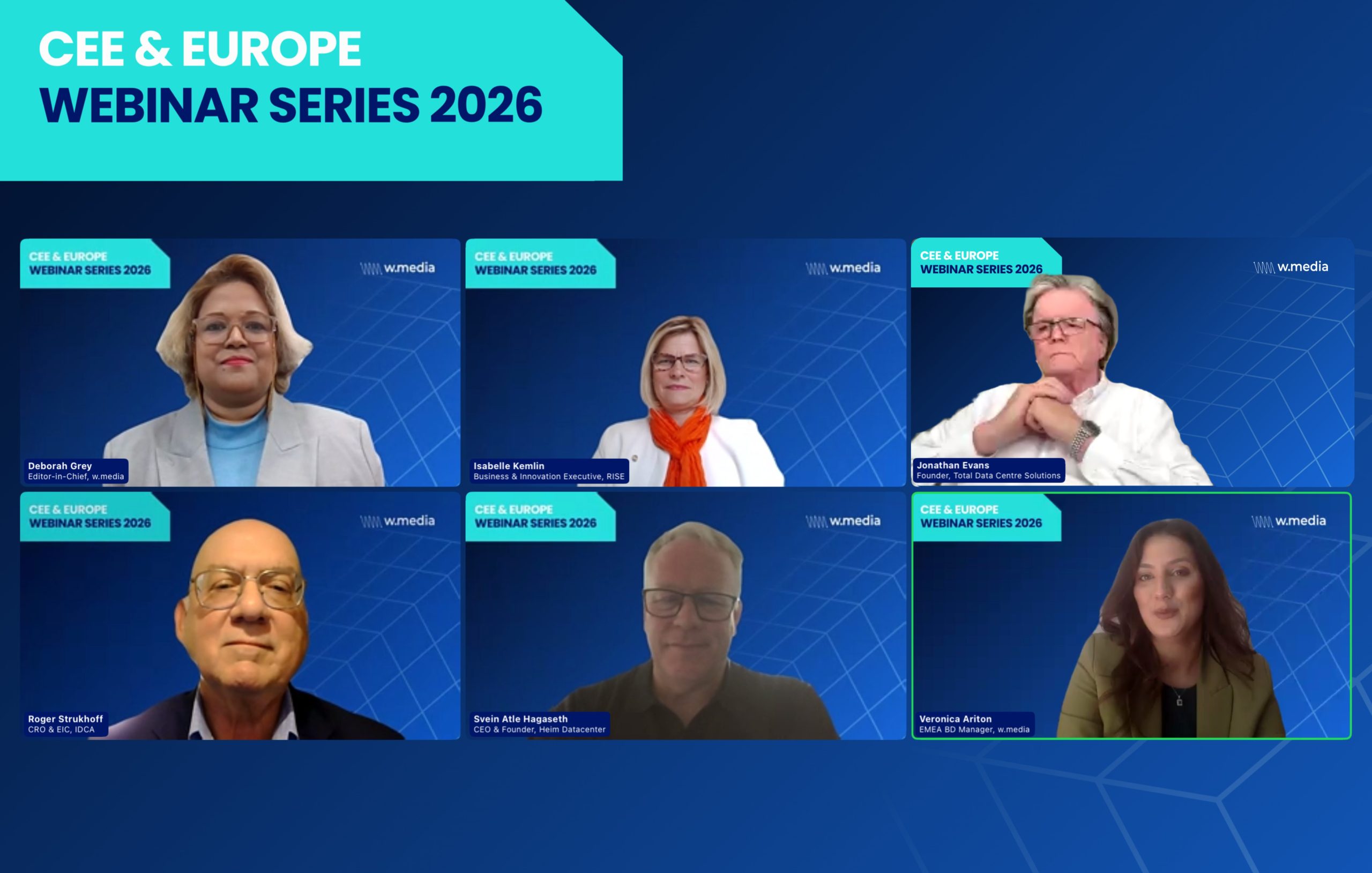
In the second episode of our webinar series covering Europe, we explored how the Nordics are emerging at the center of AI infrastructure evolution with capacity delivery at scale, access to power, grid readiness, land permitting, and long-term sustainability. The webinar delved deep into the cloud and data center market in the Nordics, taking a closer look at data centers construction, investments, and AI infrastructure development in the region.
The webinar was co-hosted by w.media’s Veronica Arinton, business development manager for EMEA, and Deborah Grey, w.media’s Editor-in-Chief. Roger Strukhoff, Chief Research Officer and Editor-in-Chief at International Data Center Authority, delivered the keynote address presenting an overview of the industry. He also moderated a panel discussion featuring the following renowned industry experts and veterans:
- Isabelle Kemlin, Business and Innovation Executive at RIZE Research Institute of Sweden
- Jonathan Evans, Founder and Director of Total Data Centre Solutions
- Svein Atle Hagaseth, founder and CEO of the Heim Data Center

Here are select excerpts from Roger Strukhoff’s Keynote presentation.
Overview of the global digital economy, and the Nordics
According to our research, we found that the entire global economy can now be classified as a digital economy, which represents more than US$ 20 trillion. Now, a digital economy is not something that’s reserved just for developed nations. There are people that have mobile phones and mobile devices in every country in the world. And so, even in very distressed developing nations, there is an element of a digital economy.
We found a range within the countries of the world of between 4 percent and 25 percent of their economies are digital. The Nordics are at the top of that list and there’s quite a disparity in the world. Today, as far as data centers go, it can be a little difficult to determine exactly. We’ve done a determination of between 64 and 69 GW and since the time of this report, we’re looking now at 67.7 GW, which takes about 2 percent of the world’s electricity.
China has enormous capacity and enormous unused capacity, our methodology is determined that China right now is at about 8 GW. within global 2 percent. There are some nations that are consuming 20 percent of all of their electricity, just to do data centers. That would be Ireland, for example, and Singapore. The United States has risen to about 6 percent, and throughout Europe, there are also many nations that are at a level of between 6 and 10 percent.
In contrast, there are more than 50 developing nations that use less than 1 percent, in fact, more like 0.1 percent of their electricity for data centers, because the electricity grids in those countries can’t serve the basic needs of the people, let alone start building massive data centers.
We have created this thing called the Digital Readiness Index, and it looks at 150 factors across a lot of different domains and areas of expertise, and we put them into three basic categories:
Economy, which also includes the amount of digital infrastructure in the nation. Environment, this one’s critical, because it includes the amount of sustainable energy and also emissions levels. Social governance, a lot of factors, corruption, income parity, human development, and government stability. We combine all those into an overall number, as well as category numbers, and again, it’s relative.
In the Nordics, there’s an overall score of 84 on a 0 to 100 scale. There’s a lot of mathematics going on underneath this, but we express it on a 0 to 100 scale. We have an optimized model where everything is just perfect, and within that standard, the Nordics, overall come up with 84, and the world average is 47.
Statistically, the world average needs to be between 47 and 53, right around the 50 level that’s where the Nordics are, the economy of the Nordics rank at 79. That would be higher, except for the very high income levels within the Nordics. The more wealth that a nation has, the more it’s expected to do. And by that standard, the Nordics rate is 79, the world average is 71.
On the environment, the Nordics are at 79. There’s a lot of sustainable energy, there’s still a lot of manufacturing in the region, and it’s interesting to note where the Nordics play in the 56 world. They may seem like relatively small nations, but combined, the Nordics would be a G20 nation. With a population and an economy that is approaching that of Canada or Australia you’re looking at a G20 economy with the Nordics. Very, very strong. And within that high level of manufacturing the environment score is 79.
The social and governance factors, the Nordics really kind of set the standard for the world come at 88, and the world average is at 42, and so that’s where the Nordics stand. Now, I think the questions that we want to answer today have to do with where are we gonna go from here? Where are we gonna go from here? The Nordics have been a very big success story, but, the question is, then, what can we do?
Key excerpts from the panel discussion
Roger Strukhoff: As far as climate, resources, technological development, and governance are concerned, the Nordic countries are very similar. So, perhaps Isabelle could start by telling us what makes Sweden different? Are there any unique advantages, or how does it stand out, among the Nordic countries?
Isabelle Kemlin: I like the Nordic perspective. So I want to start there, because I think, as you say, we have many things in common. One thing that is key, that maybe has developed because of Sweden and Finland is the connectivity infrastructure, which is not so often talked about. But this is a major advantage, because we are among the most well-connected countries in the world, and it comes from Ericsson and Nokia and these kind of companies that have kind of laid the foundation. We have now a really, strong built-out connectivity in almost every single corner of our countries. We have dense fiber networks, strong international subsea cable links, we have increasing interconnection with continental Europe which actually also makes us a European gateway for digital.
Data centers are established where the connections are good, so where the rivers meet with the sea, where the internet cables and the power cables meet. that’s where you can see the places where the biggest hyperscalers are establishing, and we see now that also very strongly with AI infrastructure.
But I also think there is a third dimension, and that is, of course, sustainability. So where you can also reuse the heat is going to become an increasing factor. But we are working very closely together, and from a Swedish perspective, we are in this region, we’re one of the biggest countries, and we have a long tradition from technical, background, technical staff who are very knowledgeable in those areas.
Roger Strukhoff: Svein, the fact is the Nordics, I think, are strongest when seen as a region, but have you seen the sort of differences among the nations within the region? Is there anything that stands out?
Svein Atle Hagaseth: Yeah, I think there are some differences between the different countries, so, when we built Green Mountain, we built it basically out of Norway, which, of course, has a fantastic opportunity due to the, the power situation in Norway, where there’s, abundant available renewable energy.
There’s a 20 percent overproduction of power in Norway each year that is kind of different between the countries. Norway and Sweden produce about the same amount of energy. But the Swedish population is twice as big. So you have two countries who are kind of net exporters of power in the Nordics, and that is Norway and Finland.
They are massive power producers so there’s good availability of renewable power across the country, currently. So, I think one of the things that made us look at Finland, compared to doing something in Norway first. Today, it’s about the ability to actually execute, and what we saw was that the regulation in Finland was a little bit better than what we saw in the other Nordic countries in regards to predictability of actually getting building permits, and also the ability to get power in the timeframe that you would like to see it. That was the reason why we decided to do our first build in Finland.
All the Nordic countries support a lot of the convergence of forces now in the market, its availability to power, it is a good technology environment, there are different countries with different kind of pros and cons, and you need to evaluate how or what you’re looking for in regards to where do you locate your data centers in the Nordic countries.
Roger Strukhoff: In this current political environment, data sovereignty is an issue that really rises up. So we urge caution regarding the hyperscalers. Svein, what can you say on that topic?
Svein Atlei-Hagaseth: A lot of the development that we did with Green Mountain back in the day was related to hyperscalers, and for us, they have been a very, very good client, of course, in regards to potential growth. We have seen growth in multiple different regions. We feel that you should always have caution, but basically, we have had a very good relationship with the hyperscalers, but not just the U.S. hyperscalers. The first one in Europe that signed a significant Chinese hyperscaler, TikTok, back in the Green Mountain days. So it’s about, I think, regardless of how you’re looking at it, it’s about getting a balanced portfolio of clients in data centers. It’s hard to say no to a hyperscaler who would like to have 10, 20, 50, 100, 200 MW of capacity.
It’s about having a balance, and when we are building our data centers now we are thinking about the ability to build what we call multifunctional data centers. The ability to support both AI training, AI inference, and cloud workloads from all our data centers, so it’s about how you can actually build a data center from a flexibility perspective to be able to accommodate that, and we’re doing that to hyperscalers, some neocloud, and to larger enterprise clients.
Roger Strukhoff: Jonathan, what are your observations about the Nordics, and as a whole, and as individual countries?
Jonathan Evans: I’ve seen the countries evolve together in some ways, but in other ways, they are very different. We sell land with power now across the Nordics. It’s become more difficult in Norway to find land with power and to find the permitting for it. Because of the administration difficulties and the difficulties dealing with the power companies. In Sweden, we used to promote Sweden as a data center destination when I worked with a company called NodeCore.
But Sweden, again, is struggling a little bit with finding sites now with sufficient power and the ability to get the permit quickly, especially around Stockholm and the south of the country. So now we’re focused mainly on Finland, because Finland has got the power available and has less regulatory problems when we obtain permits to build data centers, and the power is available. More of it is available in Finland, Norway and Sweden. So of the three at the moment, that is why Finland seems to be progressing to the top.
Roger Strukhoff: What’s your view on the hyperscalers? What experience have you had with them, and what sort of business do you think they’re bringing?
Jonathan Evans: They’ve all been building a long time in the Nordics. They were building in North Finland, building in an old paper mill back around then as well, so they’ve actually led the charge in many ways, you know, and they did so in Green Mountain.
So I’d say the hyperscalers had a huge effect on the development of those regions and everyone else is actually building for the hyperscalers still now, and although there is other demand available, it’s still mostly hyperscale demand.
Roger Strukhoff: Isabel, what do you think of the hyperscalers? And also, on the remarks about there may be some constraints that they’ve been seeing in Sweden, that it’s a little more difficult to develop in the Stockholm area than it might have been in the past. Are you seeing that?
Isabelle Kemlin: I think it’s also very important to put things in perspective, because there are countries that are not building hyperscale data centers like in Amsterdam, but there are areas and countries in the world where they even stop the build-out of the data centers. We are not in this position in the Nordics. We are net exporters, Sweden is a net exporter saying we have power, but then, of course, we need to look at where. In some areas, like in the Stockholm area, it’s starting to become crowded, from that perspective, but we have big countries, so there is plenty of space to have that. I wanted to also mention the hyperscalers. I think it’s important to really, of course, put things into perspective, because when Facebook decided to establish abroad, the place that they actually picked was Lulio in the northern parts of Sweden.
This is what was actually created, and was the start of an industry in the Nordics. It has also created a lot of things around it, and today, for example, there is world-leading research going on in Livule on data centers. There are a lot of companies and Swedish companies that have solutions that they do, for, for the hyperscalers, which is actually also able to follow them out in, in the world. Based on research from CBRI who mentioned it, between 70 percent and 80 percent up until now in the co-location companies.
Hyperscalers haven’t had the chance to build out, and they have different strategies, if they build their own, or if they go with co-location. So I think there are pros and cons, but I think also the fact that what we see in the US right now but it’s also becoming a very tough environment to actually establish, a lot of resistance towards new data centers, and I think here, and especially in the Nordics.
We think a lot around the circularity already from the start that the data centers need to be a part of the community, and that also comes with the fact that we are thinking on the sustainability factor from the beginning.
Roger Strukhoff: The Nordics are well known for a commitment to sustainability from the beginning, sustainable energy. Will that continue as far as you can see for Sweden and for the Nordics? Are you remaining committed to sustainability?
Isabelle Kemlin: Remaining committed not only to sustainability and building out the data infrastructure. Then we have the infrastructure that is the electricity infrastructure that we get the power mostly from. What we want to do is host and transfer data. That is our key we are establishing.
Because of the speed, there might be situations where we have temporary solutions up until we get the power from the power companies. Personally I believe that we have a pretty good network from the beginning in the Nordics, and we should continue to let the energy companies do their thing, and we do our thing, but we need to find ways of working together on that. So, I don’t think that that’s a long-term solution in the Nordics.
Svein Atle Hagaseth: The whole Nordic Society is built on a large degree of sustainability, and you don’t just see it in regards to power, but also in regards to a lot of other different things that are happening, especially also if you look at electrical vehicles as an example.
So, sustainability has kind of been front and center of what you’re doing. I don’t think that we’re going to do a lot of build-outs. Renewable capacity, or non-fossil-free capacity in the Nordics. Like Isabel mentioned, it might be that you’re doing it on a temporary basis. I think there are so many good opportunities, and I think just as Isabelle briefly also touched on, the ability to look at it from kind of a holistic perspective in regards to how you’re entering into these different societies, from also the power perspective you need to start early.
Hyperscalers, and the criticism of the kind of doing it on their needs. I think we need to start to look at what we need to change the whole narrative on how we’re actually building data centers, work with the local municipalities, local and central government power to look at a longer-term perspective on how we’re doing this.
Jonathan Evans: That’s what I’ve been trying to do, is help drive down the carbon footprint of data centers, and the Nordics is the ideal place to do that. The Wooden Data Center was a great example, which I haven’t been able to convince other people to do yet. They did it at the Eco Data Center. Nordics leads the way because they have the district heating functions in place for their heating systems anyway, but we’re still miles behind in terms of the capacity that can be used but the Nordics is the best, but is not doing enough, I think we only use about 3 percent of the energy at the moment that’s just wasted.
Audience Q&A Session
Deborah Grey: Our first question is from Xiaojun Mao. He asks: What is the major application for AI data centers in the Nordics? Inference, or training?
Svein Atle Hagaseth: I would say that, historically, or to this point, it’s been mainly AI training. So a lot of the development in the Nordics has been related to AI training. I think we do see a shift, though, where AI inference is coming stronger. But of course, this is back to Roger’s
initial comment as well the Nordics is not one region, and it’s a very large geographical region. So, if you look at a data center on the south tip of Norway, or in Northern Norway, there’s more than 2,000 kilometers of distance between them, so some workloads might not fit other than training for the Nordics, but if you’re south of some point, you might be able to do both AI training, AI inference, and cloud.
Deborah Grey: Our next question is from Alex Ignoshkin, and he asks: How is heat reuse being integrated into Nordic data center projects, and what role could it play in future vertical infrastructure ecosystems?
Isabelle Kemlin: So, already today, there are, existing, projects that are up and running where we are utilizing the heat. It is a low-grade heat that you need to upgrade somehow, but I think what’s, what we have is actually well-built out projects, for all we have well-built-out networks for taking care of the heat within the district, yeah, the district heating systems. So that’s already there. What we need to find now, and need to take the next… next step, it sounds easy, but we need to look at the regulation for it, because it’s not fit for purpose for actually making this happen. So this is something that we’re working on in the Swedish Data Center Industry Association. Where we actually can change the regulations slightly to actually make more, make more use of the heat for us.
Svein Atle Hagaseth: It’s about where do you locate the data centers, and how do you work with the local municipalities so that it’s not just central regulation, but also when you do, kind of, long-term planning in the municipalities on how you build homes and things like that, related to the actual capability. And then, of course, district heating is one out of many different use cases for heat reuse.
In Green Mountain back in our day, we connected the data center to the world’s largest onshore trout fish farm. So it’s not just heating houses. It’s about, kind of, having more industrial use of that energy as well.
Deborah Grey: Our next question is from Si Young Sim: What is the construction cycle in the Nordics for an AI data center?
Jonathan Evans: But the actual construction cycle will all depend on the approach of the contractor and the client, in terms of whether they go for a modular solution or whether they go for custom-built design. It would vary tremendously, but all I can say is that in Finland at the moment, the constraints will be very few in order to enable the data center to be built fairly quickly.
That’s my only thought on his concern. I can do the practical answer. When we are building our facilities, we are planning on every new facility, or every start of a new facility, it’s an 18-month build time from the permit. Or from the contract assigned. If you are doing follow-on, the typical bill period will be 12 months.

One of the key takeaways from our webinar is that the next phase of AI infrastructure growth will be defined not by demand alone, but by the ability to deliver scalable capacity in the right location, at the right time, and with long-term energy efficiency and operational resilience.
If you missed joining us live, you can watch the entire webinar here: