
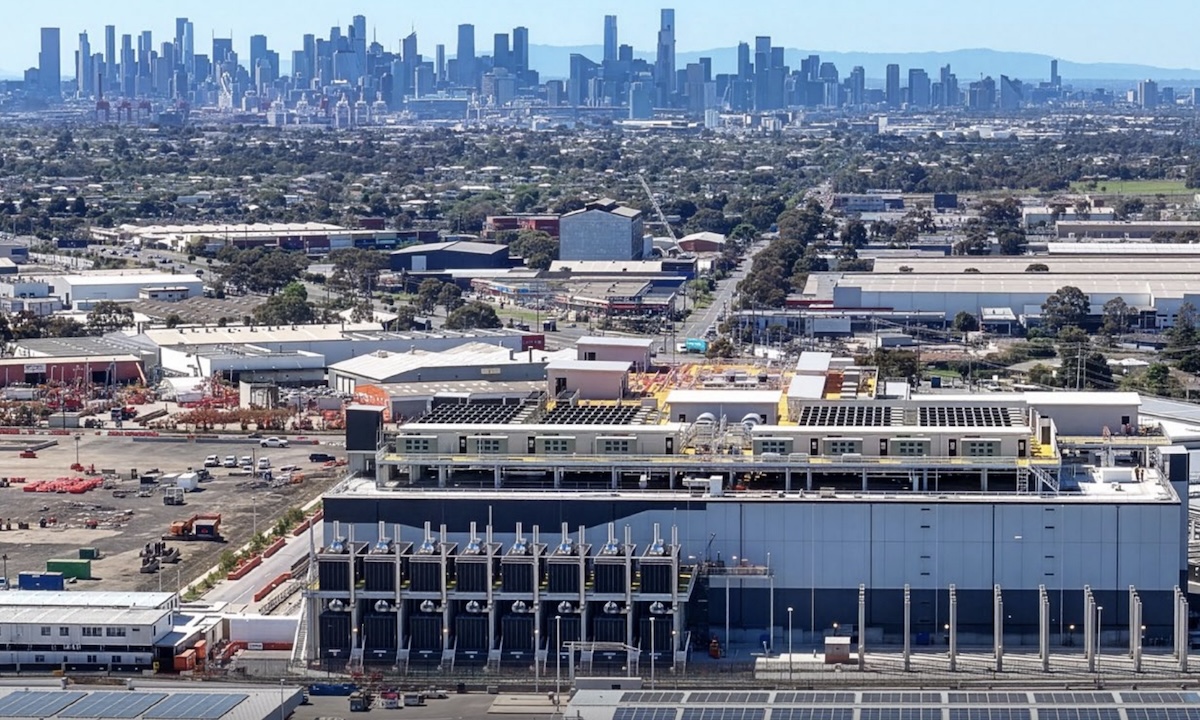
CDC Data Centres says it achieved its 2030 net-zero target four years ahead of schedule, according to its response to a federal parliamentary inquiry. In its response to the Joint Select Committee on Artificial Intelligence, the data centre operator said it achieved the target in FY26 across its defined emissions target boundary, which covers Scope 1, Scope 2 and selected Scope 3 emissions.
CDC said its sustainability reporting is prepared in accordance with Australian Sustainability Reporting Standards, including AASB S2, and is independently assured.
The company reported an operational power usage effectiveness (PUE) of 1.38 in FY26. CDC also reported a water usage effectiveness (WUE) figure below 0.02. The company said it has used closed-loop cooling systems since 2007. These systems use sealed infrastructure in which water is filled once and continuously recirculated for the life of the facility, which CDC said means its facilities do not require ongoing water consumption for primary cooling.
CDC’s response also addressed the regulatory implications of AI infrastructure, arguing that Australia’s Security of Critical Infrastructure (SOCI) framework remains fundamentally fit for purpose but was not designed as an AI governance regime.
The company supported an ongoing review of the framework’s scope to ensure emerging technologies and business models, including neocloud providers, are covered where they perform nationally significant functions or support critical infrastructure.
CDC also called for proportionate, risk-based regulation and measures to avoid overlapping compliance obligations where organisations are already subject to equivalent Commonwealth security frameworks.
On economic contributions, CDC cited modelling it commissioned in 2026 that estimated the company had supported AU$2.5 billion in gross value added through construction since 2007, alongside approximately AU$444 million in annual economic activity and more than 1,600 ongoing jobs across the Australian economy.
The company said community engagement should begin before formal planning assessment and continue throughout a project’s development, with feedback potentially influencing matters such as traffic, construction scheduling, landscaping and environmental management.