
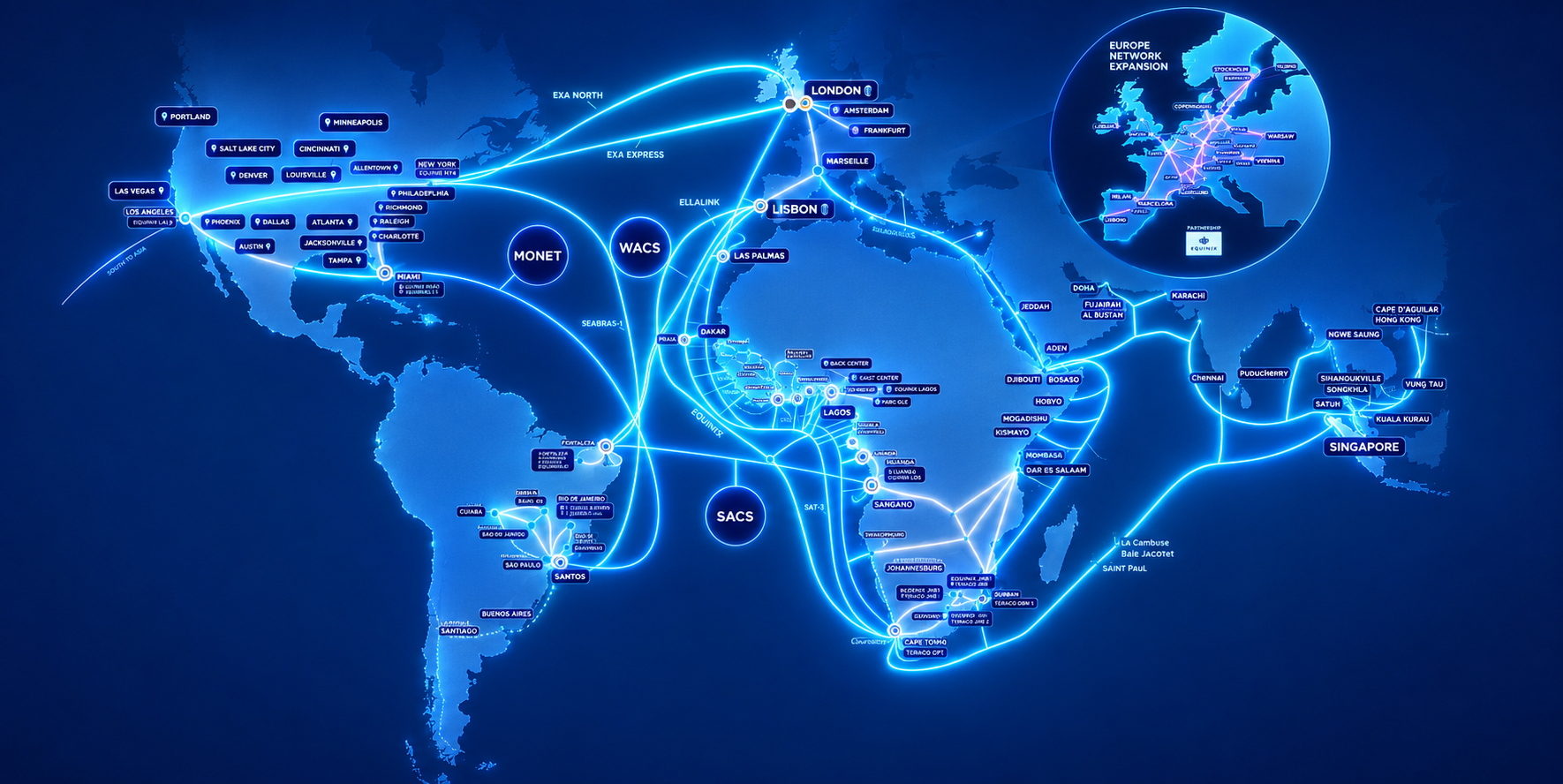
Angola Cables, a telecommunications and digital solutions provider, is planning to bolster its transatlantic network to support hyperscale, cloud, and AI traffic across the MONET and South Atlantic Cable System (SACS) subsea cables.
The MONET system links the US and Brazil over 10,556 km, while SACS bridges Brazil to Angola over 6,165 km. Together, these two systems allow data to travel between the US and Angola with a round trip delay of 130 milliseconds. As noted in a press release, the upgrades will not only support surging bandwidth demands, but also help Angola Cables simplify its operations through software control and management capabilities.

“Our submarine cable systems are a critical digital bridge connecting Africa with the Americas, offering a diverse and secure route between these continents, while demand from hyperscalers and cloud providers continues to accelerate,” said Adriano Caldevilla, Angola Cables Chief Technology Officer.
Angola Cables will deploy Ciena’s Waveserver, powered by WaveLogic 6 Extreme, along with its 6500 Packet-Optical Platform, and Navigator Network Control Suite to increase the capacity and performance of its existing subsea network. The deployment will give Angola Cables the ability to deliver high-capacity connectivity across the system, including 800G client interfaces on MONET.
“Together with Ciena, we will enhance the scale, flexibility, and intelligence of our subsea infrastructure to help customers build and expand AI-ready networks while maximizing the performance of our existing fiber assets,” added Caldevilla.
SACS was the first subsea cable to directly link Africa and South America. Its construction allowed African traffic to reach Brazil without routing through Europe and the US first. The cable was completed in 2018 and designed with a capacity of 40 Tbps. MONET has been operational since December 2017 and connects Praia Grande and Fortaleza in Brazil to Boca Raton, Florida, in the US.

According to the Africa Global Forum, the African AI market is projected to grow from US$ 4.5 billion in 2025 to US$ 16.5 billion by 2030. However, the continent has only one percent of global AI compute capacity. While countries are working to improve their compute capacity, for the time being enterprises that need access to AI compute have to look abroad for that capacity. Upgrades to the links connecting Africa to that capacity are vital as demand continues to grow and compute catches up.