
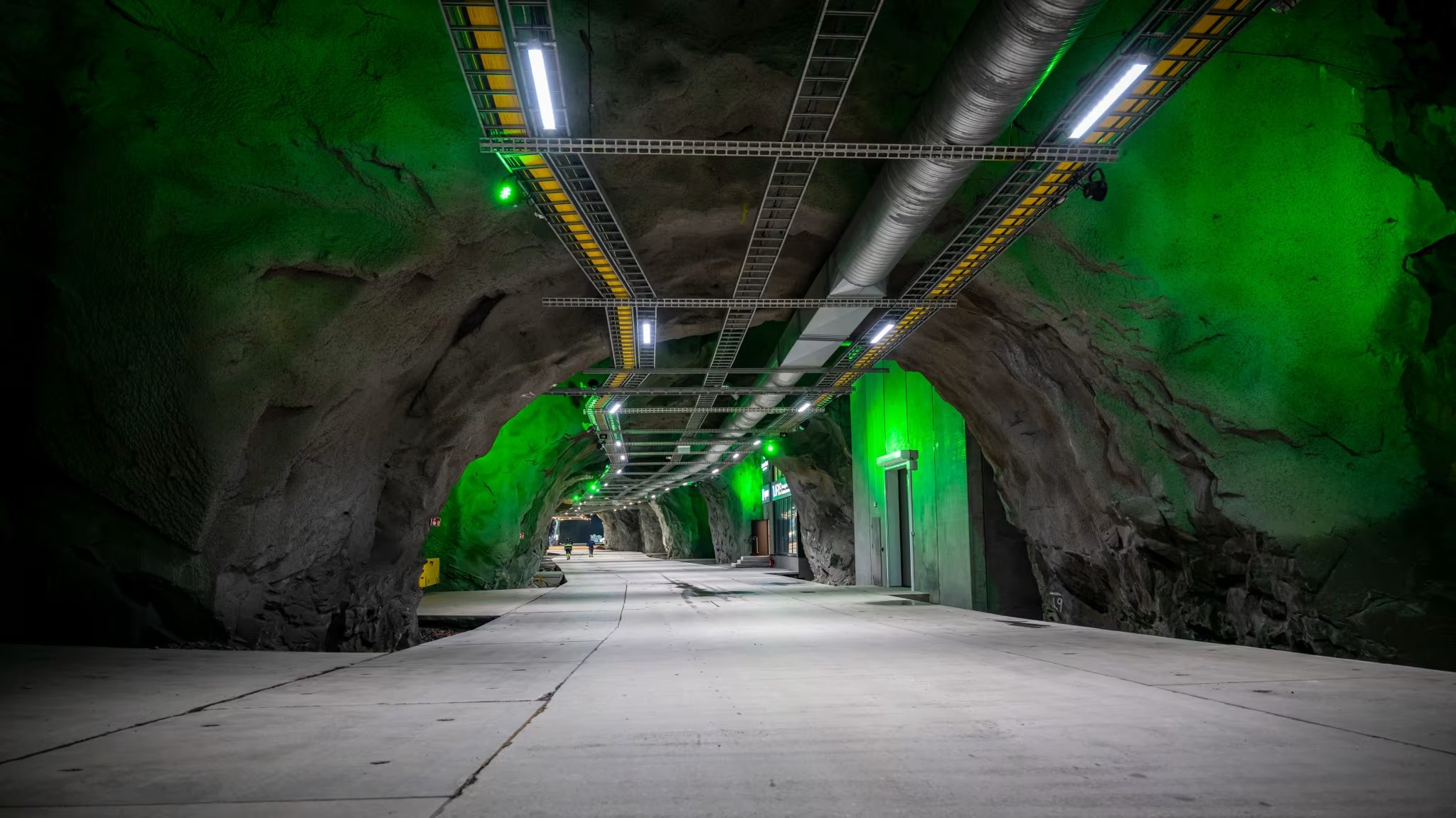
Russia is looking for innovative solutions to keep its digital infrastructure functioning amidst the ongoing war with Ukraine in wake of attacks targeting data centers. Rostelecom, a Russian telecommunication company, and Norilsk Nickel, a Russian nickel and palladium mining company, have reportedly started negotiations to build and operate data center facilities underground in order to protect digital services used by government and corporations, as the war continues.
The Norilsk Nickel mines would provide safety from Ukraine drone attacks although the financial and technical details have not been disclosed to the public. In late October, Russia’s Digital Development Ministry issued recommendations to protect data centers against aerial attacks. The measures included moving critical infrastructure underground or into bunkers, citing Kommersant. Kemerovo Oblast governor Ilya Seredyuk proposed converting depleted open-pit mines and quarries for this purpose as reported by Russian news publication Meduza.

Baxtel reported that Valeriy Ermakov, vice president, Rostelecom, during the RBC Tech forum, said, “A so-called ‘doomsday’ data center is a must-have, because backup is what allows any service provider to recover quickly.”
On November 2, Russian President, Vladimir Putin, signed a decree requiring Russian data center operators to reserve 10 percent of their available space and capacity for potential government use. While allowing a special government commission, in consultation with the Federal Security Service, to authorize the use of foreign data centers. This is a notable shift from Russia’s Sovereign Internet Law, which restricted reliance on foreign cloud infrastructure as reported by The Moscow Times.
This reflects growing Kremlin concerns about the vulnerability of domestic cloud infrastructure amid the war in Ukraine, as well as the challenges of maintaining Russia’s increasingly centralized and closed Internet, dominated by a handful of domestic technology companies.
Rostelecom has outlined three levels of data center protection. The first involves maintaining backup facilities, the second distributes computing capacity across geographically separate sites, and the third places infrastructure underground, according to a company source cited by Vedomosti.
Readers would recall that Ukraine and Russia have exchanged numerous attacks on their national digital infrastructure. Ukrainian drone attacks between October 12 and 14 significantly disrupted Russia’s technology sector, damaging three data centers operated by technology giant Yandex and affecting dozens of online services nationwide. Russia’s major technology company VKontakte (VK) also confirmed that its data center in Novosergievka had been struck by a drone, although its services remained operational. A separate attack targeted a data center under construction for Russian state-owned lender Sberbank in Balakovo, Saratov region.
The attacks were believed to be retaliatory, following Russian strikes on Ukrainian data center infrastructure in mid-to-late September. These attacks damaged facilities used by internet providers UTELS and Pavutyna, as well as the BeMobile data center, which was hit by a Russian drone strike. The strikes also affected UCloud, a service provider operating from the facility, and De Novo, one of Ukraine’s largest commercial data center operators.
Serhiy Petrenko, former head of Yandex Ukraine, has estimated that around 80 percent of Russia’s data centers are concentrated in Moscow and the surrounding region, leaving much of the country’s infrastructure within range of Ukrainian long-range drones as reported by The Kyiv Independent.
What Russia is doing now, is similar to what Norway has already done. The Nordic country is home to two notable examples of underground data centers built within former mines. Green Mountain’s facility Rennesøy island and Lefdal Mine Datacenter in western Norway both repurpose underground mine infrastructure to house servers, taking advantage of the natural protection and stable conditions provided by the surrounding rock.

Both facilities also use cold seawater from nearby fjords for cooling, reducing reliance on energy-intensive conventional cooling systems. Green Mountain draws water from approximately 100 meters below the surface, where temperatures remain close to 8 °C year-round, while Lefdal pumps cold fjord water directly into its cooling system. These approaches significantly reduce cooling energy consumption and improve overall energy efficiency. Russia also has several geographies that are blessed with a cold climate and thus low ambient temperatures, ideal for data centers.