
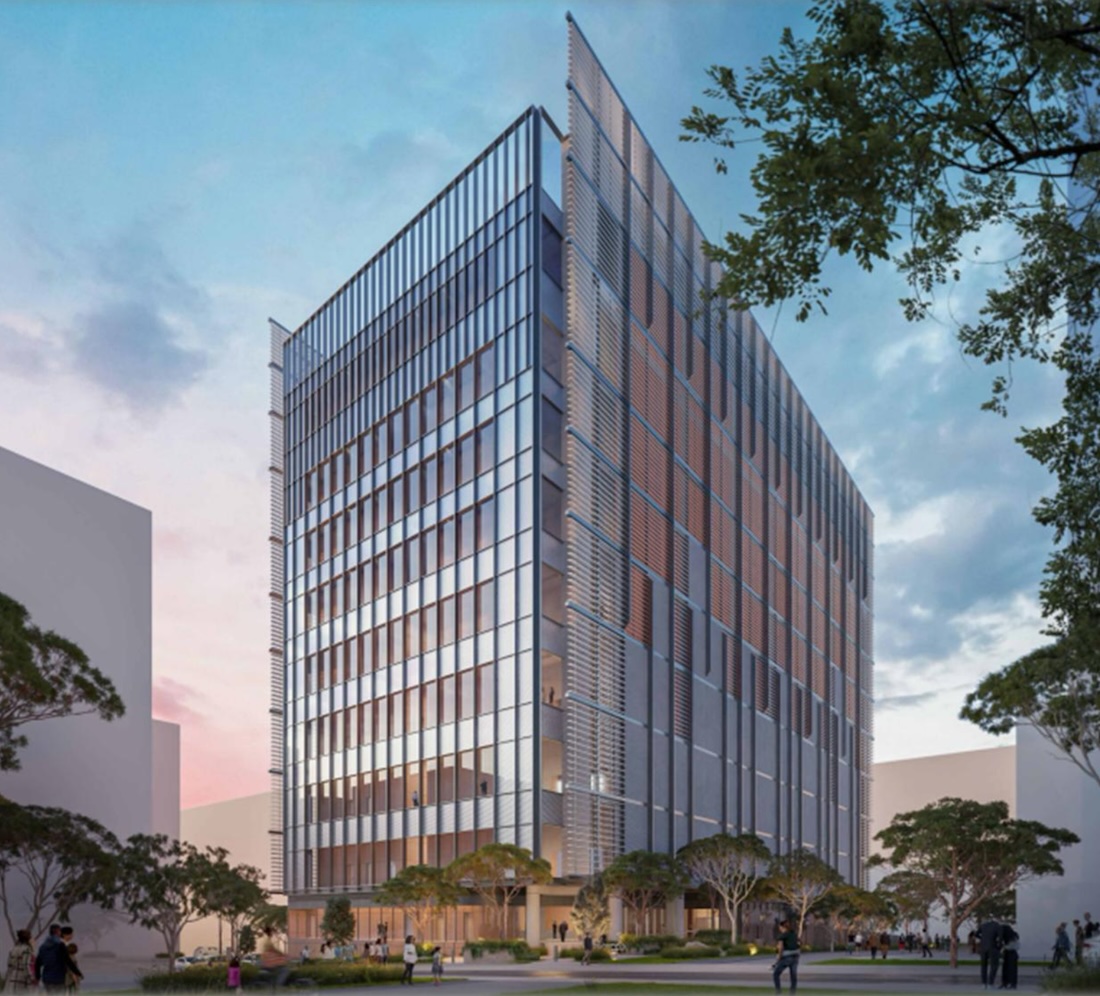
Stockland has secured approval for a AU$630.4m, 49MW data centre in Sydney’s Macquarie Park, with the 10-storey facility set to provide 34.3MW of IT load across eight data halls. The NSW Department of Planning, Housing and Infrastructure approved the Road 1 Data Centre at 1-5 Khartoum Road on 1 October, following an assessment that focused on air quality, noise and the visual impact of the building.
The project will occupy an 8,096-square-metre site and have 13,307sqm of gross floor area, with a maximum building height of 72.8 metres. Alongside the eight data halls, the facility will contain offices, ancillary space, cooling infrastructure and backup power systems. It will also involve construction of parts of Road 1 and Road 23, landscaping and associated earthworks.
Stockland estimates the development will cost AU$630.4m and create up to 250 full-time equivalent construction jobs and 50 operational positions.
The project is being developed within the Macquarie Park business precinct, alongside existing and approved data centre developments. Stockland identified the site as appropriate because of its access to sufficient power and utilities, public transport and proximity to the technology industry, industry partners and Macquarie University for research and development. The department found the use permissible in the E3 Business Productivity zone and consistent with strategic planning for Macquarie Park.
The facility will have a substantial backup power system, comprising 18 3MW diesel generators and one 1MW generator, six diesel storage tanks with a combined capacity of 450,000 litres, and 225,000kg of lithium-ion batteries. Cooling will be provided by 16 cooling towers, 16 water-cooled chillers and 128 fan-wall units.
The consent limits total power consumption to 49MW and generator capacity to 55MW. Generator operation, excluding unplanned outages, is limited to 55.4 hours a year, counted collectively in real time, with only one generator permitted to be tested at a time at full load. The consent also explicitly prevents the generators being used to sell electricity into the National Electricity Market, support load curtailment or operate during planned power outages.
Water use was one of the issues raised during the assessment. The data centre is expected to consume up to 2,018 kilolitres of potable water a day at peak capacity, primarily for its hybrid evaporative cooling system. The project is targeting a Water Usage Effectiveness (WUE) of 1.5, with rainwater harvesting, water treatment and air-side HVAC measures intended to reduce consumption.
The project will also target a five-star NABERS rating and a PUE of 1.35. The consent requires annual reporting of electricity and water efficiency and greenhouse gas performance, as well as ongoing emissions monitoring. Stockland must also offset the data centre’s operational electricity emissions through NSW-based renewable energy supply, including power purchase agreements and firming arrangements.
Air quality rethink
Air quality was a more significant issue during the assessment. Initial modelling identified potential nitrogen dioxide exceedances at future residential receivers in Stockland’s planned build-to-rent development adjoining the data centre, at heights up to the 39th floor. The department required further modelling and mitigation, after which Stockland proposed higher-performance generators and selective catalytic reduction systems designed to cut NOx emissions by 85 percent.
Further computational fluid dynamics modelling showed that the proposed mitigation would bring NO2 concentrations below the relevant criteria at the affected receiver locations, with the highest predicted concentration at 54 percent of the criterion.
The final consent requires generator exhaust stacks to reach 72.8 metres and caps total NOx emissions from the backup generators at 3.5 tonnes a year. It also requires annual emissions testing and an Air Quality Management Plan before operations begin.
Noise check
Noise was another key concern, particularly given the 24/7 operation of cooling systems and the presence of backup generators as operational noise sources. The department said modelling demonstrated compliance with operational noise criteria at residential receivers, including during night-time periods. The consent limits generator use, outside unplanned outages, to 7am-10pm Monday to Saturday and 8am-10pm Sunday, imposes operational noise limits and requires noise verification reporting.
The development attracted five public submissions during exhibition, including three objections, one submission in support and one comment. Concerns included noise and air pollution, energy and water consumption, and whether a data centre was an appropriate use for a site close to public transport and mixed-use commercial and residential areas. City of Ryde Council also raised issues around the planning agreement, parking, the Road 1 frontage, public-domain works, traffic and civil engineering.
The department ultimately concluded that the project’s residual noise, air-quality and visual impacts could be adequately mitigated and managed. It said the development would provide additional data storage capacity in an established commercial area and was consistent with state and regional planning strategies supporting knowledge-intensive employment and economic productivity.
The approval will lapse after five years unless physical construction has commenced.