
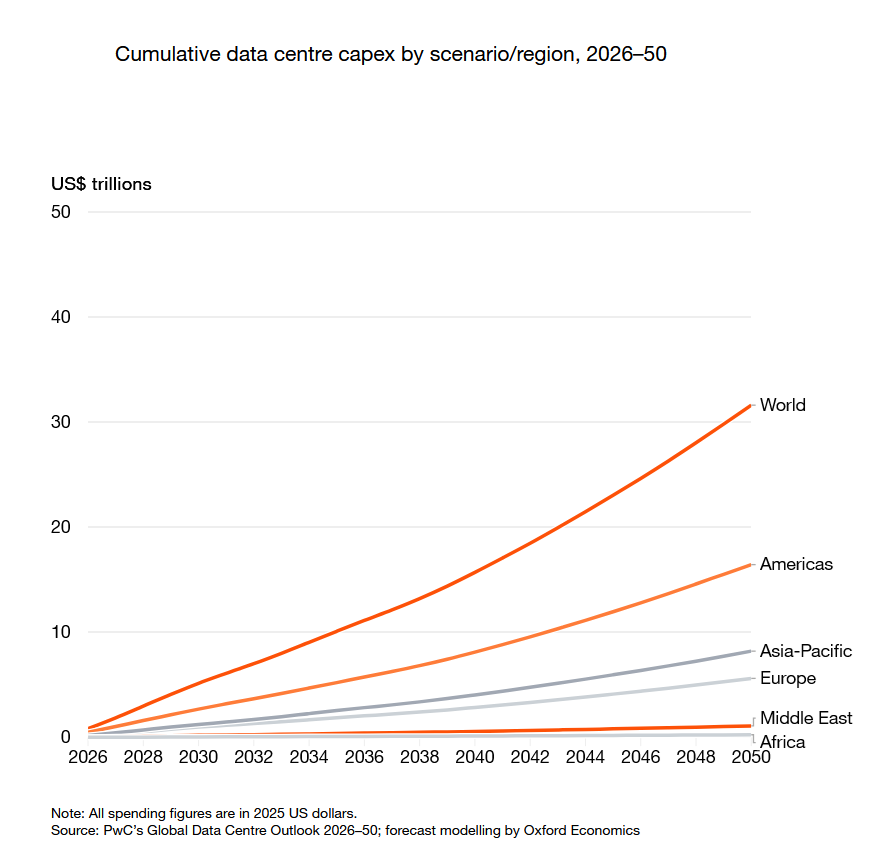
Global investment in AI infrastructure could hit a record US$ 31.6 trillion through to 2050, according to baseline projections in PwC’s Global Data Center Outlook. The US, which is central to the advanced-chip ecosystem, is expected to capture almost half or 48 percent of this investment, at US$ 15.1 trillion.
It also forecasts that on an annual basis, data center capital expenditure could rise from roughly US$ 800 billion per year in 2026, to US$ 1.8 trillion per year in 2050. In a press release, PwC further said that Asia Pacific is expected to account for US$ 8.2 trillion cumulative capital expenditure, led by China and India, while sovereign AI strategies are accelerating investment in Europe and the Middle East.

PwC commissioned Oxford Economics to model data center capital expenditure across 46 countries/territories and five regions. “Unlike traditional infrastructure booms, which taper off after the initial build out, AI infrastructure investment is expected to accelerate as chips and other ICT equipment require upgrades every few years,” it said, adding that Information and Communication Technology (ICT) equipment will account for an increasing share of investment, growing from 70 percent today to 93 percent by 2050.
“AI infrastructure is becoming one of the defining capital allocation challenges of the next generation. It cuts across technology, energy, real estate, supply chains, regulation and financing. This changes how infrastructure investors need to think about capital requirements, risk and returns,” says Clara Cutajar,Global Infrastructure Leader, PwC Australia. “The AI buildout is not a rising tide that will naturally lift all boats. Capturing this investment requires active positioning. Investors should recognize data centers as hybrid assets with a complicated risk profile.”
The Outlook identifies five factors: power, connectivity, security, policy certainty, and community consent, that it says will direct where investment flows globally. It also says that GPU access will also influence where investment lands. The Outlook covers 46 countries and territories, spanning both data center buildings and the technology they contain.
