
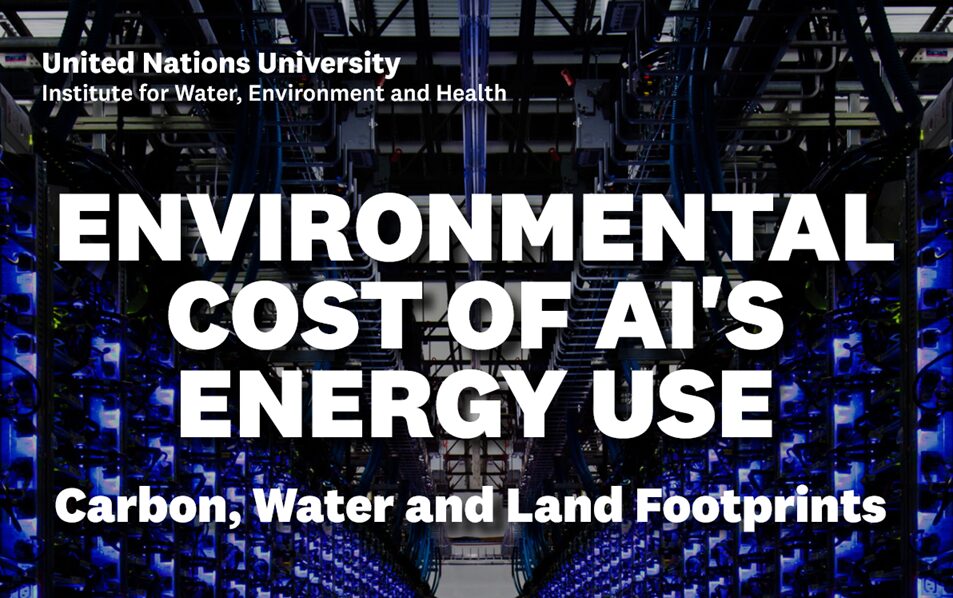
Amidst growing concerns surrounding data center sustainability comes a report by the United Nations that finds that AI’s water use will match the needs of 1.3 billion people, while its power use will triple that of 650 million by 2030. AI data centers are projected to consume 945 terawatt-hours of electricity.
“This is nearly triple the combined annual electricity use of Pakistan, Bangladesh, and Nigeria—countries collectively home to more than 650 million people,” says the report titled Environmental Cost of AI’s Energy Use: Carbon, Water and Land Footprints, by the United Nations University Institute for Water, Environment and Health (UNU-INWEH). It further says, “Their associated water footprint will equal the basic annual domestic water needs of all 1.3 billion people in Sub-Saharan Africa, and their land footprint will exceed 14,500 square kilometers, roughly twice the Jakarta metropolitan area, home to more than 32 million people.”

Beyond carbon emissions
The report doesn’t just look at carbon emissions as a measure of the environmental cost of AI data centers. It also looks at land and water use, and its impact on nearby communities and ecosystems. It found that data centers consumed an estimated 448 terawatt-hours of electricity in 2025. “If treated as a nation, they would have been the world’s 11th largest electricity consumer, behind France and ahead of Saudi Arabia,” says the report.
“What surprised us most is how often the choices that look greenest from a carbon perspective end up worse for water or for land,” said Dr. Miriam Aczel, UNU-INWEH Researcher and the lead author of the report in a press release. “If we keep judging AI sustainability by carbon alone, we might think that renewables make AI infrastructure clean but that is solving one problem while creating other problems, often in places that didn’t ask for it.”
Inference consumes more resources than training
The report finds that while a large amount of energy is consumed while training AI models, the consumption is far greater for inference and prompt processing. It then goes on to give examples of how much energy is consumed every time an AI user prompt is processed. “ChatGPT alone is estimated to process around 2.5 billion prompts per day, translating to roughly 383 GWh of electricity per year for a single product. Offsetting associated carbon emissions would require 2.6 million tree seedlings grown for 10 years, enough trees to cover a land area the size of Manhattan,” says the report. It also finds that the water footprint is equivalent to the minimum annual domestic water needs of roughly 500,000 people in Sub-Saharan Africa, and the land footprint is equal to over 800 football fields.
When it comes to using AI for image generation the report puts it into perspective saying, “A typical conversational chat query is around 200 times more energy-intensive than basic text classification. Generating a single AI image can require around 1,450 times that baseline.” It further says that a single short AI-generated video can consume as much electricity as 200,000 spam classifications.
“A lot of people think that the environmental footprint of AI reduces, as technology improves and processes become more efficient. But that is only a partial picture of the overall problem,” said Professor Madani, a co-author of the report who was recently named the 2026 Stockholm Water Prize Laureate. “More efficient and affordable AI and energy mean more consumption of AI, making the overall footprint far bigger than what we save through efficiency gains.”
Disproportionate impact on resources available for the underprivileged
The report goes on to give the example of Ireland where data centers accounted for 21 percent of total metered electricity in 2023, exceeding all urban households. The national grid operator has paused new approvals around Dublin until 2028. Similarly, in Querétaro, Mexico, expanding compute infrastructure is drawing on water supplies amid prolonged droughts. In Uruguay, plans for a water-intensive data centre coincided with a 2023 drought that depleted Montevideo’s freshwater reserves, making tap water unsafe to drink.
It also warns that AI infrastructure could generate up to 2.5 million tonnes of electronic waste each year by 2030. Moreover, much of it is processed in low-income economies with limited safeguards, while critical minerals are extracted in jurisdictions with weak environmental oversight.
“If you map where data centers are getting built against where water stress is worst, you tend to see the same regions in some instances,” said Dr. Mir Matin, Manager of UNU-INWEH’s Geospatial, Climate and Infrastructure Analytics Programme and a co-author of the report. “And the communities living near these sites are not necessarily the ones using the AI being run there. That asymmetry is the issue. Without fixing it, we’ll just be repeating older patterns, where some places carry the costs and other places capture the benefits.”
The way forward
The report calls for a responsible AI ecosystem built on six principles: transparency; efficiency by design; equity and environmental justice; lifecycle responsibility; global cooperation; and sustainable use.
“This report is not a case against artificial intelligence, a technological transformation that is improving the lives of billions of people around the world,” said Professor Kaveh Madani, Director of UNU-INWEH who led the investigation team. “It is a call for using it responsibly and addressing its unintended impacts proactively to make it sustainable and equitable. We have a narrow window to ensure that the backbone of the technological revolution of our era develops within planetary limits, and that the communities who provide the critical minerals for advancing AI and the ones that host its infrastructure and e-waste are also among those who benefit from it.”
If you too are passionate about data center sustainability, do check out Issue 13 of w.media’s Cloud & Datacenters magazine where we take a deep dive into green building, energy efficiency and sustainable data center operations. Click the image below to read our magazine online.
