
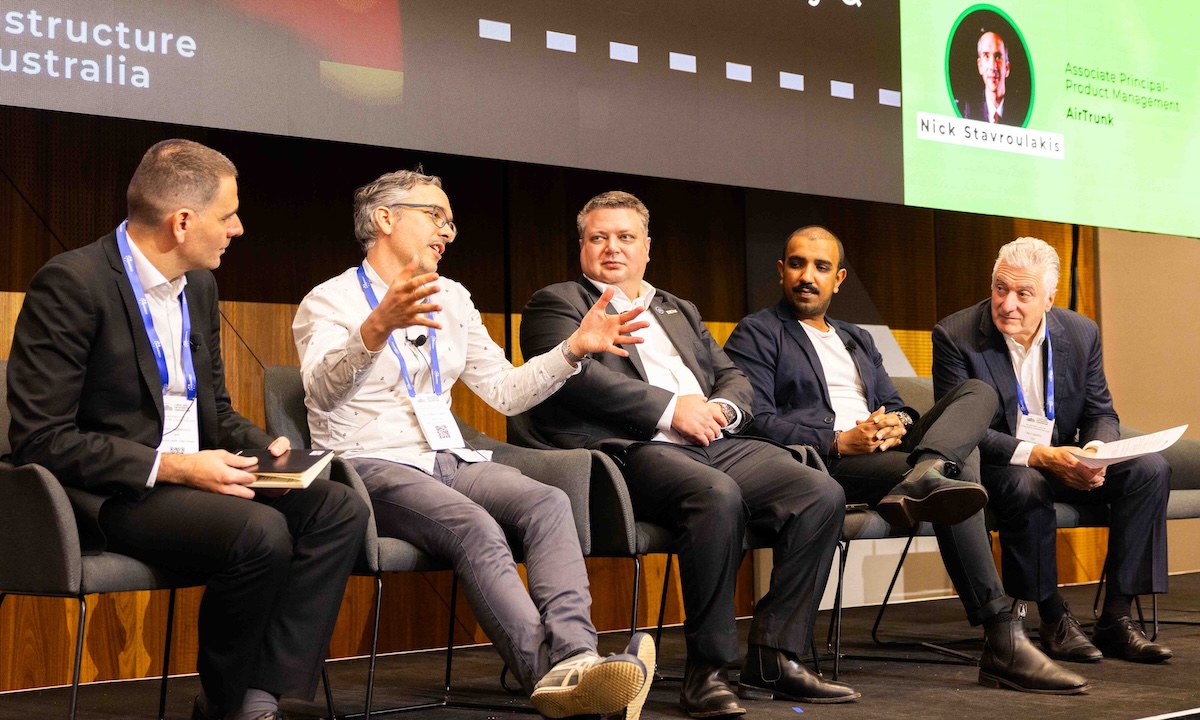
Transmission bottlenecks, gigawatt-scale customer demands, and the shift to modular construction dominated a candid panel discussion on next-generation data centre design at the recent Melbourne Cloud & Datacenter Convention, with four senior industry figures painting a picture of an industry actively working through constraints rather than being stopped by them.
The session, Constructing the Next-Gen Data Center: Designing for Sustainability, Scalability & Speed, brought together GHD national data centre leader Milan Vujasinovic, AirTrunk associate principal for product management Nick Stavroulakis, BDX Data Centers senior director of acquisitions APAC Alex Moffatt and Insite DC co-CEO Nauman Akhtar.
When it comes to power, the panel was clear-eyed about where the constraint actually sits. “The biggest challenge for the industry is power – availability of power, physical connection points, and capacity in the network,” said Vujasinovic. “It’s not so much an issue in capacity per se – there’s lots of renewable generation out there generally – but the transmission is the problem. We can’t get the power from A to B effectively.”
He pointed to a fundamental mismatch in planning horizons. “We’re talking months, they’re talking years. We’re talking years, they’re talking decades.”
Moffatt put numbers to the problem from a site acquisition perspective. Even being a kilometre from a terminal station offers little comfort, he said: “It’s still a 2028 connection.” The practical radius for viable connections is five to ten kilometres into the medium or high voltage network, and even then the queues are long. In Melbourne, grid connections are running at 2028; in Sydney, he said, it’s 2029 to 2030, which goes some way to explaining why Melbourne has become the faster-growing market.
Akhtar described customer demands arriving into the Australasia market that would have been unthinkable recently: “We’re seeing customer demands within the 2026 era which are within the gigawatts.” He added that rack densities have moved sharply alongside this, from the six-to-eleven kilowatt per rack that defined cloud-era builds to somewhere between 100 and 250 kilowatts per rack in AI configurations – “and it’s going only in one direction.”
Moffatt flagged one approach already being tested in Western Australia – bypassing the transmission network entirely by following the gas pipeline instead. “You can actually run completely from gas. It works in the US, it works in other markets.” He acknowledged it won’t necessarily apply on the East Coast, but held it up as evidence the industry is exploring alternatives rather than simply queuing.
Both Victoria’s consolidation of grid approvals through VicGrid and Greater Western Water’s proactive engagement with the data centre sector drew explicit praise from panellists. “They have nailed the data centre market,” Akhtar said of Greater Western Water. “Really sitting down and working with us rather than against us, offering actual practical solutions.”
The case for modular
Once power is secured, the challenge becomes scale and, here, the panel turned to what Vujasinovic described as an underused tool in Australia: factory-based prefabrication. “Outside of Australia, people are manufacturing in factories up to 80% or more of their facility – the entire facility, the walls, the floors, the ceilings, everything – and what they’re achieving is a 50 percent improvement on schedule.” He cited a US client turning on 10 megawatts of capacity per week using this approach.
Moffatt described projects in Asia where prefabricated power units and gantries – roughly the size of large shipping containers, fabricated in places like Dublin, North America, or KL – are craned into position alongside a conventional concrete-and-steel data hall shell. “That’s half of your building being delivered to site that’s been fabricated off-site…it basically shaves every bit of 12 months out of each stage of that build.”
Stavroulakis noted that hyperscalers, including the major cloud providers, have increasingly shifted from colocation arrangements toward self-build and built-to-suit models, bringing with them design specifications shaped by experience in the US and EMEA. “We’re seeing a lot of that modularity piece really start to hit home.” The qualification, he said, is supply chain: “We’re not only having to streamline our prefabrication capacity, but those resources are constrained because we are relying on international markets for that supply chain.”
On standardisation, often cited as the pathway to faster procurement, there was broad agreement on the direction but realism about the pace. “Standardisation is the unicorn,” said Moffatt. “It’s what everyone’s ultimately hoping to get to, but we’re a long way from that.” Vujasinovic added: “The approach needs to be standard but flexible.” The ability to commit to orders 12 to 18 months in advance – a function of building at scale with known schedules – gives operators considerably more leverage with constrained suppliers.
Akhtar framed the balance as finding where standardisation delivers speed without sacrificing site-specific opportunity: “If you can make sure you’re using standardised plant equipment so that you can get it quickly and not change everything on every project – but also where you can flex, having that flexibility so you’re not being wasteful.”
Water in context
Water, the panellists argued, is increasingly well-managed – and frequently misrepresented. Stavroulakis flagged how public reporting tends to use worst-case peak consumption figures, extrapolated across the full year. “You might use that water for a few minutes at the peak, but you might use no water at all in June and July.”
Akhtar pointed to the shift in cooling design as the more substantive story: “A lot of our fundamental designs are now heavily water-efficient solutions – closed loop circuits, top-up strategies, nighttime fill requirements. We’ve gone from direct evaporative cooling to pure air-cooled scenarios with adiabatic pads.” He described many current facilities achieving a PUE of 1.3 at peak even with air-cooled solutions.
Moffatt described an emerging model where data centres are becoming the off-take customer for treated recycled water – water that might otherwise be discharged. Water authorities in both Sydney and Melbourne are telling operators there will be significant supply, Moffatt said – there is so much potential output from treatment plants that based on current data centre requirements, excess volume would still remain available. In several projects, he said, the data centre’s commitment to purchasing that recycled water is what can bring forward the water treatment investment case. “They’ve been either not going forward with the projects, or designing them for discharge.”
Akhtar described projects where recycled water is now the primary top-up strategy. “Not only are we reusing water that could have just been discharged — we’re now basically making it a circular economy scenario.”
Vujasinovic connected these decisions back to the cooling system selection process, describing it as the central variable from which water and energy outcomes both flow: “As you start your project and go through your initial design considerations, there’s location of the site, workload density, site constraints, operational requirements – and you come up with a holistic outcome as to what’s best for that site, for that application at this point in time.”
Sustainability baked in, not bolted on
On sustainability more broadly, the panel pushed back against any suggestion it is still a secondary consideration for data centre operators. Moffatt described three interconnected drivers – customer sustainability reporting requirements, funding conditions, and operator intent – all pointing in the same direction. “It’s baked into every part of the data centre from day one: sourcing, even embodied carbon or recycling what might already be on site.”
Stavroulakis noted that data centre power purchase agreements are directly underwriting new renewable generation projects – “where we’re buying power, customers are buying the power, they put in the agreement to buy X kilowatts, and it makes it stack up.” He added that as the grid decarbonises, embodied carbon in the building itself becomes proportionally more significant over the facility lifecycle.
Vujasinovic pointed to Amazon’s recent announcement of 430 MW in new PPA agreements in Australia, bringing that company’s total Australian renewable commitments to 990 MW as a single data point on the scale of the sector’s renewable investment. He also raised the potential for materials like engineered timber and other low-embodied-carbon materials, already used in data centre construction elsewhere, and noted that factory-based prefabrication offers better material utilisation and reuse than on-site construction.
The panel was moderated by Paul Stathis, CEO of Digital Infrastructure Advocacy Australia (DIAA).