
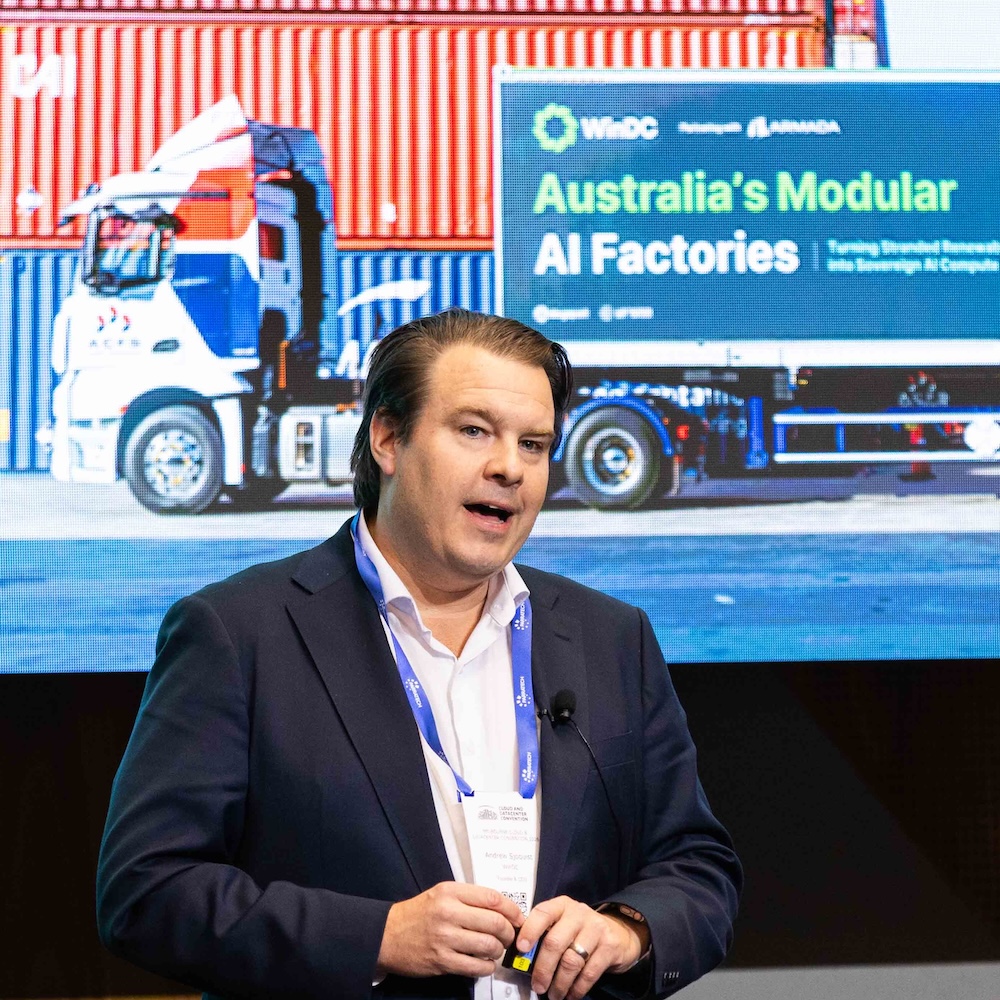
WinDC founder and CEO Andrew Sjoquist has spent more than a decade inside Australia’s energy system, helping connect over six gigawatts of generation assets to the national electricity market. When he views the data centre industry’s current infrastructure debate, he thinks it is asking the wrong question.
“Everyone is trying to solve the same problem – how do we build enough infrastructure to support this wave of AI,” Sjoquist told attendees at W.Media’s recent Melbourne Cloud & Data Center Convention. “And depending on who you talk to, the constraint is either GPUs, capital, or people. I spend most of my time inside the energy system, so I’ll give you a different answer. The answer, I believe, is power.”
That argument, that the bottleneck is not inside the building but in how the energy system moves power to where it is needed, formed the backbone of his presentation in Melbourne and resurfaced soon after when he gave evidence before New South Wales’ Public Accountability and Works Committee, which is conducting a parliamentary inquiry into data centres.
The curtailment problem
Sjoquist’s starting point is a number he returns to repeatedly: 7.2 terawatt hours. That is the volume of renewable energy that was curtailed – effectively wasted – across regional Australia in 2025 alone. “That’s enough energy to supply roughly two million homes,” he told the inquiry, “and more than double the estimated electricity consumption of Australia’s entire built data centre sector today.”
His argument is that this wastage is not incidental; it is structural. Australia has been building generation faster than its transmission infrastructure can absorb, a problem Sjoquist says he observed first-hand on a wind farm in northern New South Wales more than a decade ago, when a perfectly operational turbine was instructed to shut down, not because demand was absent, but because the grid could not handle the load.
“Fast forward 12 years,” he told the Melbourne audience, “it’s widespread across the grid.” The conventional response to this mismatch – build more transmission to carry power from regional generation to metropolitan demand – is, in Sjoquist’s view, both slow and increasingly unnecessary for a significant share of data centre workloads.
“The grid and resources for moving electricity into metropolitan areas needs to be prioritised to people and place,” he told the inquiry. “As for giant hotels for computers, it often doesn’t really matter where they are, to some degree.”
Flipping the development stack
The model Sjoquist is building at WinDC starts from that observation and works backwards. Rather than selecting a site based on land availability and then procuring power, the company identifies renewable energy assets first and colocates modular compute infrastructure alongside them – deploying containerised, “waterless” data centres at solar and wind sites, operated as what he describes as “a new class of energy-linked digital infrastructure.”
The practical benefit is measurable in his view. Moving power long distances through the national electricity market incurs losses captured in AEMO’s Marginal Loss Factor framework – up to 20 percent for assets in constrained parts of northern New South Wales. A data centre consuming power at the point of generation avoids those losses entirely.
“If you were consuming a megawatt but buying your PPA from an asset with a 20 percent margin loss factor, you would actually need to be generating 1.2 megawatts to get your resulting megawatt,” Sjoquist explained to the inquiry. The industry’s standard efficiency metric, Power Usage Effectiveness, he argues, captures none of this as it measures only what happens inside the building’s perimeter. “With an abundant mindset, we can’t as a society say that this is someone else’s problem. A system-wide approach needs to be taken.”
In Melbourne, he went further, proposing a new headline metric he calls “generated GPU efficiency” – a complete end-to-end view from electron creation to compute output, designed to replace PUE as the industry’s primary optimisation target.
Two tiers, not one
Sjoquist is careful not to argue that metropolitan data centres should be replaced. His thesis is that the market is splitting into two distinct tiers with different economics, and the industry has been slow to acknowledge it.
The first tier, urban and edge facilities, serves latency-sensitive applications, pays a proximity premium, and will continue to cluster around population centres. The second tier is energy-aligned and regional: denser, more cost-sensitive, better suited to high-throughput AI workloads where the sub-150-millisecond latency threshold that humans can perceive is rarely in play.
“The mistake is to turn latency into a blanket veto,” he told the Melbourne audience, pointing to Nvidia’s own distinction between latency-sensitive real-time applications and high-throughput batch processing. “The market leader in AI infrastructure is telling you there is not one workload class out there.”
At the NSW inquiry, he made the same point in practical terms, noting that AI training workloads in particular are highly “schedulable”. Average utilisation across data centre infrastructure sits at around 50 to 60 percent, he observed – meaning significant capacity already sits idle as a contingency. A 40-year-old aluminium smelter at Tomago can participate in AEMO’s demand response market; modern AI workloads should be capable of the same.
Water, planning and the regional opportunity
WinDC’s modular approach also sidesteps one of the inquiry’s other central concerns: water. The company uses closed-loop liquid cooling with refrigerant rather than evaporative systems, consuming no potable water. Sjoquist acknowledged the trade-off – slightly higher electricity use – but was direct about the priority. “We think preserving the water is more important than consuming a little bit of extra power, particularly where we’re not incurring MLF losses anyway.”
On planning, Sjoquist advocated for a concept he called a Digital Economic Zone – a DEZ to accompany each Renewable Energy Zone – that would provide regulatory clarity for energy-aligned data centre investment, streamline approvals in appropriate locations, and allow communities to participate directly in the digital economy rather than watching infrastructure concentrate in capital cities.
He said that fibre connectivity, often cited as a barrier to regional deployment, is already more advanced than commonly assumed: Transgrid’s own fibre network runs directly into the REZs as part of high-voltage transmission infrastructure.
His broader argument to the inquiry was that the current debate – framed largely around the costs data centres impose on metropolitan communities – is missing a significant opportunity. “Australia has a genuine opportunity not only to support domestic demand but to participate in a rapidly growing global AI infrastructure market,” he said. “Global compute demand is effectively searching for power. Australia’s job is not just to offer land and planning pathways. It is to rapidly convert energy into higher value digital output.”
Sjoquist gave evidence to the NSW Public Accountability and Works Committee’s inquiry into data centres in May 2026 and presented at the Melbourne Cloud & Data Center Convention in April this year.