
Bridge Data Centres (BDC) does not just adopt ESG principles — it builds its entire business on them. From day one, sustainability has been embedded into the company’s DNA, guiding its decisions, shaping its innovations, and driving its long-term objectives. As global expectations around Environmental, Social, and Governance (ESG) intensify, BDC stands out by treating ESG not as a compliance exercise, but as a strategic blueprint for resilient growth, operational excellence, and meaningful impact. To highlight these market-leading moves as well as small incremental steps, the company has compiled its inaugural 2024 ESG Report, designed to give a comprehensive look at how the Bain Capital-backed hyperscale data centre platform deals with the green imperatives now sweeping across the globe.
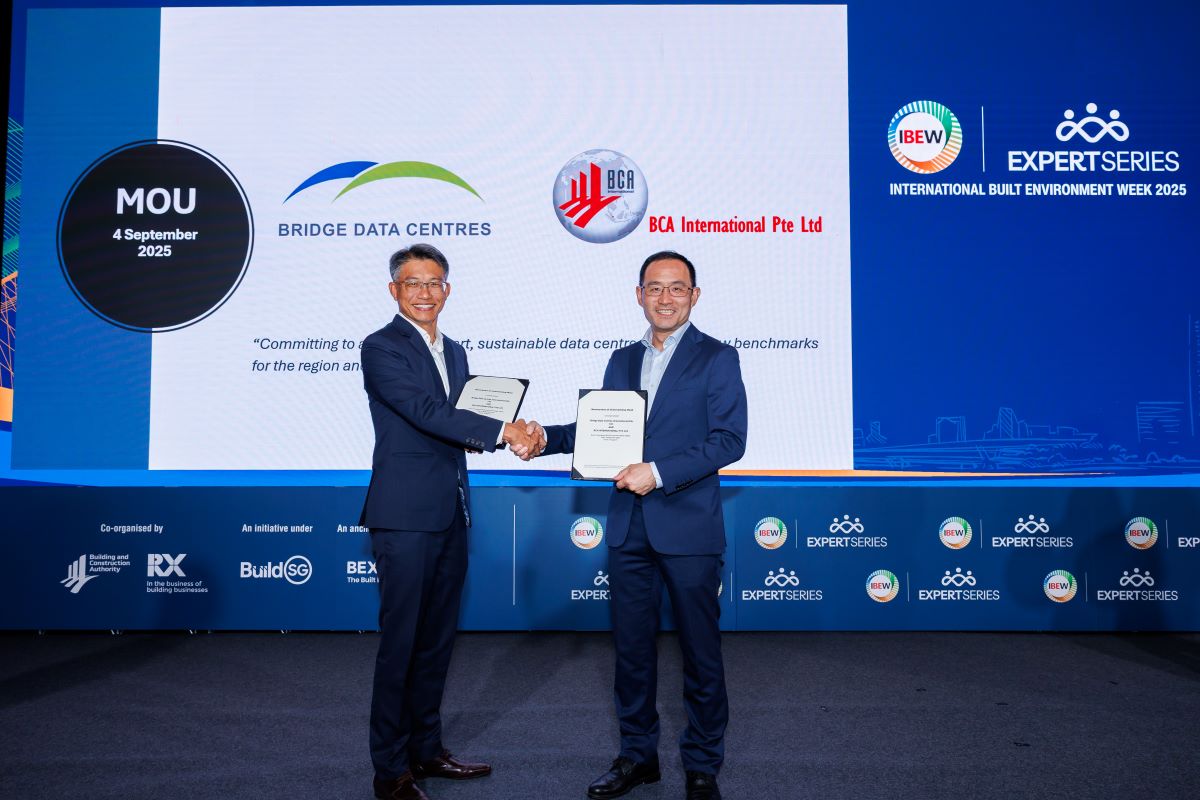
Most recently, three events marked pivotal moments in the history of Bridge Data Centres (BDC), namely pioneering the repurposing of treated effluent as reclaimed water for its data center’s operational use in Johor, possibly the first in Southeast Asia; collaborating with BCA International (BCAI) to advance sustainable practices globally, and clinching the IDC Future Enterprise Awards 2025 – in the ESG30 category as Sustainable Development Leader.
These align with the company’s green commitments, outlined in the 2024 ESG report.
But those are not the only examples – there are many instances where BDC has shown remarkable leadership in sustainability. Examples include reducing construction cycles by over 30 per cent to eight months, maintaining a Power Usage Effectiveness (PUE) of below 1.2 in subtropical regions, amongst others.
The company believes that its long-term commercial success is inextricably linked to its ability to operate sustainably. As Eric Fan, Chairman of the ESG Development Committee, puts it aptly, “The long-term success of our company is inseparable from the health of our planet, the well-being of our communities, and the trust we earn from our stakeholders.”
Fan, who is also the CEO of Bridge Data Centres, adds that ESG is not just a framework for the company, it is a moral imperative. “It represents our pledge to transparency, resilience, and long-term value creation for all stakeholders.”
The CEO elaborates, “Resiliency today means more than just physical durability – it means creating adaptable, sustainable, and future-proof systems.”
And that about sums up BDC’s guiding principles which is used to build a blueprint for a sustainable data center future. Based on those principles, BDC is integrating renewable energy, optimizing efficiency, and championing circular economy principles to reduce its environmental impact and set a new regional standard. BDC is a leading hyperscale data infrastructure builder headquartered in Singapore, with facilities in Malaysia, Thailand, and India.
Launched in 2024, BDC’s ESG strategy aligns with the United Nations Sustainability Development Goals (UN SDGs). Structured around its namesake ‘Bridge’, the concept sees each letter of the “Bridge” framework being assigned BDC’s sustainability vision – which is weaved into the company’s DNA.
In brief, ‘B’ stands for Bonding with stakeholders; ‘R’ for Responsibility for various issues such as environmental protection, employee rights, data security protection and public welfare; ‘I’ for Innovation which is continuous, ‘D’ for Diversity in workplace; ‘G’ for Green resources to power data centers and reduce carbon emissions; and ‘E’ for Empowering its clients and their cloud-first and AI-driven strategy as well as empowering industry progress jointly with its partners.
At the design phase, BDC already integrates sustainability practices which adheres to LEED standards to enhance construction efficiency, energy efficiency, safety and environmental impact reduction. It has achieved LEED Gold from the U.S. Green Building Council.
Decarbonisation & Innovation
BDC implements a life-cycled carbon offset strategy, forming a closed-loop carbon management system across the data center value chain. This ensures transparent and compliant carbon management. Decarbonisation is deeply integrated into its hyperscale infrastructure, setting new industry standards.
This principle is embedded into the firm’s business strategy which is to create resilient and futureproof data centers that meet the requirements of its hyperscale clients. By optimising PUE, water usage effectiveness (WUE), and carbon usage effectiveness (CUE), as well as comprehensive utilisation of renewable energy, BDC delivers more value per unit of resource consumed, thus lowering operating expenditure and potentially driving innovation.
I In 2024, BDC launched the AI-Ready Data Centre Total Solution 2.0 which incorporates advanced prefabrication and modular building models; the innovative “X-Power” power system; and the “X-Cooling” solutions such as cold plate liquid cooling and maglev two-phase cooling. Apart from these proprietary solutions, BDC also employs AI tools for comprehensive operation and maintenance management such as ‘X-Monitor’ Smart Operations System for real-time optimization of energy and water use. This state-of-the-art solution is designed to support the accelerated growth of artificial intelligence and ensure high-quality and flexible business operations for customers.
The successful deployment of the AI-Ready Data Centre Total Solution 2.0 across various Malaysian locations is proof of its efficacy with some projects taking only eight months to complete. In addition, all BDC’s self-built and operated data centres in Asia Pacific are ISO/IEC 27001 and SOC 2-certified, with the highest standards in information security, cybersecurity and privacy, as well as multiple data centers being certified with ISO-14001.
| Case Study 1 |
| Using its own construction technology innovations, BDC managed to reduce construction timeline to enable delivery as fast as eight months for new capacity. Prefabricated, Prefinished Volumetric Construction (PPVC) was used to assemble 326 factory-built modules, cutting the on-site assembly time by 40 per cent compared to traditional methods. This was notably achieved on its MY06 (Phase 1) campus in Malaysia. |
| Case Study 2 |
| By developing Malaysia’s first Water Reclamation Plant (WRP) at its MY07 campus in Johor, BDC has managed to report a substantial improvement in WUE that exceeds industry standards during test runs. The WRP is expected to be fully operational by the fourth quarter of 2025. The plant, a collaboration with local authorities, will use advanced Membrane Bioreactor (MBR) and Reverse Osmosis (RO) technologies to convert treated effluent into high-grade reclaimed water specifically for data centre cooling. |
Social Resiliency
“Our data centers are not just facilities – they are economic engines that create jobs, support communities, and inspire innovation,” says Fan when referring to the company’s commitment to social resiliency.
In 2024, BDC has increased its new job opportunities by 24.1 per cent compared to 2023, with 85.5 per cent of new hires being locals. The company has also invested heavily on human capital, having logged in 2,851 training hours in 2024, and ensuring 100 per cent employee coverage. In addition, it offers education sponsorship of up to US$ 15,000 per employee per year.
The company has also rolled out a Goal Setting Training Programme covering ethics, certifications, safety, soft skills and technical competencies, as well as established a dedicated e-learning platform in 2024.
A culture of inclusivity is core to the company’s principles. Women make up 33.3 per cent of the executive management team, well exceeding the industry average of 20 per cent. The company adheres to a strict zero-tolerance policy for discrimination, child labour, and forced labour, with no reported incidents (including zero injuries and fatalities) in 2024. This is supported by anonymous feedback channels to ensure a safe and ethical workplace culture.
BDC believes a thriving workforce is the foundation of sustainable progress thus it has allocated 29 fully paid workdays for community volunteering efforts.
When it comes to third party suppliers, BDC actively cultivates local supplier ecosystems – as of 2024, its key procurement partnerships span Malaysia, India, Singapore, China, and Thailand. All its suppliers have signed the Supplier Integrity Commitment, agreeing to an anti-corruption and eco-friendly supplier code of conduct. In 2024, there has been zero incidents of unethical or fraudulent business practices reported, including bribery, corruption, and unfair competition. Despite this, the company still maintains a vigilant stance as the supply chain is still vulnerable to disruptions and performance shortfalls in today’s environment.
Resource Management
BDC’s ESG strategy translates into several commitments that show how serious the company is in walking the talk. It has joined the global RE100 initiative with a target of 100% renewable electricity by 2040, as well as the Science-Based Targets initiative (SBTi) which targets a 30 per cent reduction in Scope 1 & 2 emissions by 2030 from a 2023 baseline, followed by net-zero status by 2040.
To be fully powered by renewable energy by 2040 is perhaps easier said than done. Thus, BDC is utilising other options beyond grid and off-grid purchasing. For example, it has secured nearly 2GW of renewable energy reserves for the mid- and long-term through multiple Memorandums of Understanding (MOUs) with partners such as SK, Ecoceres, Climaveneta, Pacific Light, SuperMICRO, Vertiv and ECL. The company has also developed on-site distributed photovoltaic (PV) systems; and participated in green certificate and carbon trading markets to increase its procurement of verified green energy.
Another example is the Malaysian Corporate Renewable Energy Supply Scheme (CRESS) Framework that it has signed with Johor Tenaga Nasional Berhad (TNB), as well as a 400MW Renewables Electricity Supply Agreement with TNB Renewables. As one of the earliest participants under Malaysia’s Corporate Renewable Energy Supply Scheme (CRESS), BDC is helping to set the benchmark for sustainable data centre operations. The initiative allows BDC to draw renewable electricity directly from suppliers via TNB’s grid, supporting its commitment to 100 per cent renewable energy by 2040.CRESS is a Malaysian government initiative to facilitate direct green energy access for corporates through its grid system while TNB is a state electricity utility in Malaysia.
Water scarcity is another challenge affecting 20 per cent of its sites. The landmark Johor Water Reclamation Plant (WRP) is not just a progressive step forward, it was a feat in dealing with multiple stakeholders such as government agencies and navigating complex regulatory frameworks.
Comprehensive Governance
Underlying it all is BDC’s three-tier ESG governance framework with overall oversight from the Board of Directors, identification of issues from the ESG Development Committee and implementation from the ESG Working Groups, providing a clear line of sight from the boardroom to the on-ground operations. Measures that have been implemented when it comes to government and regulators include strengthening risk controls, legal compliance, ethical conduct enforcement, conducting end-to-end green management and disclosing carbon reduction pathways and emissions data clearly.
Investors and shareholders also benefit from its transparent policies through regular updates in ESG-related and financial information, as well as climate strategy and performance. Customers get robust protection for physical, data, and cyber as well as a complaint handling mechanism, amongst many other benefits.
Conclusion
By embedding sustainability into the core of its business model, BDC has set out to prove that long-term success is inseparable from planetary health and community well-being. The case studies above show that green ambitions can inspire innovations and can go hand in hand with business advantages. For example, the pioneering Johor Water Reclamation Plant gives BDC a competitive advantage. Similarly, its eight-month construction timeline has speeded up deliveries to hyperscalers thus meeting capacity faster than its competitors.
By investing heavily in human capital, it has with one fell swoop, built a competent future workforce, fostered positive relationships with host communities and mitigated any future reputational risks. BDC has proven through its industry-leading PUE of below 1.2; 85.5 per cent local hires and 100 per cent customer satisfaction, among other performance metrics, that sustainability and profitability can co-exist. The sustainability upfront costs are no doubt high but with its long-term foresight, it is an investment that will eventually pay off.
BDC is not just building data centers; it is building partnerships and navigating ecosystems. It continuously engages in collaborations with multiple corporates to advance sustainable data center technologies, as well as exploring potential alternative ways to reducing carbon emissions.
Having said that, the customer is still king – BDC’s “Customer First” philosophy permeates every aspect of its operations.
As a result, the company achieved a 100 per cent customer satisfaction rate in 2024, plus garnered multiple industry awards, thanks to its formidable leadership and a thriving workforce. Recently, its top leadership especially Sandy Xiao and Eric Fan, President and CEO respectively, were both awarded w.media’s leadership awards, in the Hyperscale Infrastructure Leader and Strategic Network Infrastructure Leader categories, respectively, demonstrating how excellent leadership can transform companies from the inside-out on its path towards full ESG conformity.
List of ESG related Awards won by BDC for 2025
- Ram Charan Management Practice Award
– ESG Management Practice (Global Innovation Driver)
– Global/Enterprise-wide
– November 2025 (Post shared in November)
- Green Mark Platinum Certification (BCA-IMDA GMDC:2024 scheme)
– Singapore’s highest sustainability benchmark for data centres.
– MY06 Campus
– September 2025 (Awarded at IBEW)
- ESG Business Award 2025
– Sustainable Water Management Award
– Enterprise-wide
– Post shared in September 2025
- IDC Award 2025
– Versatility in High Energy Performance Hyperscale Data Centre Solutions / Best Practices for High Energy Efficiency Solutions in Hyperscale Data Centres
– APAC
– Post shared in September 2025