
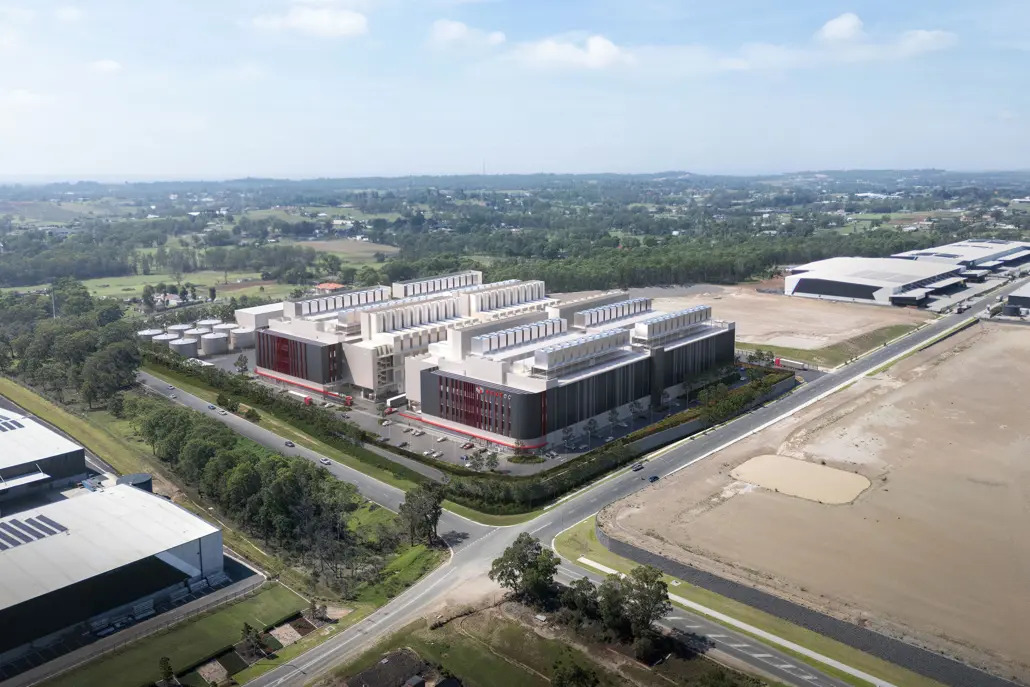
A group of Western Sydney organisations has warned that the rapid expansion of data centres across the region is placing increasing pressure on infrastructure, land availability, and planning systems, as the area emerges as Sydney’s second major data centre cluster.
Submissions to the NSW parliamentary inquiry from local government bodies and regional advocacy groups had a common theme: while Western Sydney is well positioned to host new digital infrastructure, growth is outpacing coordinated planning and infrastructure delivery.
Western Sydney investment hotspot
The Western Sydney Leadership Dialogue, which represents business, government, and community stakeholders across Greater Western Sydney, said the region is now at the centre of a new wave of investment driven by AI and cloud demand.
Across New South Wales, around AUD 29 billion worth of data centre projects are currently awaiting approval, with more than AUD 21 billion of this pipeline located in Western Sydney alone. The group noted that 10 of the 15 projects recently endorsed by the NSW government’s Investment Delivery Authority are based in the region, reflecting its access to industrial land, energy infrastructure, and connectivity.
Similarly, the National Growth Areas Alliance, which represents fast-growing outer metropolitan councils nationally, highlighted that Sydney remains Australia’s primary data centre market, with 1,123MW of live IT capacity and 90 operational facilities, alongside a further 20 under assessment.
Growth area councils in Western Sydney are playing a central role, with Blacktown alone hosting 51% of NSW’s data centre investment worth AUD 5.35 billion, including a AUD 3.1 billion, 504MW multi-campus development at Marsden Park.
The National Growth Areas Alliance also noted that these same growth area councils are expected to deliver around 26% of Australia’s new housing under the National Housing Accord, including around 92,000 dwellings across Greater Sydney over the next five years, highlighting the increasing overlap between digital infrastructure expansion and housing delivery in the same regions.
Infrastructure constraints and sequencing challenges
Across the submissions, infrastructure capacity and sequencing emerge as key constraints. The Western Sydney Regional Organisation of Councils (WSROC), a regional body representing multiple local councils, said the benefits of data centres are broadly distributed, while their impacts are concentrated in host communities.
“Grid constraints, heat, noise and visual bulk” are already being experienced in Western Sydney, with concerns that cumulative impacts are not being adequately assessed.
The organisation highlighted that data centres are currently assessed on a project-by-project basis, with no single framework accounting for combined energy, water, and environmental impacts across clustered developments.
The National Growth Areas Alliance also pointed to infrastructure bottlenecks, noting that only around 385 hectares of Sydney’s zoned and undeveloped employment land is currently serviced with both water, sewer, and transport access, limiting the ability to bring new sites online.
More broadly, only around one-third of Sydney’s 20,210 hectares of zoned employment land remains undeveloped, with 90% of that located in growth areas, placing further pressure on infrastructure delivery timelines.
The Western Sydney Leadership Dialogue added that infrastructure planning is further complicated by the presence of “phantom” applications, where projects seek approvals or grid access without firm delivery timelines, making it more difficult to forecast demand and coordinate investment. Data Centres Australia (DCA) has also recognised this as an issue to be addressed.
Energy and water demand under scrutiny
The scale of resource demand associated with data centres is a recurring concern across submissions. The Western Sydney Leadership Dialogue cited estimates that a single 250MW hyperscale facility could require between 0.88 and 5.5 gigalitres of water per year, depending on cooling technology and operating conditions.
Energy demand is expected to grow significantly, with projections in the submissions suggesting data centres could account for up to 12% of total electricity consumption by 2040. The Penrith City Council reinforced these concerns at a local level, noting that data centres in Australia consumed around 3.9TWh of electricity in FY25 (around 2% of the National Electricity Market), with forecasts rising to 12TWh by FY30 and 34.5TWh by FY50.
On water, the council said Sydney’s 88 data centres currently use around 3.5 billion litres annually – less than 1% of total supply – but could rise to 25% by 2035, albeit under high-growth scenarios. The council also pointed to local climatic conditions, noting that Western Sydney’s higher temperatures, including multiple days above 40°C and peaks of 48.9°C, could further increase cooling demand for facilities located in the region.
More broadly, several submissions highlighted that Western Sydney is already more heat-vulnerable than other parts of the city, with concerns that large-scale data centre development could contribute to urban heat through increased hard surfaces and reduced tree canopy if not carefully managed.
Land use and employment trade-offs
Land use pressures and employment density were also raised consistently across submissions. The Western Sydney Leadership Dialogue said industrial land is a scarce resource, with only around 2% of Greater Sydney zoned for industrial use.
Analysis cited in its submission suggests data centres generate between 12 and 14 ongoing jobs per hectare, compared to 35-55 jobs in manufacturing and light industry, highlighting potential trade-offs in how land is allocated.
The National Growth Areas Alliance similarly said that data centres occupy large areas of employment land while generating relatively few operational jobs, raising concerns in regions already experiencing jobs deficits.
At the same time, the Western Sydney Leadership Dialogue pointed to the sector’s role in generating around 6,000 construction jobs across projects currently under assessment in Greater Western Sydney, alongside opportunities to build long-term skills pipelines through partnerships with universities and training providers.
Penrith City Council added that Western Sydney is expected to deliver significant housing and employment growth, including 23,000 additional jobs locally by 2031, and warned that land cannot be unlocked for these uses without sufficient water and energy infrastructure.
Planning fragmentation and cumulative impacts
A consistent theme across all submissions is the need to move beyond project-by-project assessment toward more coordinated planning. WSROC warned that current planning pathways risk “piecemeal assessments” that fail to capture cumulative impacts across clustered sites, including energy demand, water use, and environmental effects.
The Western Sydney Leadership Dialogue also pointed to approval timeframes exceeding 690 days from initial application, with post-exhibition approvals taking more than 300 days on average, significantly longer than comparable projects in other states.
This lag was contrasted with international and interstate benchmarks, where some projects have been approved in under 100 days, highlighting the importance of approval timelines in attracting globally mobile investment to Australia.
Recommendations focus on coordination and cost allocation
Across the submissions, there is broad alignment on the need for more strategic planning frameworks. Key recommendations include developing a statewide digital infrastructure strategy, identifying preferred data centre precincts aligned with available infrastructure, and introducing system-level monitoring of energy, water, and land use impacts.
Several organisations also called for clearer mechanisms to ensure data centre developers contribute to infrastructure costs, particularly for electricity and water systems, to avoid cost shifting onto households and other users.
Other submission proposals include prioritising recycled water for cooling, co-locating facilities with energy storage and generation, and improving transparency through public reporting frameworks. Penrith City Council went further, recommending that no additional data centre applications be considered until the impacts on water and energy systems are fully understood and infrastructure capacity can be assured.
Balancing growth with regional capacity
While the Western Sydney submissions were generally more supportive of data centre development than some inner Sydney councils, the submissions collectively highlight the challenges of managing rapid growth in a region that is simultaneously expected to deliver housing, jobs, and major infrastructure. That the next phase of growth will depend less on land availability and more on the coordination of infrastructure, planning, and resource allocation at a system level.