
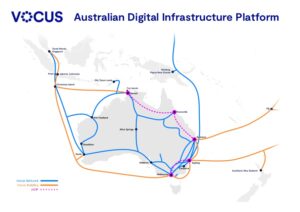
Australian operator Vocus has announced plans for a 4,000-kilometre ducted fibre route connecting Brisbane, Townsville and Darwin, expanding its Australian Digital Infrastructure Platform (ADIP) beyond the Sydney-Melbourne corridor. The Brisbane-Darwin route is the second project under ADIP and is expected to be ready for service in 2030. Vocus has begun route planning, technical design and customer engagement, with the network designed to accommodate up to 3,456 fibre cores.
Vocus CEO Andrés Irlando said the expansion reflects the increasing infrastructure requirements associated with AI and data centre investment. “Australia is in a period of unprecedented investment in AI infrastructure, data centres, and international connectivity, requiring exponential investment in new terrestrial and subsea fibre networks,” he said.
Irlando said northern Australia was becoming increasingly important for AI, cloud and digital services, with Queensland and the Northern Territory emerging as data centre locations and gateways to Asia and the US.
Northern extension
The new route will extend Vocus’s existing northern Australian network, which includes the Darwin-Jakarta-Singapore Cable and North-West Cable System. CTO Nikos Katinakis said the Brisbane-Darwin corridor would provide additional capacity, route diversity and resilience while extending the ducted intercapital design Vocus introduced with its Sydney-Melbourne project.
That Sydney-Melbourne project, announced in June as the first ADIP deployment, involves approximately AUD 500 million of investment and is scheduled for service in 2029. Vocus said it will support up to 6,912 fibre cores, or 3,456 fibre pairs, using ducted infrastructure that allows additional cables to be installed without further major civil works.
Vocus has subsequently appointed UGL as development partner for the Sydney-Melbourne project, with early works covering route surveys, design, engineering, stakeholder engagement and cost modelling. The company has described ADIP as a multi-year programme involving thousands of kilometres of new fibre routes, thousands of fibre pairs and hundreds of terabits of additional capacity.
Global link
The Brisbane-Darwin announcement also comes as Vocus expands its role in northern Australia’s international connectivity. Environmental filings reported by W.Media in July identified Darwin, Townsville and Karumba as proposed Australian landing locations for Meta’s Project Waterworth subsea cable, with Vocus responsible for environmental survey work associated with the proposed route.
The planned Waterworth alignment includes approximately 5,360km within Australian waters and would create new international cable landing points at Townsville and Karumba if the project proceeds.
The relationship between the two developments is not spelt out by Vocus in the latest announcement, and the Brisbane-Darwin project is a separate terrestrial network. However, the overlap in geography is notable: the new terrestrial route will connect Brisbane, Townsville and Darwin, while the proposed Waterworth infrastructure would establish subsea connectivity at Townsville and Darwin.
Vocus has positioned ADIP as a response to projected growth in Australian data centre and AI infrastructure. The company says commissioned market research indicates Australian data centre capacity could triple by 2030, with AI workloads expected to account for most future long-haul fibre demand. It also says existing fibre corridors are approaching higher utilisation as connectivity requirements increase.
Vocus said the Brisbane-Darwin project is currently in its early works phase. The operator has not disclosed the expected capital cost of the project.