
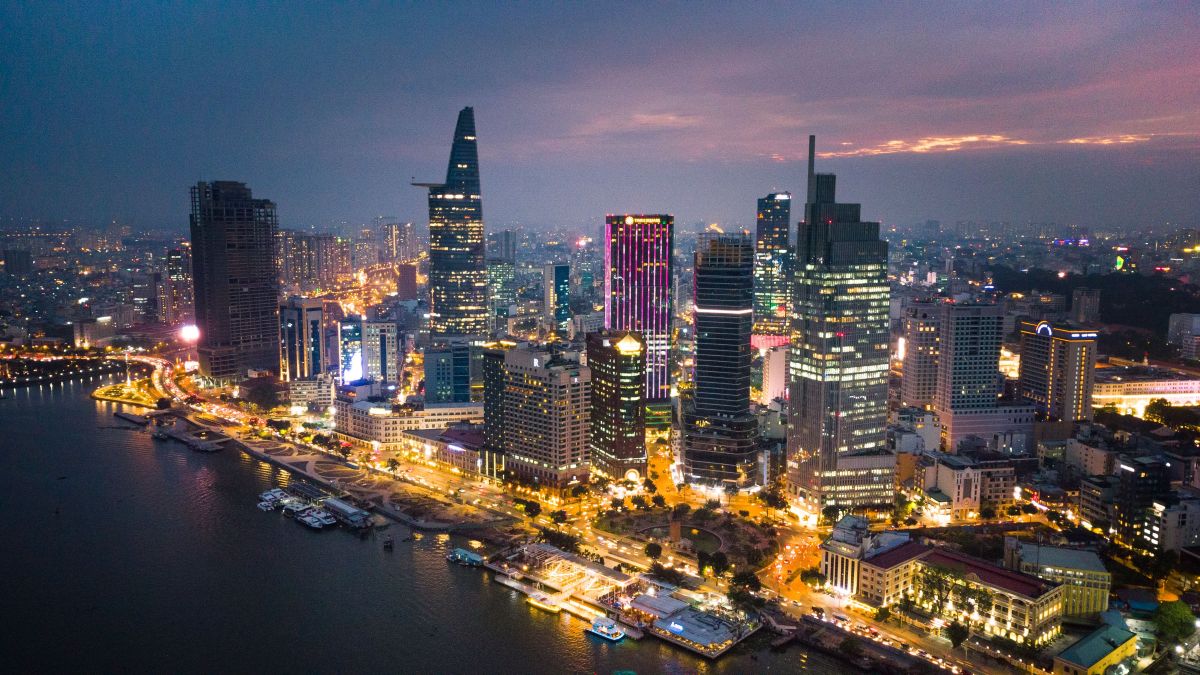
In the last few months, there had been news about multibillion-dollar AI data centers being announced in Vietnam. The latest is the US$ 2 billion, 200-megawatt data center campus outside Ho Chi Minh City that’s designed to support 100,000 GPUs. By any measure, this Kinh Bac City Development Holding partnership with VietinBank and Accelerated Infrastructure Capital is massive in the context of Vietnam. In parallel, a few other operators have also announced joint ventures to build massive hyperscale data centers. The pipeline is growing slowly but surely.
Vietnam’s data center market is projected to grow at 20.48 per cent annually from US$1.04 billion in 2025 to US$3.18 billion by 2031, according to the most optimistic projection particularly for AI and hyperscale data centers.

In 2025, the country counted about 41 operational facilities delivering between 104MW – 221MW of power capacity (depending on the source of the statistics and how they measure it). Projected pipeline is estimated to scale from about 525MW up to 950MW by 2030.
Over half of the data centers are located in and around the capital city, Ho Chi Minh City, with Hanoi and other smaller cities hosting the rest.
Pull factors
One of the biggest draws for foreign operators is the low cost of building a data center in Vietnam. Estimates range between USD $6 and US$ 8 million per megawatt – about half the price in Tokyo or Singapore, and lower than Malaysia and even Indonesia.
To entice more foreign investment, the government has come up with a slew of laws and measures. Chief among them is the removal of the 49 per cent foreign cap on ownership of data centers. This allows international firms to fully own and operate their data centers.
Another are tax incentives and facilitating faster approvals through a dedicated inter-agency task force headed by the municipal Department of Science and Technology.
Data localization laws, though not an incentive, are forcing foreign firms to store user data locally, hence taking up space in colocation facilities or building their own on Vietnamese soil.
Unresolved challenges
Behind the headlines however, data centers in Vietnam face quite big challenges.
Incoming AI-ready facilities are putting a lot of strain on the state grid resulting in narrow reserve margins and localized brownout risks near major metro hubs. As a result, state utility Vietnam Electricity (EVN) has mandated new operators to build their own 110 kV substations. Estimates say these range between US$8 million and US$12 million each, significantly pushing up initial CAPEX.
Operators already face high commercial power tariffs following recent regulatory reclassifications.
Diesel generators are ubiquitous as backups. As solar and wind energy are intermittent, more of such backups are needed, adding to the operating costs.
Research has shown that a 100MW facility could consume as much power as 270,000 Vietnamese households, while AI-optimised racks may consume up to 60kW each.
Thus, although the new Direct Power Purchase Agreement (DPPA) framework is welcome as it allows operators to source 100 per cent renewable energy directly from private renewable energy producers, they are still stuck with expensive grid backups to survive peak-load drop.
Grid transmission bottlenecks are the number one challenge now facing operators even if renewable energy such as wind and solar are plentiful.
The other challenge is supply chain disruptions which has caused delays in procuring hardware such as Nvidia’s advanced AI chips.
And finally, complex licensing requirements. Although the government has tried to fast-track approvals through an inter-agency task force, this is mainly targeted at high end AI data centers.
The many layers of approval needed in investment, land, construction, electricity, telecom, and data protection will continue to be a regulatory hurdle that could trip up foreign operators. For them, regulatory certainty matters almost as much as tax incentives although the overall low cost in Vietnam makes up for many of the disadvantages.

w.media’s Vietnam Cloud & Datacenter Convention (VNCDC 2026) is taking place tomorrow. Click here for more information.