
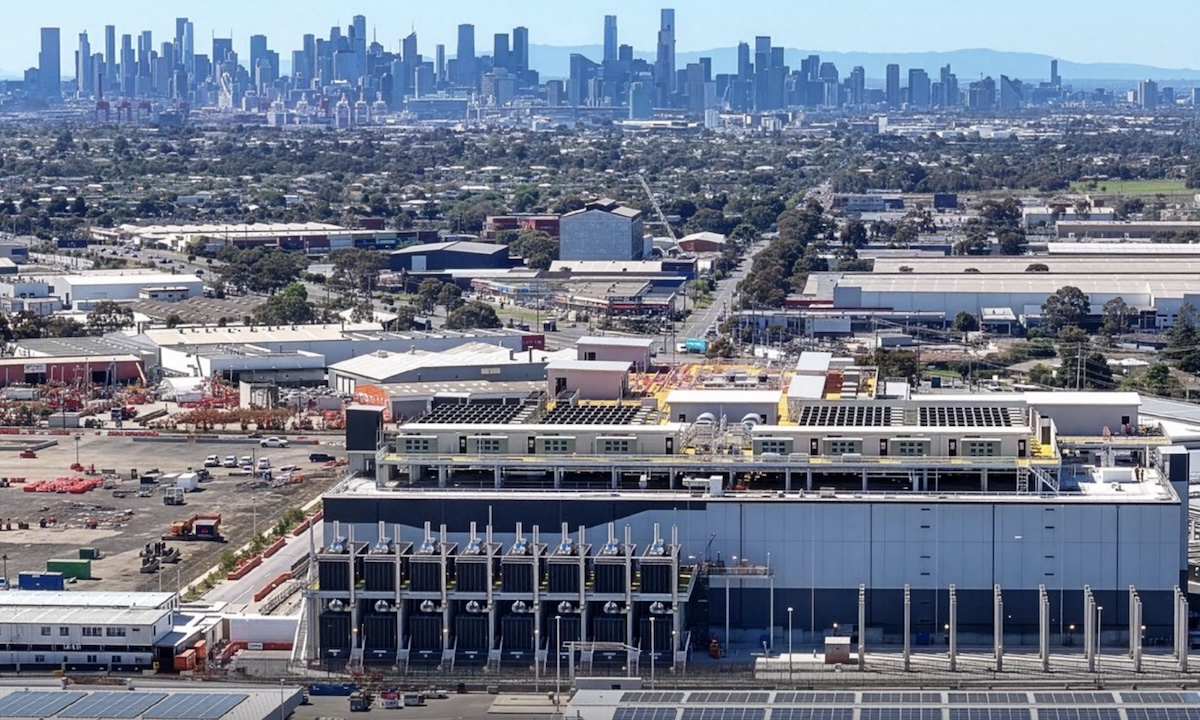
A report from the University of Sydney-based United States Studies Centre (USSC) has positioned Australia’s growing data centre sector as a potential catalyst for energy system investment, arguing that increased demand from digital infrastructure could help accelerate the build-out of renewable generation.
In its paper “Powering the cloud: data centres and the future of Australia’s grid,” the Sydney-based policy institute said rising demand from data centres, particularly driven by AI workloads, will place increasing pressure on electricity systems, but that these challenges can be addressed through improved coordination, planning, and investment.
The report frames data centres as both a source of strain and a strategic opportunity, suggesting that their large, predictable energy demand could help underwrite new generation capacity and support the transition to cleaner energy. It also highlights Australia’s strong global position, noting that in 2024 the country ranked second globally – behind the United States – as the most attractive destination for data centre investment, with growing expectations it could serve as a hub for the Indo-Pacific digital economy.
Demand growth and grid pressure
The USSC notes that data centres are among the fastest-growing sources of electricity demand globally, with Australia expected to see a significant increase in consumption as hyperscale and AI-driven facilities expand. This aligns with modelling cited in recent submissions to the NSW Data Centre Inquiry, which suggest data centres could account for up to 12% of electricity consumption in the National Electricity Market over time, up from low single digits today.
The report highlights a key structural issue: the pace of data centre deployment is often faster than the rollout of supporting energy infrastructure, creating a mismatch between demand growth and grid capacity. However, it frames this primarily as a coordination challenge – arguing that better alignment between digital infrastructure planning and energy system investment could mitigate risks such as congestion and supply constraints.
Constraints are real
While the USSC focuses on national energy system dynamics, the recent local government submissions suggest that constraints are already being felt at a more granular level. In Western Sydney, where a large share of new development is concentrated, councils and regional bodies have pointed to infrastructure bottlenecks and sequencing challenges. Only around 385 hectares of Sydney’s zoned and undeveloped employment land is currently serviced with the necessary water, sewer, and transport infrastructure to support development, limiting near-term expansion capacity.
At the same time, Sydney Water has indicated that data centre demand – currently a relatively small share of total consumption – could rise significantly under high-growth scenarios, with estimates suggesting usage could reach up to 25% of the city’s drinking water supply by 2035. These dynamics highlight the difference between system-level capacity and localised constraints, with infrastructure availability varying significantly by precinct.
The USSC argues that data centres can play a constructive role in the energy transition by providing long-term, stable demand that supports investment in renewable generation. This includes mechanisms such as power purchase agreements (PPAs), co-location with generation assets, and investment in storage, which can help de-risk new projects and improve system reliability.
Industry stakeholders have echoed this view. Belinda Dennett, chief executive of Data Centres Australia, said operators are already contributing to grid infrastructure and renewable development. “None of the risks outlined above suggests that data centres are inherently incompatible with Australia’s energy transition,” she said, adding that long-term agreements and infrastructure investment can help “unlock new renewable projects by providing long-term revenue certainty. Dennett claimed total investment by the sector into grid infrastructure is projected to reach AUD 7.2 billion by 2030.
Despite this, several submissions to the NSW inquiry highlight the challenge of aligning rapid demand growth with slower infrastructure delivery. Approval timeframes for major projects can exceed 690 days in New South Wales, while enabling infrastructure such as transmission, substations, and water systems often require multi-year planning and construction cycles.
At the same time, the prevalence of speculative or “phantom” connection requests has been identified as complicating demand forecasting and infrastructure planning, further contributing to uncertainty around future capacity requirements. These factors suggest that while additional investment may be forthcoming, the timing of delivery remains a key constraint.
Water can’t be ignored
The USSC analysis focuses primarily on electricity demand, with less emphasis on other resource inputs such as water. However, several of the submissions have highlighted water use as a parallel constraint, particularly in regions such as Western Sydney where climate conditions and existing infrastructure capacity may intensify demand.
Large hyperscale facilities can require significant volumes of water for cooling, with estimates ranging from 0.88 to 5.5 gigalitres annually for a 250 MW facility depending on technology and operating conditions, adding another layer of complexity to infrastructure planning.
The report ultimately positions data centres as a strategic opportunity for Australia, particularly in the context of becoming a regional hub for AI and digital infrastructure. Industry spokespeople have pointed to broader economic benefits associated with this growth. Dennett said the expansion of data centre infrastructure could support a wider ecosystem of construction, engineering, and technology jobs, as well as contribute to renewable energy investment.
Broader risk
However, the USSC highlights that this investment does not eliminate the broader risk of rising electricity prices across the market. “Electricity prices are determined by the balance of supply and demand at any given moment. When demand rises, and cheaper renewable generation is insufficient, more expensive gas-fired generators are brought online to fill the gap,” writes analyst Johanna Lim. “As electricity prices are set by the highest-cost generator required to meet demand, this can increase wholesale prices for all consumers.”
She adds: “The extent of price effects will ultimately depend on how quickly new generation, storage and transmission capacity are delivered alongside energy demand growth.”
At the same time, local government submissions in the NSW inquiry suggest that realising these benefits will depend on how effectively infrastructure, planning, and resource allocation are coordinated across different levels of government.
The USSC report does reflect a broader policy perspective that data centre growth can be accommodated through improved coordination and investment in energy infrastructure. However, recent evidence from local governments and regional bodies suggests that constraints are already emerging at the regional level, particularly where clusters of large facilities place concentrated demand on electricity, water, and land.
The interaction between national opportunity and local infrastructure capacity is likely to play a central role in shaping the pace and location of future development. As the USSC report points out, although Australia has sufficient energy generation capacity at a national scale, the impacts of data centre expansion are not felt evenly across the grid.
Lim concludes that aligning digital infrastructure expansion with renewable and transmission planning, reducing approval times and accelerating enabling infrastructure will be critical to incentivising investment consistent with national interests.
On 23rd April 2026, The Melbourne Cloud & Datacentre Convention will bring the entire ecosystem together under one roof – uniting cloud providers, data centre operators, enterprise IT, AI innovators, sustainability leaders, policymakers and infrastructure experts to discuss issues like these. To attend or take part, please visit: https://clouddatacenter.events/events/melbourne-cloud-datacenter-convention-2026/