
As many as three Amazon digital infrastructure facilities have reportedly been affected due to the ongoing escalation of violence in the Middle East. While two of these are in the UAE, one is in Bahrain. Moreover, Amazon has also now clearly attributed the damage to drone strikes.
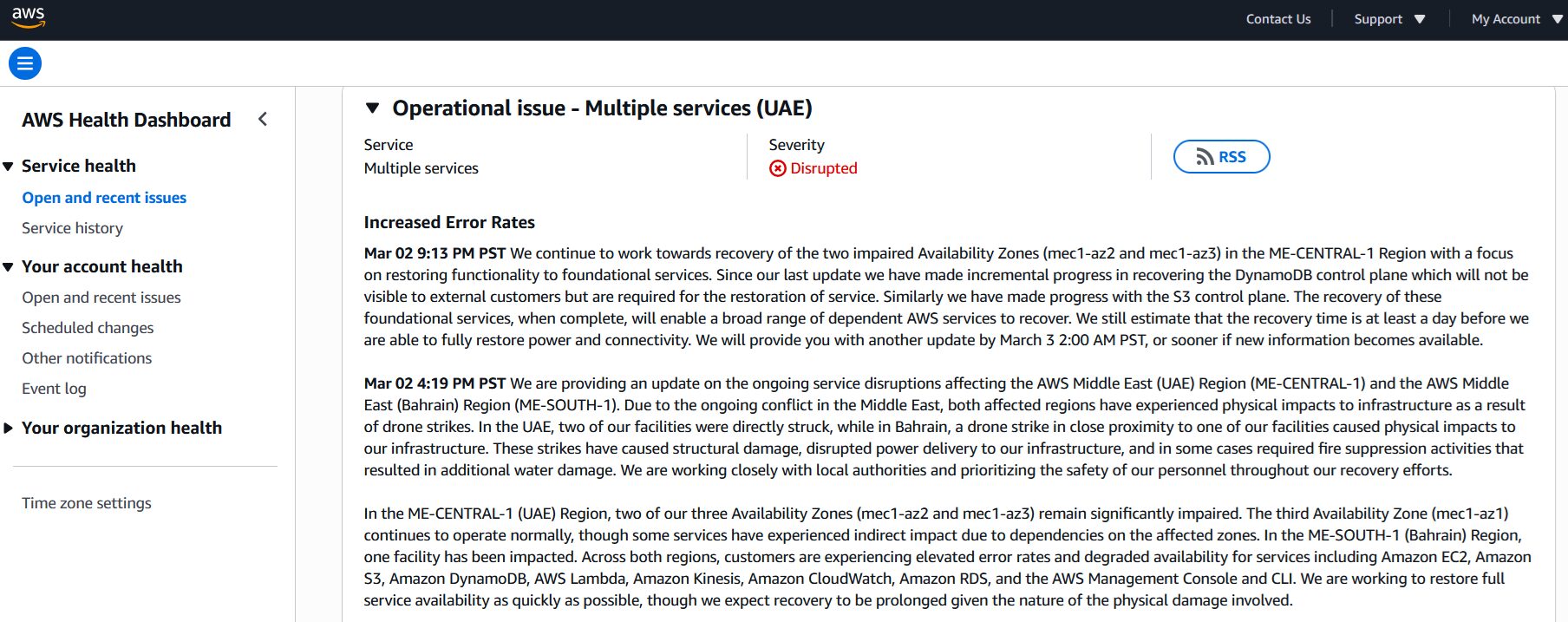
In a post on the AWS Health Dashboard, at 4:19 PM PST, on March 2, the company said, “Due to the ongoing conflict in the Middle East, both affected regions have experienced physical impacts to infrastructure as a result of drone strikes. In the UAE, two of our facilities were directly struck, while in Bahrain, a drone strike in close proximity to one of our facilities caused physical impacts to our infrastructure.”
This is a significant departure from the previous statement about falling “objects” causing “fire and sparks” leading to a temporary power shutdown at one of its UAE data centers on Sunday.
The post further said, “These strikes have caused structural damage, disrupted power delivery to our infrastructure, and in some cases required fire suppression activities that resulted in additional water damage. We are working closely with local authorities and prioritizing the safety of our personnel throughout our recovery efforts.”
The AWS post explained the extent of the damage saying, “In the ME-CENTRAL-1 (UAE) Region, two of our three Availability Zones (mec1-az2 and mec1-az3) remain significantly impaired. The third Availability Zone (mec1-az1) continues to operate normally, though some services have experienced indirect impact due to dependencies on the affected zones. In the ME-SOUTH-1 (Bahrain) Region, one facility has been impacted.”
Across both regions, customers reported experiencing elevated error rates and degraded availability for services including Amazon EC2, Amazon S3, Amazon DynamoDB, AWS Lambda, Amazon Kinesis, Amazon CloudWatch, Amazon RDS, and the AWS Management Console and CLI.
Amazon responded by saying, “We are working to restore full service availability as quickly as possible, though we expect recovery to be prolonged given the nature of the physical damage involved. In parallel with efforts to restore the physical infrastructure at the affected sites, we are pursuing multiple software-based recovery paths that do not depend on the underlying facilities being fully brought back online.”
At the time of publishing this piece at least 25 services remain disrupted, and at least 34 are degraded, as a result of the impact of the war. We will update this story when we have more information.