
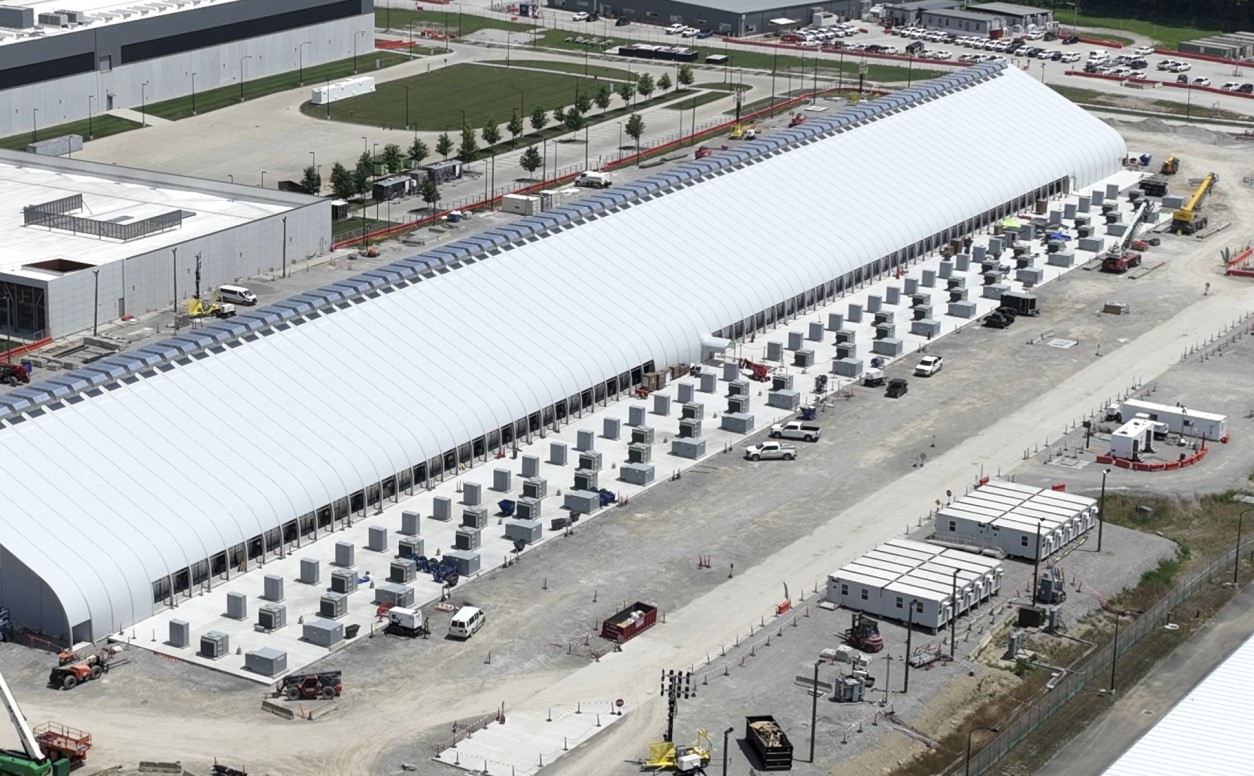
Meta is betting that fabric structures and fresh air cooling can win the AI race through sheer speed. But can they stand the test of time?
Data centers are typically associated with fixed and boring fixtures from the exterior, but times are changing. The AI arms race is intensifying with Sam Altman saying OpenAI plans to spend trillions of dollars on data center buildout to stay ahead of the race. Now, how would other big tech companies in the running plan to beat that?
One novel strategy is to deploy simple structures that do not require months of civil engineering work to build. These structures contain high-tech computing infrastructure and enable faster scaling for AI demands. That’s what Meta’s CEO Mark Zuckerberg is thinking – and it seems to work. These easy-to-build structures utilise aluminium frames (aerospace grade, apparently) covered with robust fabric and look like tents, hence are called “tent” data centers.
But don’t let these simple structures deceive you into thinking that they are just temporary one-off structures. An experiment in 2008 by two Microsoft design pioneers proved that racks of servers inside a tent structure can last for several months with no server failure or downtime. So, contrary to popular belief, tent-like structures are tougher than they look.
While Meta only plans for these camp-like structures to be temporary while waiting for completion of their multiple, multi-gigawatt data centers, these tent data centers are actually proof that they can be deployed at scale for anyone hoping to build capacity as fast as possible. Built within weeks (three weeks is the fastest estimate), they can be immediately put to work as GPU (Graphics Processing Unit) hubs, with billions of dollars worth of compute inside, no less.
These ultra-light tents come with many perks – they’re hurricane-proof (as claimed by Zuckerberg), cheap, utilize basic HVAC (Heating, Ventilation, and Air Conditioning) optimized for free air cooling, and can easily be dismantled or reconfigured. Incidentally, how often do you encounter a hurricane? They also require far less permitting and regulatory compliance, a great advantage considering that regular data centers can take months to get their permits approved.
Hence, despite all its disadvantages – such as susceptibility to heat in summer, no backup generator or robust power infrastructure resulting in less PUE, tent data centers do work, and very well too, with their prefabricated power and cooling modules. Both its estimated liquid cooling efficiency and uptime are tagged at about 95 per cent.
In Meta’s case, power comes from the tech giant’s on-site substations (estimated 400 MW) although some tents might get it from the grid depending on how Meta manages its power distribution. Enabling massive AI compute capacity (estimated US$ 2 – 3 billion under each tent with 20,000 plus GPUs per site) to go live in weeks would be a huge competitive advantage – speed without sacrificing too much efficiency and resiliency.
With some observers thinking that AI compute hardware will only last three to four years anyway before technical obsolescence renders them useless, this could be one of the most practical solutions coming out of the industry, if the disadvantages could be resolved or minimized.
Proponents of tent data centers enthuse that today’s “crazy” will become tomorrow’s standard, and that to win the AI race, you have to trade redundancy for speed.
“On the other hand, this strategy is not suitable for all, and this may well be a proof of concept to show the ‘art of the possible’,” opines James Rix, JLL’s Head of Data Centre and Industrial, Malaysia and Indonesia.

Be that as it may, innovation is the lifeblood of the digital infrastructure industry, and with AI accelerating demand, we could very well see massive improvements over the current limitations of these new GPU housing. It could well herald a new type of rapid modular deployments where speed to market is paramount – because delays can cost billions.