
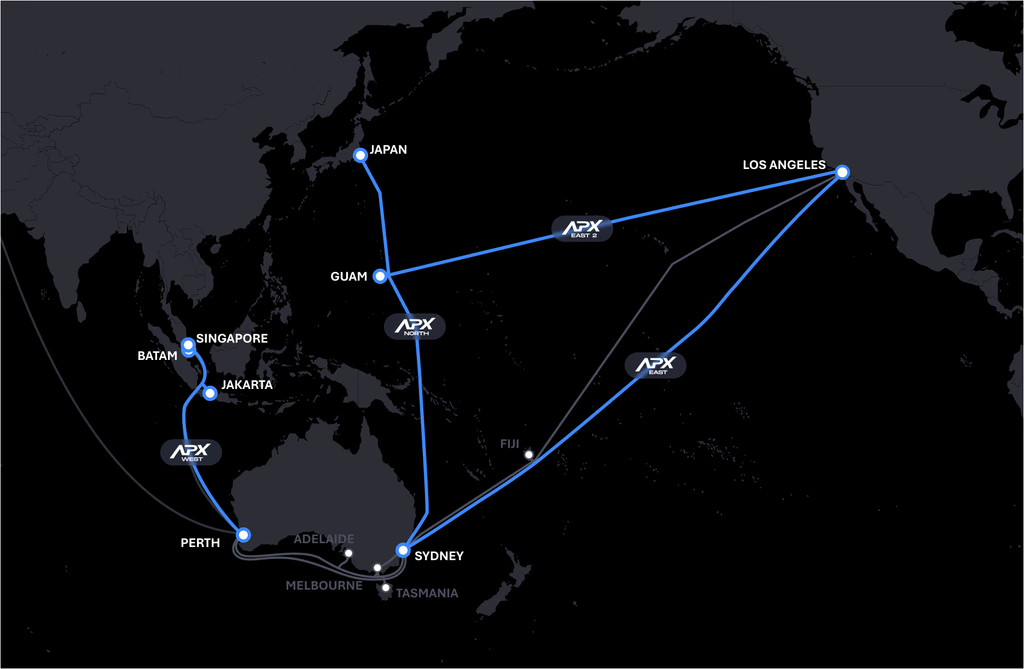
SUBCO, a developer, owner, and operator of next-generation submarine fiber-optic cable infrastructure, has announced that it will be building three new subsea cables connecting Australia to several locations in Asia and the US over 40,000 km.
According to a press release, APX North will span 9,500 km, connecting Sydney to Japan via Guam. APX East-2 will be 10,000 km long and connect Guam to Los Angeles. APX West is a 4,600 km cable connecting Perth to Singapore with branches to Jakarta and Batam. Each cable will contain 24 fiber pairs, with SUBCO targeting completion of all three systems by 2029.

“People have been slow to understand that AI factories are dead without massive subsea connectivity to carry tokens from factory to customers. Hundreds and hundreds of terabits per second. That’s why we are about to undertake the single largest subsea infrastructure build ever by a carrier in the Indo-Pacific. Not only is the build itself huge, but the timeframe is compressed with over 40,000km of cable to be installed in just over three years. Our team has signed up for the challenge, and will grow significantly as each system reaches CIF,” said Bevan Slattery, SUBCO Founder and Co-Chief Executive Officer.
The co-CEO noted that APX Eat-2, connecting Guam and Los Angeles, is vital for trans-Pacific digital traffic and expects the system to be incredibly popular. Similarly, APEX West is important for resiliency and interconnection at hubs in Batam and Jakarta.
“Singapore and Indonesia remain critical to Asia’s connectivity landscape, and their strategic importance will only grow as bandwidth demand accelerates, and new interconnection hubs are needed to deliver greater flexibility and route diversity. We are building as much of that as possible into our system design and making that available to our cornerstone customers through APX West,” said Slattery.

The company announced in June that its SMAP cable system connecting Sydney, Melbourne, Adelaide, and Perth was ready for service. The 5,000 km cable features 16 fiber pairs and delivers more than 400 Tbps of capacity.