
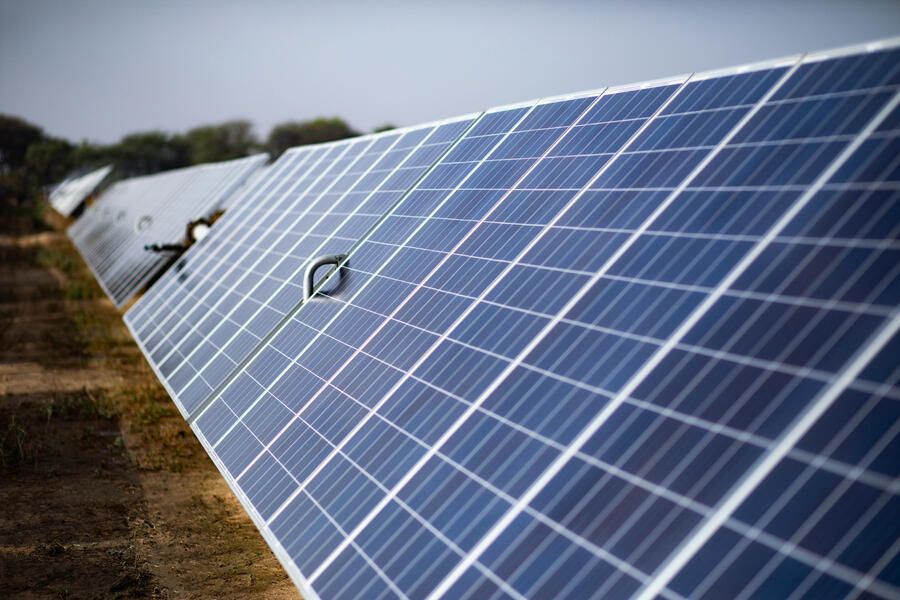
Johor is building one of the world’s largest renewable energy zones, partly to meet the demand of insatiable data centers.
Johor is tipped to become Southeast Asia’s largest data center hub by 2030, and its power consumption will surge accordingly. To meet that demand, the state has contracted one of the world’s largest renewable energy zones.
The Southern Johor Renewable Energy Corridor (SJREC) is a US$6 billion hybrid solar and battery storage project spanning 2,000 square kilometers. It sits within the Johor-Singapore Special Economic Zone (JS-SEZ), a bilateral initiative that pairs Johor’s land and labor resources with Singapore’s capital and technology.
The initial phase of SJREC targets up to 4 gigawatts peak (GWp) of solar capacity and 5.12 gigawatt-hours of energy storage, which will be supplied to hyperscale data centers and large corporations in the state as well as transmitted across to Singapore. The SJREC will be co-developed by the World Bank Group, Permodalan Darul Ta’zim (PDT), the strategic investment arm of the Johor State, and Ditrolic Energy, an integrated energy company based in Malaysia.
With this, Johor will also scale up to become the primary renewable energy hub for the ASEAN Power Grid (APG) initiative, which aims to interconnect regional electricity networks by 2045 to enhance energy security and sustainability.
From 1 percent to leadership
Both the SJREC and the simultaneously launched Johor Renewable Energy Policy 2030 framework are anticipated to thrust Johor into a regional leadership position in clean energy. It is a tightrope between growth and decarbonization that Johor has, so far, managed to walk.
The framework is a comprehensive roadmap outlining 12 strategic pillars and 38 implementation initiatives to decarbonize the state’s energy system. As of 2024, only about 1 percent of Johor’s energy mix — about 199 megawatts — comes from renewable sources. JLL’s James Rix, Head of Data Centres Practice for Southeast Asia and Korea, however reckons it’s closer to 17.7 percent, citing figures from the Grid System Operator (GSO), an entity authorized under Section 22A of the Electricity Supply Act 1990.
“The power generation mix for renewables from GSO shows it generates 3,774MW of renewables against a total Grid demand of 18,761MW which comes up to 17.7 percent,” he explains.
The policy sets a target of at least 600 MW of renewable capacity by 2030, which could reduce annual carbon emissions by up to 2.1 million tons. With the many opportunities to explore clean energies in the state, the framework anticipates about US$2.5 billion (RM10 billion) in investment creating an additional 15,000 jobs.
Among all the renewables, solar is being prioritized due to its availability, relative ease of conversion and affordable costs. As photovoltaic efficiency improves and panel costs decline, the case for using solar energy is further strengthened. Large-scale solar (LSS) deployment is expected to take place in Mersing and Kota Tinggi districts —particularly around Pengerang. Johor reportedly has 68.9 MW of LSS capacity currently. Apart from ground-mounted photovoltaic farms or rooftop installations, floating solar installations are also being seriously considered in coastal areas and lakes.
JLL’s Rix thinks solar is the only viable renewable energy in the state now as “wind does not blow strong enough or long enough to make it viable.” But for renewables to be truly used in a facility, the building must be directly connected to the grid where the renewables are being injected into, he adds.
“Furthermore, a large Battery Energy Storage System (BESS) would need to be built to store this energy. The BESS needs to be able to support 100 percent of the load for an extended period – or as a bridge before either utility power or back up power generation is used,” he said.
“This intermittency means that BESS may only be suitable for non-critical loads such as lighting. Also, land and capital constraints mean the operator may have to resort to buying electricity through the CRESS system.” Corporate Renewable Energy Supply Scheme (CRESS) is an open-grid, market-driven program allowing companies to directly procure green electricity (primarily solar) from developers.
Beyond solar
Johor has the advantage of large land acreage, out of which about 670,862 hectares (as of 2023) are planted with oil palm, Malaysia’s fifth biggest export. Oil palm plantations produce over 16 million tons of biomass annually, which can produce an estimated 3.2 GW of potential energy from biomass and biogas. The policy envisions the establishment of a centralized biomass collection hub, and converting biogas to biomethane for injection into the natural gas grid.
Other potential renewables that Johor can explore include green hydrogen, mini-hydro systems, and solid waste-to-energy facilities. Modernizing the grid is crucial to enable renewables to reach end users. In this regard, the framework proposes privatizing a dedicated renewable energy grid within the SJREC to bypass national grid constraints. To manage the issue of solar intermittency, the policy recommends the deployment of BESS.
Johor’s transition to fully renewables usage is however not a smooth path. Challenges include high upfront costs for energy storage, inconsistent biomass quality, fragmented land ownership complicating LSS acquisitions, and the lack of recycling facilities for end-of-life solar panels.
The policy proposes some solutions including creating a state land bank of agricultural reserves earmarked for renewable projects; offering tiered tax incentives based on solar irradiance and grid proximity; developing standardized biomass quality protocols, and incentivizing private investment in solar PV recycling infrastructure.
The Singapore connection
The green initiatives above align with Malaysia’s National Energy Transition Roadmap as well as Johor’s Sustainable Development Plan 2030, emphasizing sustainability while aspiring to economic prosperity. It is also a vital link to Singapore’s long-term energy needs. Singapore has a projected energy demand of 83.5 TWh by 2050 with limited domestic renewable capacity. The nation-state has started importing hydropower from Laos through Malaysia (Johor) and Thailand, marking the first renewable energy import into Singapore.
Thanks to Johor’s strategic proximity to Singapore, and at times acting like the island state’s hinterland, their decades-long symbiotic relationship will further extend into supplying Singapore with solar-generated electricity and renewable energy certificates (RECs) well into the next few decades. Under the APG’s Southern System, Johor is positioned as a critical node for regional green energy trade through exporting its surplus renewable energy.
The success of Johor’s renewable energy transition depends on coordinated action among government agencies, utilities, private investors, and communities. The potential economic benefits are significant, but they must be balanced with environmental safeguards to ensure long-term energy security.
*This article was originally published in w.media’s Issue 12 Cloud & Datacenters magazine and may be read on pages 28-29-30 here
