
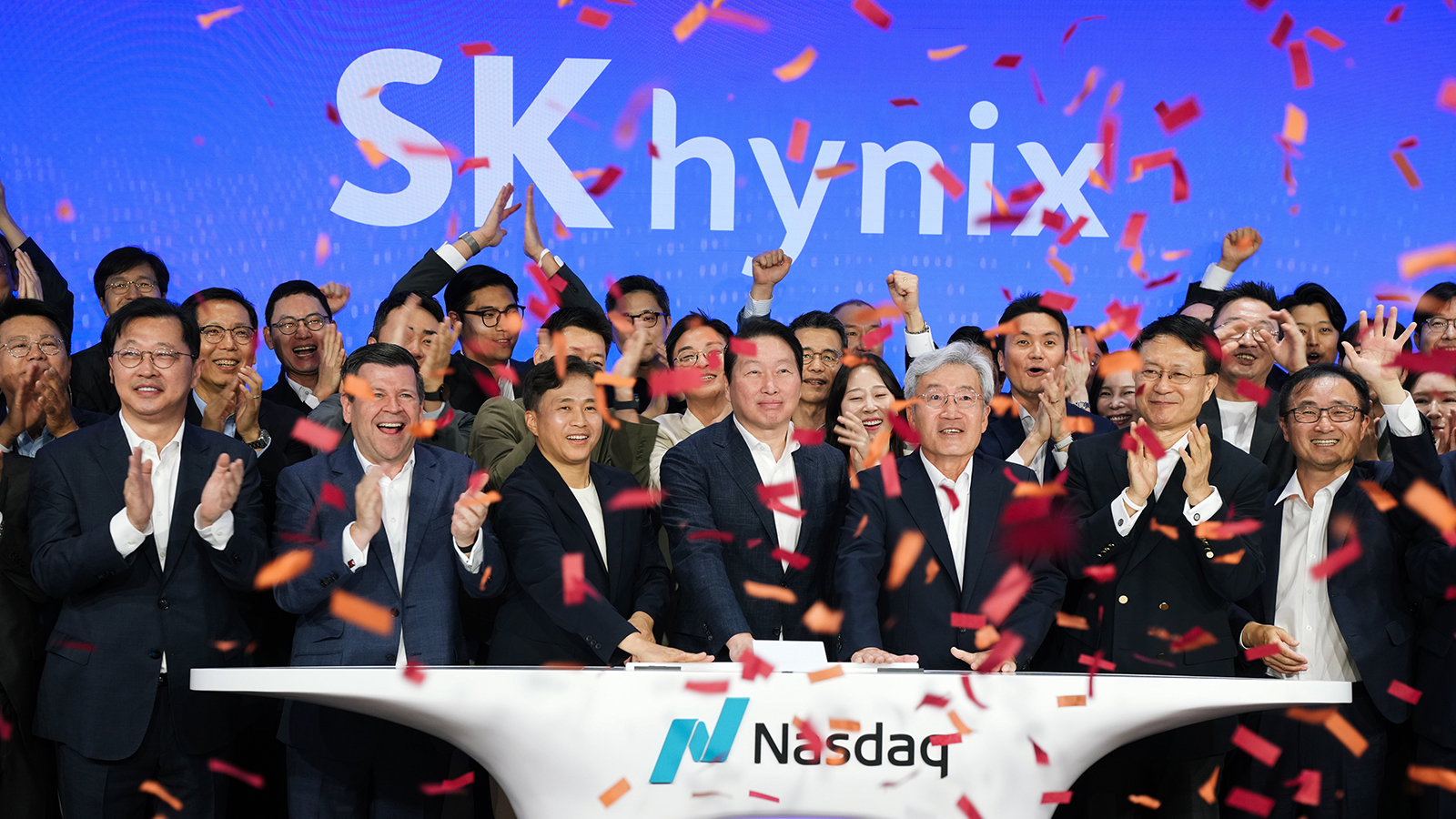
SK hynix, South Korea’s second-largest company by market value, began trading on Friday July 10 after holding an opening bell ceremony at Nasdaq MarketSite in New York, marking the company’s entry into the U.S. capital market through American depositary receipts (ADRs). On the first trading day shares rose by 13 percent closing at US$ 168.01 after opening at US$ 170.
The listing comes as the artificial intelligence boom accelerates demand for high-performance memory. SK hynix, has become a key supplier of high-bandwidth memory (HBM), a critical component for AI accelerators used by companies including Nvidia and Apple.

According to a SK hynix press release, the Nasdaq listing would expand the company’s global investor base and strengthen its role as an AI memory supplier. The ADRs, trading under the ticker SKHYV before switching to SKHY, were priced at US$ 149 thus raising US$ 26.5 billion to fund expansion plans including new factories and equipment.
At the Nasdaq ceremony, Kwak Noh-jung, CEO, SK hynix, said, “I am grateful to investors and customers who trusted me, I will expand the boundaries of memory possibilities through innovation, and I will support the executives and employees who work with me to achieve greater achievements.”
Chey Tae-won, Chairman, SK hynix, said, “The demand is enormous, exponentially, so I don’t really see signs that HBM demand is shrinking.” Tae-won also commented on how AI-related developments could sustain memory demand beyond previous industry cycles by saying, “The AI agent, a physical AI robot, actually needs a lot of memory chips.”
The company’s market valuation has increased more than sevenfold over the past year as shortages in AI-related memory pushed prices higher. However, analysts have raised concerns that the semiconductor industry’s traditional boom-and-bust cycles could return if AI demand slows as reported by CNBC.

SK hynix plans to use the proceeds from its market expansion to increase production capacity. The company is building an advanced packaging plant in Indiana with an investment of US$ 4 billion, while larger-scale expansion efforts, including a semiconductor cluster in Yongin, South Korea, are expected to require about US$ 390 billion.