
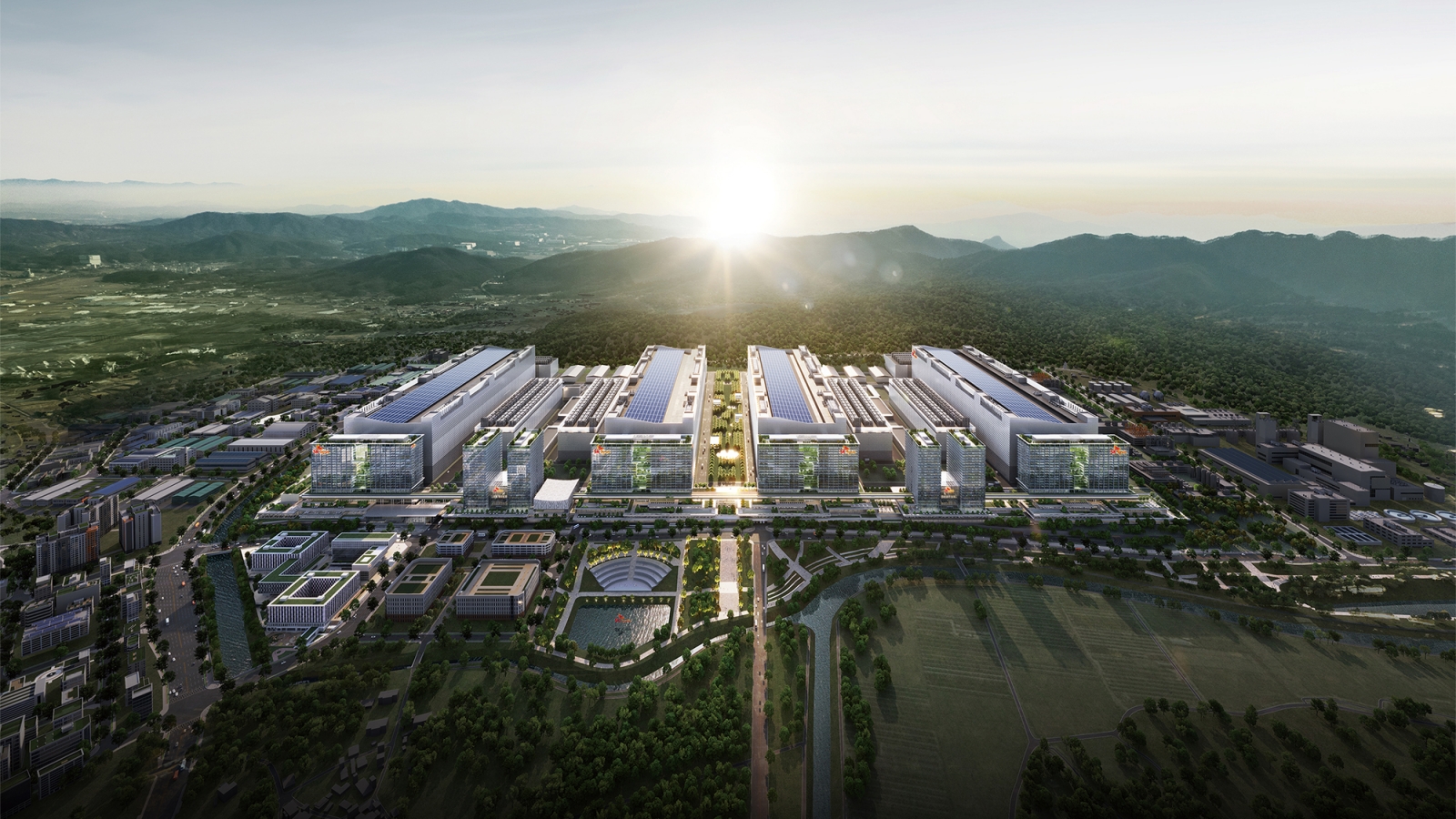
SK hynix, a South Korean semiconductor manufacturer, has announced that it will invest approximately KRW 54 trillion (US$ 38.1 billion) into new fabs in Yongin, Gyeonggi Province, and Cheongju, North Chungcheong, as a response to the surging demand for memory.
The company said in a press release that it will invest KRW 35.2 trillion (US$ 24.8 billion) in the Yongin Y2 fab and KRW 19.1 trillion (US$ 13.4 billion) in the Cheongju M17 fab.

“This investment is a decision made to seize opportunities in line with the market’s growth speed. By proactively securing production capabilities, we aim to establish ourselves as a key partner in AI infrastructure, contributing to the stability of the global AI semiconductor supply chain,” an SK hynix official said in a statement.
Yongin Y2 is the second of four fabs earmarked for the Yongin Semiconductor Cluster. The company will use the facility to produce high-bandwidth memory and other next-generation DRAM products. Construction on the fab will begin in July 2027 with the first cleanroom planned to open in June 2029.
The company said that Phase 1 power and water infrastructure for the Yongin Semiconductor Cluster is 99 percent complete, allowing SK hynix to proceed with the Y2 plans according to schedule. Construction of Y1 is progressing smoothly with its initial cleanroom still scheduled to open in February 2027.
The fab planned for Cheongju will become part of SK hynix’s Cheongju Campus, which already houses the M11, M12, and M15 fabs and is the firm’s new NAND fabrication base. Construction at M17 is planned to begin in February 2027 with the first cleanroom expected to be open in December 2028.
The company has said it is expanding production capacity to align with customer needs. Fabs are built to SK hynix’s master schedule, while cleanroom expansions and equipment installations will happen as demand dictates to maximize capital efficiency.

Globally, the memory chip market was valued at US$ 273.1 billion in 2025, and analysts estimate that value will climb to US$ 805.1 billion by 2034 ,according to Research and Markets. Memory chip production is concentrated in Asia-Pacific with South Korea and Taiwan dominating the sector.