
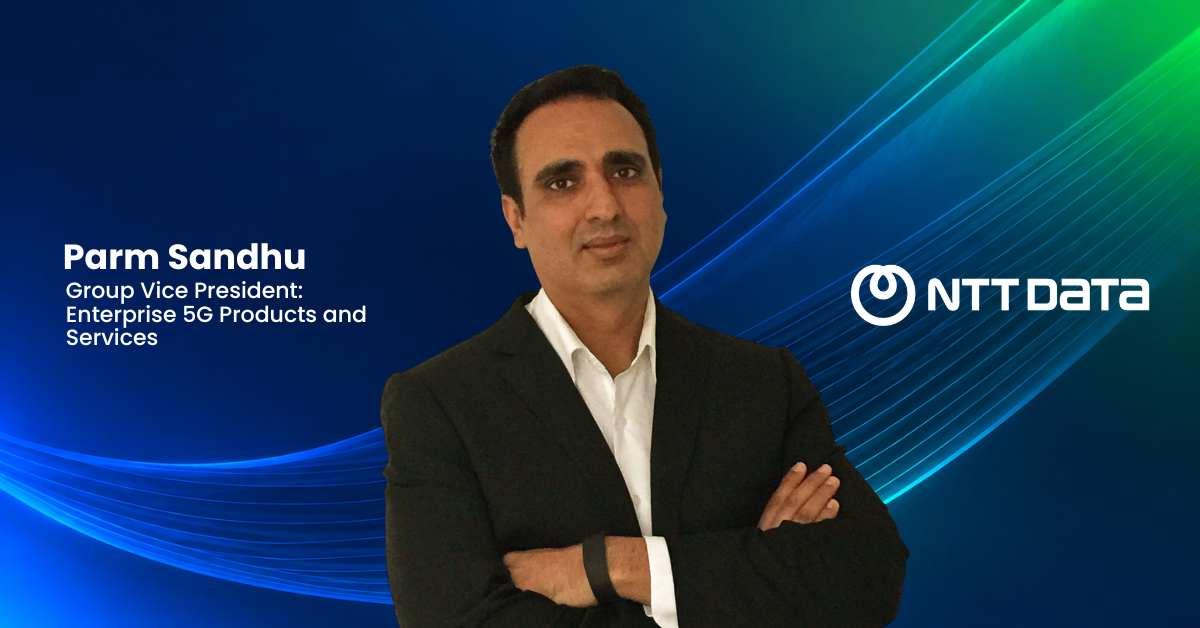
As the global interest in GenAI grows, Parm Sandhu (Group Vice President: Enterprise 5G Products and Services, NTT DATA), says we cannot ignore the importance of physical AI. In this special tête-à-tête Sandhu takes us through the myriad complexities and challenges involved in AI deployment decisions, and explains why physical AI will be the next AI inflection point.
What is your assessment of global AI adoption maturity, especially in key markets like Japan, China and South Korea?
Global AI adoption remains uneven, and the gap is no longer about model capability but rather, it is about the infrastructure and governance beneath it. Japan brings applied-engineering rigour and a deep industrial base, ideal ground for domain-tuned models like tsuzumi and for edge deployments where operational precision matters. China is compressing the cost curve on open-source models, most visibly through Qwen and DeepSeek. South Korea leads on AI-ready hardware. Across APAC, our research shows a widening divide: the organizations pulling ahead are operationalizing AI securely, responsibly and at scale — treating infrastructure, architecture and governance as strategic choices, not downstream compliance tasks.

In your opinion, what hinders the development of AI projects from the use case identification stage to the proof-of-concept stage?
Most AI projects stall for three reasons, and model performance is often not one of them. First, teams treat AI as a portfolio of use cases rather than a business transformation, so every proof-of-concept has to justify itself in isolation, and none scale. Second, the data and infrastructure foundations are not ready for what AI now demands: our research finds that around one in three Chief AI Officers identify building and integrating models in private or sovereign environments as their single biggest adoption barrier. Third, IT and OT continue to operate in silos across industrial environments, blocking the operational data physical AI needs. The path from ideation to production is not primarily a technology challenge; it is one of architecture and governance.
This is precisely why our recent partnerships are structured around the full journey from strategy through to managed services — not point solutions. And our US$ 1.5 billion commitment to AI-ready data center infrastructure in India, with a deliberate focus on sovereign compute and secure data residency, speaks directly to the infrastructure readiness gap that is stalling programs across the region.
Why is physical AI and not Gen AI the next AI inflection point in your opinion?
GenAI amplifies how enterprises think; physical AI transforms how they operate.
It moves intelligence off the screen and into machines and operations where the largest enterprise value pools sit: manufacturing, logistics, energy, mining. This is not a hypothetical shift. Our recent work with Hyster-Yale embeds physical AI directly into a manufacturing assembly line, cutting deployment timelines from months to weeks compared with legacy techniques. Independent analyst forecasts point to edge computing spend nearly doubling by the end of the decade, with physical AI compounding faster still.
How does processing AI on-site vs in the cloud impact the deployment cycle?
The “round trip to the cloud” model wasn’t built for physical operations. A decision delayed by 500 milliseconds in a high-speed warehouse becomes a safety hazard, not just a latency issue. On-site processing changes three things at once: it collapses the decision loop from seconds to milliseconds, keeps sensitive operational data inside the enterprise perimeter, and materially reduces bandwidth costs generated by high-volume sensor feeds. That compresses the deployment cycle. In our Hyster-Yale deployment, physical AI cut rollout from months to weeks compared with legacy approaches. The right architecture is a division of labour — edge for real-time inference, cloud for training, fleet analytics and continuous learning across sites.
Could you shed light on the role of private 5G and edge infrastructure in making physical AI production-ready?
Physical AI is only as production-ready as the connectivity beneath it. In real industrial environments like metal-heavy factory floors, mobile robotics, high-density sensor networks, Wi-Fi can face issues with interference, coverage and deterministic latency. Private 5G can address these constraints: predictable low-millisecond latency, reliable mobility for autonomous vehicles and robotics, and a network perimeter that keeps operational data on-premises. Combined with edge compute for on-site inference, this offers a strong foundation for operationalizing physical AI securely, responsibly and at scale. Our work with Ericsson brings their private 5G and edge platforms together with our edge AI services, embedding intelligence directly into enterprise connectivity for real-time, autonomous decision-making where data is generated.

What are your predictions for the physical AI market in the near future?
The physical AI market is approaching an inflection point over the next two to three years. Research indicates that the share of organizations where physical AI is transformative could increase more than six-fold during that period.
Three developments will shape the market. First, we will see companies move beyond pilots and begin deploying physical AI at production scale. Second, successful single-site implementations will expand into multi-site operations, particularly across manufacturing, logistics and industrial environments. Third, AI systems will become increasingly multimodal, combining vision data with thermal, acoustic and vibration signals to deliver richer insights and more autonomous decision-making.
In APAC, where manufacturing investment and digital transformation continue to accelerate, organizations that successfully scale these capabilities will be well positioned to gain a lasting competitive advantage.