

Long seen as a laggard in digital infrastructure appeal, the Philippines is starting to see more activities in this sector with Mordor Intelligence Report projecting an impressive compound annual growth rate (CAGR) of 22.88 per cent between 2026-2031.
“The Philippines data center market is experiencing robust expansion, valued at USD 0.69 billion in 2025 and estimated at USD 0.85 billion in 2026. Projections indicate the market will reach USD 2.37 billion by 2031,” it said.
In terms of installed capacity, the market is expected to grow from 632.80 megawatts in 2025 to 852.80 MW by 2030, reflecting a 6.15% CAGR during the forecast period. The report attributed the growth to hyperscale deployments, government cloud-first mandates, expanding submarine cable infrastructure, and accelerating enterprise digital transformation across banking, telecommunications, and e-commerce sectors.
Government incentives also played a part including allowing full foreign ownership of telecom and data centers, eliminating the previous 40 per cent ceiling. This resulted in new commitments for hyperscale facilities such as the US$ 5 million Philippine Digital Infrastructure Project, and the US$ 2.7 billion hyperscale campus in New Clark City.
Colocation facilities dominated with 94.85 per cent of market value in 2025, but hyperscale self-builds are accelerating at an 8.29% CAGR with Alibaba Cloud and Google increasing their local workloads. The National Cloud First Policy obliges public agencies to migrate workloads to the cloud while e-government platforms consolidate services on shared infrastructure, thus requiring more compute.
The Philippines is well connected with international bandwidth supplied by new trans-Pacific subsea routes such as Bifrost, which reduces latency and improves redundancy, thus attracting global providers towards Manila, Clark, and emerging provincial hubs.
Most data centers are located in Metro Manila which dominates with market share of 23.70 per cent in 2025. The area has the advantages of proximity to multiple cable landing points, financial headquarters, and skilled manpower. In terms of IT load, Metro Manila, Cavite, and Laguna dominated in 2025, with facilities such as STT Makati and Beenfotech HIVE each exceeding 5 MW IT load capacity.
In the provinces, Batangas is experiencing growth at a 3.38% CAGR, contributed by the 47-hectare technohub in New Clark City and DITO Telecommunity’s planned USD 362 million campus. Angeles City is attracting disaster-recovery deployments from Manila-based clients due to its proximity to the airport and its free port tax incentives, while Cebu and Davao are building more edge facilities. Edge nodes are fast gaining ground as more financial institutions, telecom operators, and digital platforms shift transaction processing closer to end users. For example, Union Bank reduced loan approval cycles to a mere three minutes from six weeks by leveraging on closer facilities to users.
Furthermoe, more data centers are adopting sustainability measures such as liquid cooling and renewable energy procurement. An example is PLDT partnering with Meralco’s retail arm to achieve a 35 per cent renewable energy mix for new expansions.

However, challenges remain including fragmented municipal approvals and overlapping agency jurisdictions, relatively high electricity cost and complex right-of-way and permitting procedures for submarine and terrestrial cables. The average electricity price is US$ 0.18 per kWh for commercial entities, the highest in Southeast Asia. Outages occur at an average 28 times annually, which is considered relatively higher than its neighbours. This has restrained more hyperscaler buildups compared to Malaysia and Thailand.
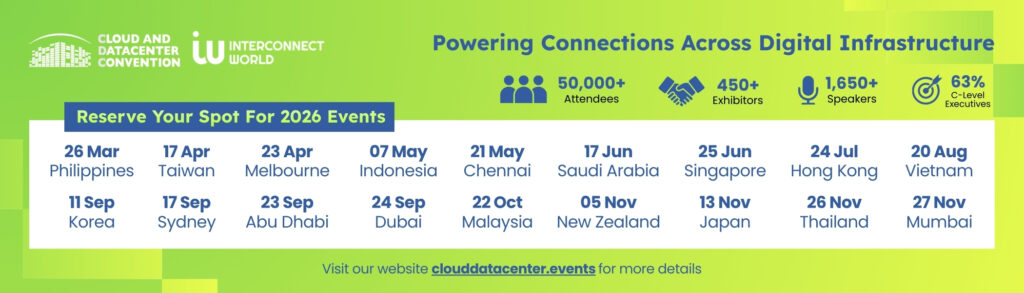
The Philippines Cloud & Datacenter Convention 2026 is happening tomorrow. Join us to hear what the experts have to say and for great networking opportunities with industry leaders, infrastructure builders, and power innovators.