
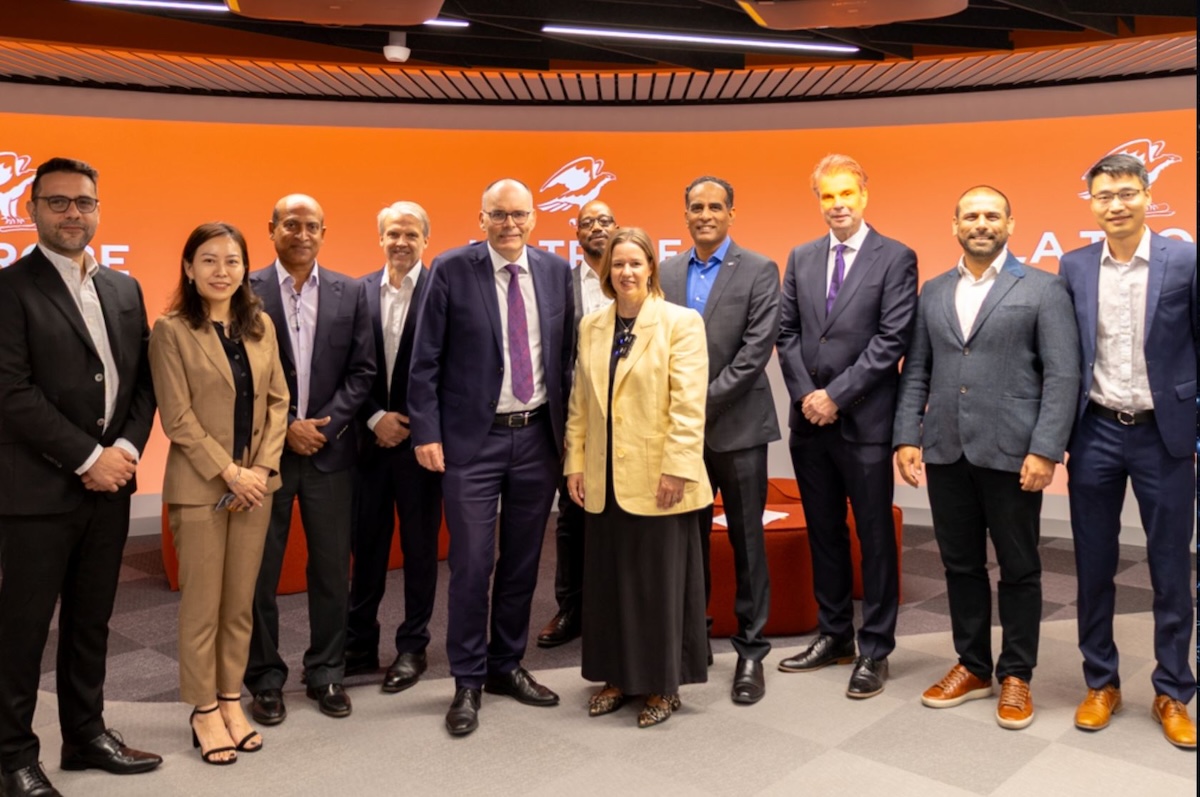
An AUD 1.1 million federal grant will fund development and real-world testing of a hybrid quantum and AI optimisation platform aimed at cutting energy use and emissions in Australian data centres. La Trobe University is leading a national project to deploy quantum-inspired optimisation and artificial intelligence techniques inside an operational Australian data centre, in a bid to reduce energy consumption and carbon emissions linked to digital infrastructure.
The initiative has secured AUD 1.1 million under the Federal Government’s National Critical Technologies Challenge Program and will see researchers move beyond simulation into live testing within a facility operated by NextDC. The project was announced by Kate Thwaites MP, Federal Member for Jagajaga.
The consortium brings together La Trobe’s Centre for Data Analytics and Cognition, the University of Western Australia’s Centre for Quantum Information, Simulation and Algorithms (QUISA), and industry partners including NextDC, Fujitsu and AQ Intelligence.
Under the programme, researchers will develop a hybrid optimisation framework combining quantum-inspired algorithms, quantum machine learning and advanced classical optimisation to manage heating, ventilation and cooling (HVAC) systems more efficiently. Cooling can account for up to 30% of a data centre’s total energy use, according to project partners.
The system will first be tested in a high-fidelity digital twin before deployment in a physically isolated operational testbed within a NextDC data centre. The aim is to demonstrate measurable reductions in energy consumption and associated emissions under live conditions.
AI-focused infrastructure
Professor Damminda Alahakoon, who is leading the project at La Trobe, said the rapid expansion of data centres driven by cloud computing and AI had already shifted workloads from inefficient office environments into purpose-built facilities, delivering sustainability gains. The next phase, he suggested, would require more sophisticated optimisation as facilities evolve into what some describe as AI-focused infrastructure.
NextDC chief executive Craig Scroggie said: “By applying quantum-inspired techniques to real-time energy and cooling systems inside an operational data centre, we are targeting improvements in power utilisation at scale.
“As AI accelerates, the challenge is not simply producing more energy, but orchestrating it intelligently. Delivering this capability in an operational facility strengthens Australia’s sovereign quantum and digital infrastructure capability and positions us to lead research in this field of next generation sustainable, high-performance AI computing systems.”
Fujitsu Oceania chief executive Peter Grassi said: “With cooling systems accounting for up to 30 per cent of a data centre’s energy use, Fujitsu is actively working to address this challenge. Fujitsu’s quantum simulators and our Digital Annealer, a quantum-inspired technology, are designed to solve complex, real-world problems like improving the efficiency of data centre cooling systems.
“These capabilities support our global quantum ambitions, including building a 10,000+ qubit quantum computer, turning our deep expertise into practical solutions that bolster Australia’s sovereign advantage.”
Professor Jingbo Wang, Director of QUISA at the University of Western Australia, said the project would provide an opportunity to assess whether quantum-inspired optimisation could deliver measurable efficiency improvements in large-scale operational environments.
The programme aligns with Australia’s National Quantum Strategy and broader policy initiatives around AI and digital infrastructure, including the Federal Government’s National AI Plan and Victoria’s Sustainable Data Centre Action Plan.
Beyond data centres, the optimisation framework under development could have applications in manufacturing, logistics, smart buildings and renewable energy systems, according to the project team. Testing of the prototype is expected to generate performance data that will inform future deployment decisions and contribute to the development of domestic capability in quantum-enabled optimisation for critical infrastructure.