
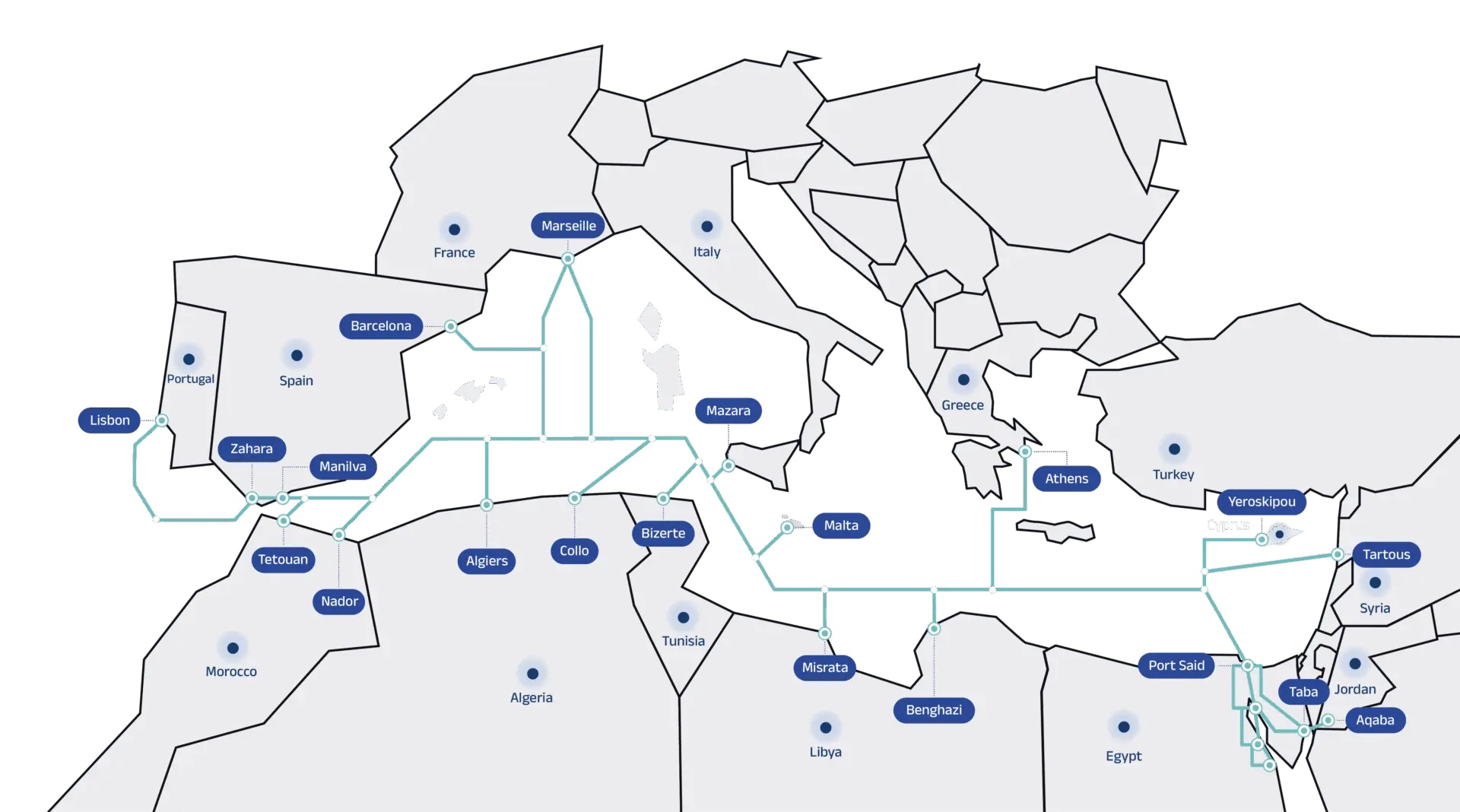
The European Union will provide a € 11.1 million (US$ 12.2 million) grant to support the terrestrial extension of the Medusa Submarine Cable System’s landing point in Port Said, Egypt, through to Jordan. At the same time, the European Investment Bank (EIB) will provide a loan of up to € 60 million (US$ 65.8 million) to support the cable system across the Mediterranean region.
Medusa comprises some 8,000 kilometers of cable that makes landfall at 21 landing stations, creating a massive network that reaches Portugal, Spain, France, Italy, Malta, Greece and Cyprus with Morocco, Algeria, Tunisia, Libya, Egypt, Syria, and, soon, Jordan. According to a press release, the first phase, connecting France, Morocco, and Tunisia, is complete and already providing services. The EIB loan will support the second phase.

“Reliable digital connections are essential for innovation, economic resilience and cooperation. With Medusa, we are supporting infrastructure that brings Europe and its Mediterranean partners closer together,” said Gelsomina Vigliotti, EIB Vice President.
“MEDUSA was conceived to bring the two shores of the Mediterranean closer together through better digital connectivity. This new EU support reinforces that vision, enabling universities and research institutions across Europe, North Africa and Jordan to collaborate, exchange knowledge and access the digital resources they need,” explained Damien Bertrand, Medusa Submarine Cable System Chief Operating Officer.
The European Union has already provided € 40 million (US$ 43.9 million) in funding for the project through the Neighbourhood Investment Platform for a dedicated research and education subnetwork on both shores of the Mediterranean.
The cable system forms part of the EU’s Global Gateway strategy to support sustainable and trusted infrastructure while building stronger international partnerships.
“Jordan’s research community has much to offer to Europe. Faster, more reliable connections will make it easier for researchers at SESAME and for students and scientists at Jordanian universities to share data and work on joint projects with their European peers. Better connectivity can also help Jordanian businesses reach new markets and improve access to public services. Through Global Gateway and the Pact for the Mediterranean, we’re investing in the infrastructure that makes this cooperation possible,” said Dubravka Šuica, EU Commissioner for the Mediterranean.

The Medusa Submarine Cable System is currently serving the West Mediterranean and expects to be ready for service in the East by 2027. In addition to support from the EIB, AFR-IX telecom, a telecommunications operator active in Portugal, the US, and multiple African countries, also supports the project. The cable is designed to be operational for at least 25 years and houses 24 fiber pairs each with a capacity of 20 Tbps.